


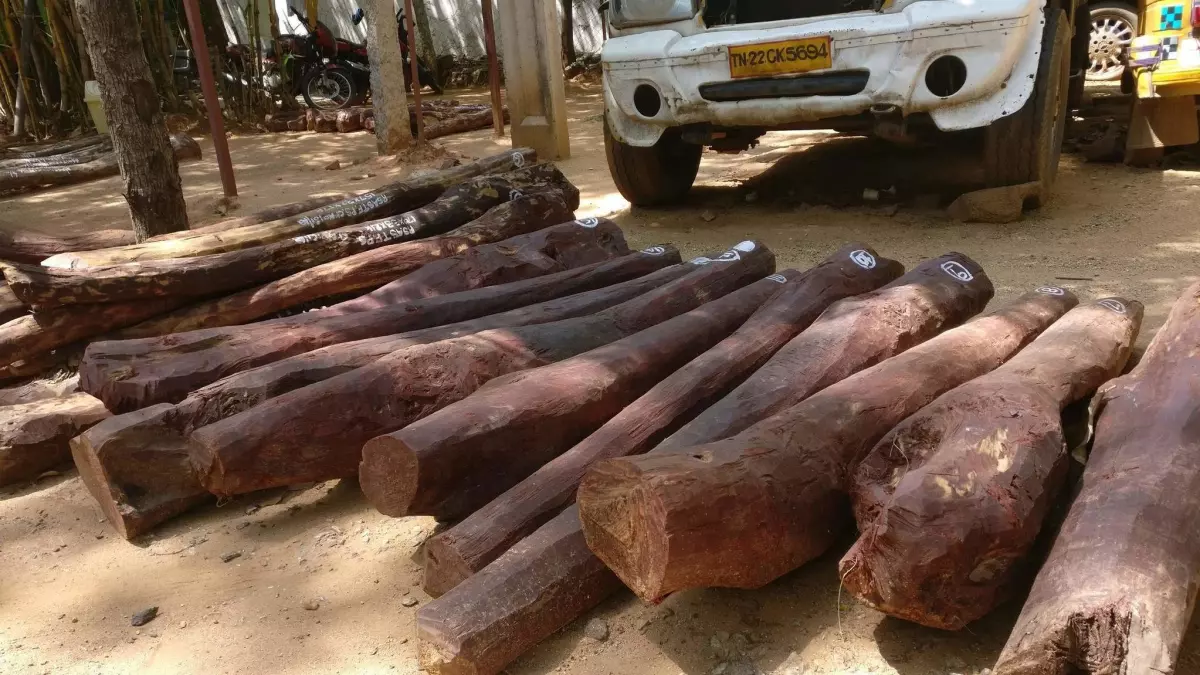
There were two bandits in India’s sandalwood story. One carried a rifle in the forests of Sathyamangalam; the other wielded red tape in the corridors of power. Veerappan may have smuggled sandalwood out by the truckload, but the real looter was the system that turned the world’s most prized tree into a bureaucratic hostage.
A latest Niti Aayog document, “Sandalwood Development Committee Report” has exposed what every forester already knew and every policymaker ignored: India’s sacred tree has been bled dry not by smugglers alone, but by the state’s own suffocating embrace.
The document is nothing short of an autopsy of a tragedy decades in the making: a tale of ecological neglect, regulatory arrogance and environmental amnesia. The species that once perfumed empires has been reduced to a ghost of its former glory.
Sandalwood (Santalum album) once grew wild and plentiful across southern India. From Mysuru’s royal reserves to Tamil Nadu’s forest slopes, its fragrance was as much a part of India’s identity as its temples and monsoons. But what centuries of devotion could not destroy, a few decades of overreach and greed ultimately did.
The state declared sandalwood its monopoly, a “royal tree”, that only governments could own, fell and sell. The intention was protection; the outcome was pillage. Once sandalwood became contraband even on private farms, farmers stopped planting it. Smugglers, emboldened by scarcity and high prices, moved in. And in the ensuing decades, the forest became a battlefield between an outlaw with a moustache and an establishment with blinkers on. When Veerappan was killed in 2004, the government claimed victory. But the truth is bitter: his death did not end sandalwood’s decline — it merely buried the evidence. The real crisis continued quietly, through policy neglect, poor regeneration, and a bureaucracy more interested in guarding files than forests.
A resource ruined by protectionism
According to the Sandalwood Development Committee Report, India’s sandalwood stock has collapsed by more than 80% since the 1950s. The species that once covered vast belts of Karnataka, Tamil Nadu, and Kerala now survives in patchy clusters, many of them senescent and non-regenerative.
The state monopoly, intended to curb smuggling, instead made sandalwood cultivation a crime. Farmers were not allowed to own or sell sandalwood trees grown on their land without multiple clearances. Felling required permission. Transport required more permission. The sale required an auction. Every step was a bureaucratic tollbooth.
Who benefited? Not the farmer, not the forest and certainly not the environment. Smugglers flourished and the black market blossomed. The government became both the jailer and the undertaker, punishing cultivators while presiding over the species’ ecological demise.
Even when the rules were relaxed in the 2000s, after decades of outcry, the damage was already irreversible. Few farmers wanted to wait 20 years for a harvest surrounded by red tape. In the free-for-all of India’s post-liberalisation economy, sandalwood became the forgotten orphan of forestry — too slow for investors, too restricted for growers, too valuable for thieves to ignore.
The scent of failure
The report catalogues an extraordinary environmental failure. Natural regeneration has collapsed because mature trees were harvested before they could seed. Large-scale plantations, launched with much fanfare, have failed miserably. Sapling survival rates in some states hover at 10-15%. Many were planted in unsuitable soils, without companion “host” trees that sandalwood depends on for nutrients.
This is ecological illiteracy masquerading as development. Replanting a parasitic species without its host is like trying to grow coral on sand. But India’s plantation drives, driven more by budget targets than by biology, persisted regardless, churning out press releases instead of forests.
Meanwhile, the few surviving sandalwood groves in places like Marayoor in Kerala or Chamarajanagar in Karnataka are aging fast. Poaching continues. Forest departments remain underfunded and overstretched. In effect, India is guarding museum pieces while the living species withers away.
As India dithered, Australia quietly stole the show, and the species. In the 1990s, it began cultivating Santalum album, India’s own sandalwood, using advanced biotechnology and tissue culture. Backed by science, industry, and policy support, Australian plantations now account for nearly 80% of global sandalwood oil exports.
What India lost to red tape, Australia gained through research and regulation. Their sandalwood farms are privately owned, scientifically managed, and environmentally sustainable. Ours are still fenced in by outdated laws and bureaucratic control. It is an irony too pungent to miss: the land that worshipped sandalwood now imports its own fragrance from Perth.
Ecological cost of greed
This is not just a commercial failure; it is an ecological disaster. Sandalwood is a keystone species in dry deciduous forests. Its presence supports a network of biodiversity: host trees, birds, insects, and soil microorganisms. Strip it out and the ecosystem unravels.
In many regions of southern India, overharvesting has triggered a chain reaction: soil erosion, loss of host species, declining groundwater and increased vulnerability to forest fires. Entire microclimates have been disrupted by the disappearance of a single tree species.
The report rightly warns that sandalwood cannot be revived in isolation. Its regeneration requires restoring entire forest systems. Replanting without ecological context is just greenwashing — a photo-op with saplings that won’t survive the next summer.
Every government since Independence has promised to “revive” sandalwood. Committees have been formed, funds allocated, policies tweaked. Yet the decline continues. Why? Because the system treats the tree as a source of revenue, not a living organism.
The Sandalwood Development Committee proposes a “National Sandalwood Board,” but unless it’s backed by real autonomy, scientific leadership, and farmer participation, it risks becoming yet another talking shop.
Real revival requires three hard shifts:
• From control to stewardship. The state must let go of its monopoly and empower cultivators and communities.
• From plantations to ecosystems. Sandalwood cannot thrive without its host species and forest ecology.
• From revenue to regeneration. Policy must prioritise biodiversity and sustainability over short-term profit.
Without these, sandalwood will go the cheetah way that reintroduced ceremonially, but extinct in essence.
The fragrance fades
India’s sandalwood story is a parable of environmental mismanagement. It exposes the gap between our cultural veneration of nature and our institutional contempt for it. We chant hymns to sacred trees while cutting them down for revenue. We worship the forest goddess while licensing her destruction.
The state’s monopoly created Veerappan; Veerappan’s raids created panic; panic created more monopoly. The cycle continues — the same tree, the same mistakes, only fewer forests left to loot.
If the government’s new “blue economy” dreams of harnessing the seas, it should first learn from how it lost its forests. The sandalwood crisis is not just about a tree; it’s about how India manages every natural resource through control instead of care, through paperwork instead of science. Unless that changes, the next report won’t be an assessment; it will be an obituary.