



How do nations rise or crumble based on the choices they make with their limited resources? While at the International Monetary Fund (IMF) a few years ago, my desk was often the final stop for the countries on the brink of economic collapse. From this vantage point, I observed a recurring, tragic pattern: countries, lured by the siren song of populism, slowly shipwreck themselves on the rocks of fiscal irresponsibility. The debate on “freebies” versus “welfare” is not academic; it is the fundamental divide between sustainable prosperity and a one-way ticket to the IMF’s boardroom, begging for a bailout.
The principles of sound economics are, in fact, elegantly simple. First, money does not grow on trees. Even for a government, every rupee spent must come from somewhere. It comes primarily from the taxes paid by hardworking citizens and businesses. Second, because resources are limited, a nation’s true test is in its allocation. Do you invest in the future, or do you merely consume in the present?
This brings us to the critical distinction: the welfare model versus the freebie model. It is the difference between teaching a man to fish and giving him a fish.
A welfare model is an investment in human capability. PM’s kisan schemes, as per University of Chicago research, reduce risks due to droughts and floods, freeing small farmers to invest in seeds, technology and tractors, leading to productivity jumps when vulnerability ebbs. Ayushman Bharat is another example. It flipped health spending patterns, from 80 per cent out of pocket to 47 per cent, creating a safety net that lets families bet on education, not just survival. Free rations for 80 crore citizens have, as per Brookings data, helped slash extreme poverty from 12.2 per cent in 2012 to 2.2 per cent in 2022.
Such measures act as shock absorbers—like a car’s suspension—protecting families from being derailed by a single illness or a bad harvest. This safety net provides the psychological security for a family to think beyond mere survival—to invest in their children’s education and health. This builds a nation from the ground up.
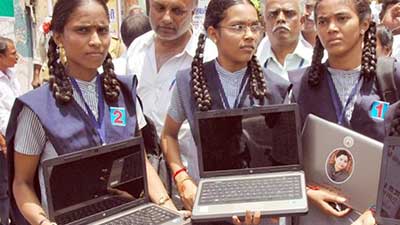
Freebies, on the other hand, are the potholes that jolt us backwards. They are a destructive political shortcut. When governments offer free electricity, bus rides or blanket cash transfers as entitlements, they don’t create capability; they create dependency. And the money for these “gifts” doesn’t appear from thin air; it is diverted from investments that fuel genuine progress: schools, hospitals, and infrastructure. Freebies erode both savings and foresight. Why save for your child’s education when the state promises a perpetual handout? In a democracy where elections often turn on short-term sops, this cycle breeds dependency, not dignity.
When you distribute freebies, you’re not feeding a nation; you’re eating its seed corn. Freebies are not free, they are theft from tomorrow. They draw from the same taxpayer pool: GST, income tax, corporate levies that could transform lives through better public goods. When a state waives bus fares for women, it forgoes revenue that could have upgraded rural clinics or teacher training. The salaried earner, paying taxes on every rupee, ends up subsidising a system where a farmer earning the same dodges scrutiny, often laundering black money as untaxed “agricultural income”. This is not equity; it is a distortion that starves investment. For a country of 1.5 billion, with 80 crore people still vulnerable to slipping back into poverty after a single health shock or crop failure, this is not a theoretical debate, it’s a national imperative. It is time to call this what it is: not compassion, but economic self-sabotage. India must pivot from distributing fish to teaching people how to catch it, or risk never scaling from 10 to 100 in our growth story.
We have seen this movie before, and it never ends well. The United States, during the Covid-19 pandemic, faced a massive supply shock: factories shut, logistics halted. Instead of tackling the root causes, they flooded the economy with printed money. The result was predictable: too much money chasing too few goods, triggering the worst inflation in decades. A complex crisis was met with a simplistic and wrong solution.
When a country like Sri Lanka or Bangladesh seeks a bailout, the IMF plays the doctor. It provides the medicine, the financing, but insists the patient change their habits. These programme conditionalities are not punishment; they are the cure for the underlying disease of fiscal profligacy, distorted taxation and poor governance. The IMF loans come with a lifeline and a mandatory lifejacket drill.
India must never reach that desk. We need not kneel for bailouts; we can sprint to 2047’s tryst with a $30 trillion economy. But that requires political will. States must wield the rod, not the bait.
The path to prosperity is not easy. It demands tough, farsighted choices—much like my father, who spent one-fifth of his income on my English-medium education instead of immediate comforts. For India and indeed for all developing nations, the choice is clear: Move away from the freebie model that erodes fiscal discipline and fosters dependency. Double down on the welfare model that empowers citizens, builds human capital and strengthens the productive foundations of society.
The former leads to fiscal crises and forced austerity.
The latter leads to dignity, resilience and shared prosperity. So the question for every citizen and politician is this: Do you want to be the generation that taught its people to fish, or the one that ate the seed corn and left a famine for its children?
(K V Subramanian is an economist and former chief economic adviser to the Government of India. He has also served as India’s executive director at the IMF)