





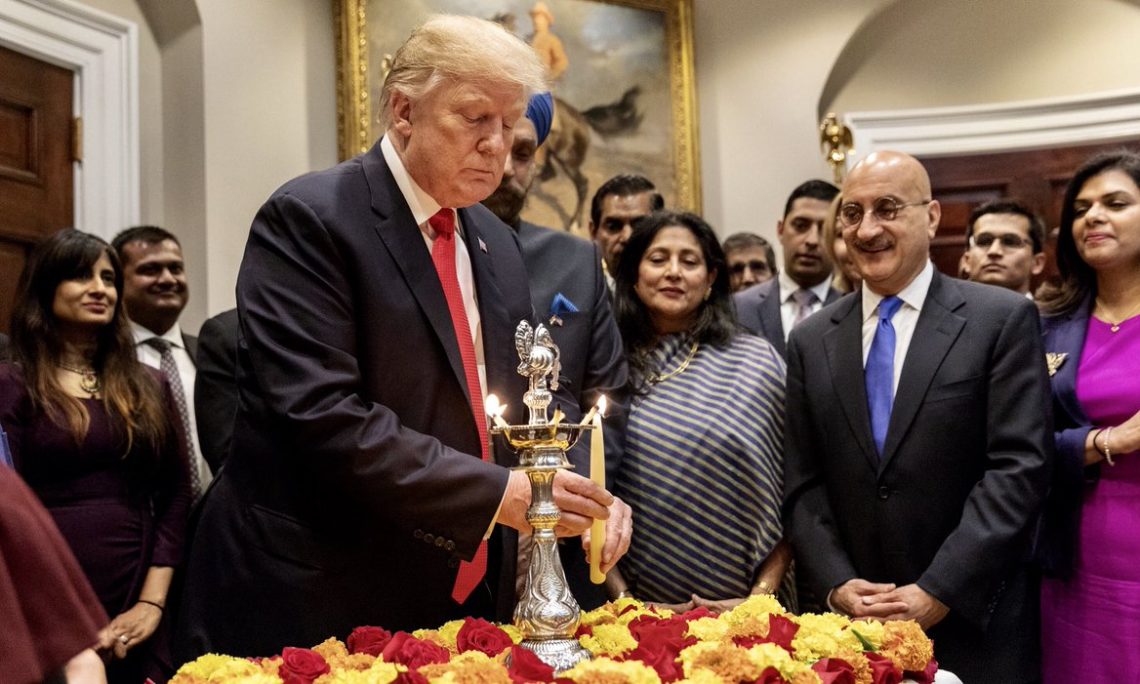
Washington, D.C., Oct 22: When President Donald Trump hosted a Diwali celebration in the Oval Office on Tuesday, the most dazzling light wasn’t the brass lamp on the table — it was the combined market capitalisation of the guests standing around it.
In attendance were some of the most powerful Indian-origin business leaders in the world: Arvind Krishna of IBM, Shantanu Narayen of Adobe, Sanjay Mehrotra of Micron Technology, and Nikesh Arora of Palo Alto Networks. Between them, their companies are valued at more than $1.5 trillion and employ hundreds of thousands of Americans.
Trump, who thrives on optics, knew precisely what he was doing. He wasn’t just hosting a cultural ceremony; he was staging an economic tableau. “This is seriously the biggest business group anywhere in the world,” he told the media in the room. “It’s a great tribute.”
Each CEO used the occasion to blend courtesy with corporate messaging. Krishna announced IBM’s plan to invest $150 billion over five years. Mehrotra spoke about Micron’s $200 billion semiconductor expansion, which would add 90,000 jobs and a $1.5 trillion boost to the US economy. Narayen reminded the president that Adobe’s innovation engine runs entirely on American soil. Arora declared his company’s $25 billion commitment to make cybersecurity technology “made in America”.
Trump responded with characteristic flair. “All of these people mean two things — big investment and big jobs,” he said, before joking, “I have a good memory, but those machines have a better one.” Laughter filled the room.
The symbolism ran deep. These executives represent the most visible wave of Indian-American success in corporate America — a demographic that’s reshaping both the tech industry and US politics. Two top Indian-American CEOs were not in attendance: Satya Nadella of Microsoft and Sundar Pichai of Google.
Their presence also echoed Trump’s broader narrative: that American prosperity could be built through smart deals, secure borders, and favourable trade.
But beneath the optics lay a subtle message to India: that Washington sees New Delhi not only as a strategic ally but also as a co-architect of the next digital revolution. Trump’s repeated praise for Modi and his call for new trade talks suggested a transactional friendship rooted in mutual economic gain.
“Trade and technology are where the future lies,” Trump said, pointing to the group before him as proof of “what happens when you mix great minds and great markets”.
By the time the diya flame flickered out, the Oval Office had witnessed more than a photo-op. It was a real-time snapshot of shifting power — from heritage to high tech.
If politics is theatre, this was its high-budget production: Diwali as diplomacy, CEOs as emissaries, and a president using the glow of a festival to project both faith and financial firepower. (5WH)


