



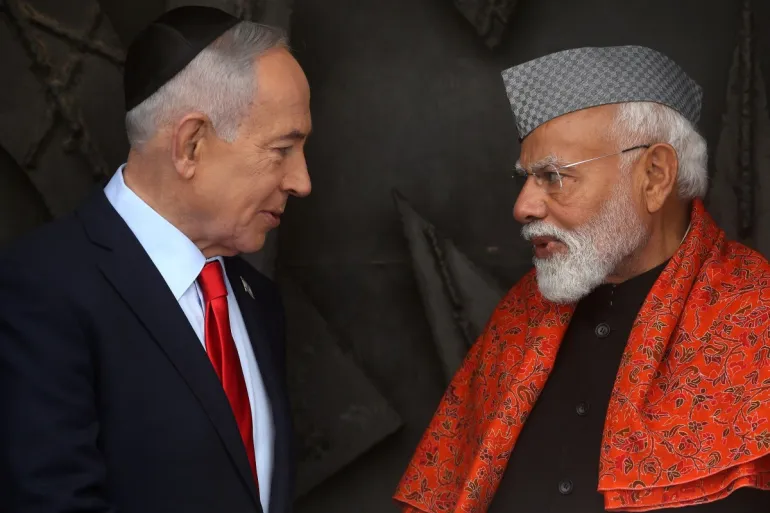
Prime Minister Narendra Modi’s visit to Israel marks a significant moment in India’s evolving foreign policy and carries far-reaching geopolitical implications. More than a routine diplomatic exchange, the visit demonstrates the transformation of India-Israel relations from a defence partnership into a broad-based strategic alliance. Coming at a time of heightened tensions in West Asia, the trip reflects New Delhi’s willingness to assert its interests even in complex and sensitive geopolitical circumstances.
Historically, India maintained a distance from Israel due to its support for the Palestinian cause and its dependence on energy supplies from Arab states. However, since the establishment of full diplomatic relations in 1992, bilateral ties have expanded considerably, particularly in defence and security cooperation. Prime Minister Modi’s visit underscores how far the relationship has progressed. Israel has emerged as one of India’s key defence suppliers, providing advanced military technology, surveillance systems, drones and missile defence components. The recent engagements aim to move beyond a buyer-seller dynamic towards joint research, co-development and technology transfer, aligning with India’s broader objective of strengthening indigenous defence manufacturing.
The geopolitical implications of this growing partnership are significant. By deepening ties with Israel, India enhances its access to cutting-edge technology in areas such as artificial intelligence, cybersecurity, agricultural innovation and water management. These sectors are not merely economic priorities; they are strategic assets in an increasingly competitive global order. For Israel, closer relations with a rising power like India diversify its diplomatic partnerships beyond its traditional Western allies. The partnership thus represents a convergence of interests between two technologically ambitious democracies seeking resilience in uncertain times.
At the same time, the visit sends a carefully calibrated message about India’s foreign policy posture. Under Modi, India has emphasised strategic autonomy, that is, engaging with multiple global and regional powers without being confined to rigid alliance structures. Strengthening ties with Israel does not necessarily imply abandoning support for a two-state solution to the Israeli-Palestinian conflict, a position India continues to officially endorse.
However, this recalibration is not without risks. Iran, with whom India shares energy interests and connectivity projects such as the Chabahar Port, may view closer India–Israel cooperation with suspicion. Similarly, India’s strong economic and diaspora ties with Gulf nations require a delicate balancing act. Any perception that New Delhi is tilting decisively towards one regional actor could complicate its relationships across West Asia.
Economically, the visit holds promise beyond defence. Discussions around expanding trade, negotiating a potential free trade agreement and enhancing digital payment linkages point to a diversification of bilateral engagement. Israel’s strength in innovation ecosystems and startup culture complements India’s vast market and technological talent pool. If effectively harnessed, this synergy could elevate economic ties to a new level, embedding the relationship within long-term development goals rather than limiting it to strategic necessities.
Domestically, the visit also carries political resonance. It reinforces the government’s narrative of India as a confident global actor capable of forging partnerships on its own terms. The optics of high-level engagement with Israeli leadership project strength and decisiveness to domestic audiences. Yet the government must also remain mindful of diverse domestic opinions regarding Middle Eastern politics, ensuring that foreign policy decisions are communicated within the broader framework of national interest and regional stability.
On the broader geopolitical canvas, Modi’s visit reflects the changing architecture of the Middle East itself. The region is witnessing shifting alliances, economic realignments and new connectivity initiatives linking Asia, the Middle East and Europe. India seeks to position itself as a central player in these emerging corridors of trade and infrastructure. Engagement with Israel is part of a larger strategy that includes robust relations with the United Arab Emirates, Saudi Arabia and other regional powers. In this sense, the visit is less about choosing sides and more about expanding India’s strategic footprint across multiple axes.
Ultimately, Modi’s visit to Israel symbolises a decisive phase in India’s foreign policy evolution. It demonstrates New Delhi’s readiness to engage assertively in geopolitically sensitive spaces while pursuing technological, economic and security advantages. The success of this approach, however, will depend on India’s ability to sustain balance, maintaining productive ties with Israel while preserving longstanding partnerships across the broader Middle East. In a volatile global environment, such multidirectional diplomacy is not merely desirable; it is essential for safeguarding India’s long-term strategic interests.
(Abhinav Mehrotra is an associate professor and Amit Upadhyay is an associate professor at Jindal Global Law School, OP Jindal Global University)