






A Generation Awakens
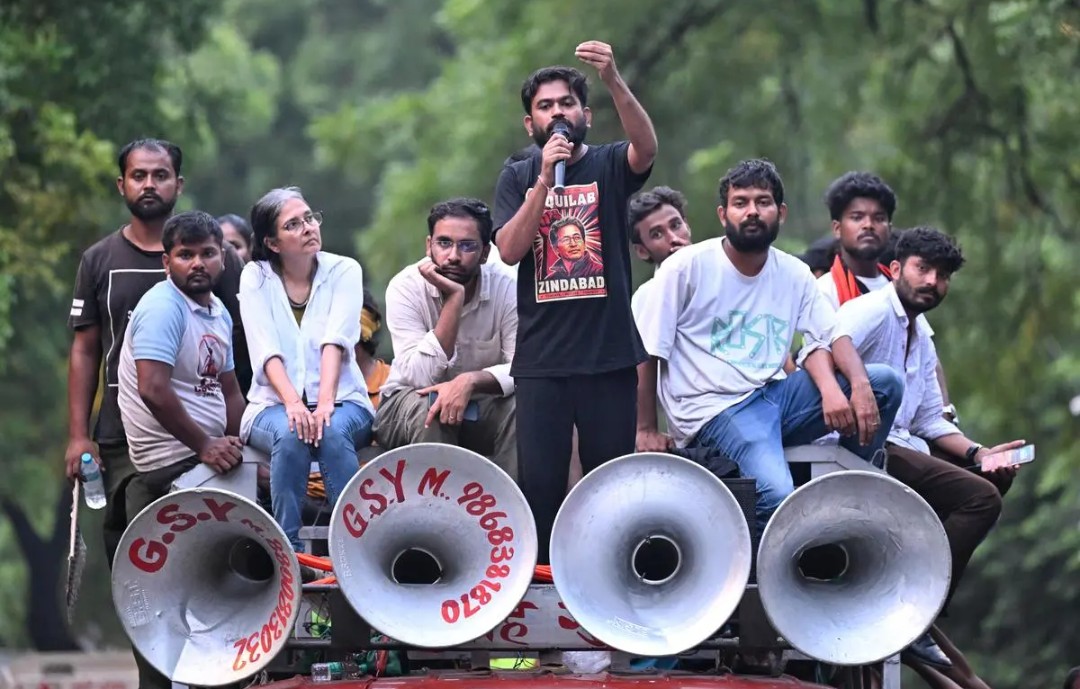
The Cockroach Janata Party (CJP) and its recent Jantar Mantar protest, together with its all-India offshoots, have left a mark that is likely to endure for years to come. For perhaps the first time in independent India, a mass movement of this scale was both genuinely secular and conspicuously apolitical. The young people who participated were articulate, whether in English or their mother tongues, and remarkably well informed about the issues confronting the country: gender rights, economic stagnation, unemployment, rising prices and the growing lack of accountability in government.
The boys and girls braved scorching heat, rain, the police, poverty, family opposition, power cuts, police batons, pellet guns, crude cudgels, tear gas and water cannons. They endured the police-imposed denial of essential supplies at Jantar Mantar, the near-complete absence of the New Delhi Municipal Council (NDMC), the lack of trained healthcare personnel and medicines, and the absence of running water and toilets, among countless other hardships.
Yet these youngsters continued to offer food and flowers to police personnel on duty. They also cleaned the protest site several times a day, carefully collecting litter in plastic garbage bags.
There was never any doubt about their patriotism. Their collective rendition of the national anthem often sounded more stirring than the official instrumental version. They remained orderly throughout, even stepping aside for police patrols and greeting officers politely.
The response they received, however, could not have been more different. According to participants, Delhi Police personnel beat them mercilessly. Two youngsters are reportedly fighting for their lives in the intensive care unit at Ram Manohar Lohia Hospital. Delivery riders were deprived of parking space around Jantar Mantar, deliveries to the area were restricted, girls were allegedly molested, and one deputy commissioner of police was accused of thrusting a baton into a protester’s private parts in full public view. Internet access, including voice calls, was also suspended, along with a host of other alleged excesses.
A Movement Sustained by Ordinary Indians
Equally remarkable was the support these youngsters received from across India and abroad. Food often arrived in such abundance that the surplus had to be distributed among the urban poor. Drinking water flowed in continuously.
Young MBBS doctors and paramedics established a fully functioning medical camp equipped with first-aid facilities, a wide range of medicines, women’s hygiene kits, dressings, paper napkins, tumblers and other essentials. Older citizens, regardless of whether their own children were involved in the protests, came forward with food, water, snacks, stickers, power banks and countless other supplies.
Houses of worship and faith-based organisations provided shelter, bedding, freshly cooked food round the clock, drinking water, mobile toilets — some reserved for women students — and even return rail and air tickets for those who had left home without informing their families and lacked the means to return.
Only a handful wore masks to conceal their identities. Almost everyone else faced television cameras without hesitation and spoke openly. The vast digital archive created during the protests may one day serve as compelling evidence against officials accused of misconduct.
The youngsters also transcended communal divisions. They happily shared meals prepared by khansamas, while cloud kitchens, home kitchens, restaurants, takeaways and small businesses ensured that no protester went hungry.
A video of a woman in her late thirties, who described herself as belonging to India’s wealthiest one per cent, captured the public imagination. She said she paid 40 per cent income tax every year and had come because her university education in India had enabled her to enjoy a comfortable life. She therefore wished to contribute several lakh rupees to support the students.
Another supporter from Nagaland reportedly spent ₹68,000 to send 150 pizzas to the protest site. Donations continued to pour in. The sight of 18-to-21-year-olds being beaten by the police as if they were terrorists ignited public anger and deepened resentment against what many protesters saw as a colonial-style policing system.
Creative Protest, Serious Message
The youngsters also devised remarkably original forms of protest. One striking example was a young woman, barely 20, who arrived dressed as a bride in a resplendent red ghagra choli. She quietly explained that her parents believed her degree had become worthless and that she had no meaningful career prospects. Marriage, she said, appeared to be their only solution.
It was an immensely powerful statement on gender and employment, delivered without slogans or theatrics. Many of the young women participating were exceptionally well informed. They presented carefully argued accounts of what they saw as 13 years of misgovernance, corruption in infrastructure projects, environmental degradation, irregularities in competitive examinations and the erosion of India’s justice system.
Many also expressed deep frustration that demands for employment, educational reform and accountability were too often met with the refrain that “Hindu khatre mein hain”.
A Colonial State Meets a New Generation
Perhaps the greatest humiliation for the so-called “godi media” was the way protesters openly confronted television crews, forcing many to leave Jantar Mantar amid slogans branding them ‘pimps’ and ‘prostitutes’.
In stark contrast to this group of politically conscious youngsters stood a State that behaved, in many respects, more like a colonial administration than the British Raj it so often condemns. Its much-publicised commitment to decolonisation appeared to be little more than rhetoric.
The lieutenant governor of Delhi, the chief minister, the Ministry of Home Affairs and the directors general of the various police forces deployed must all answer for actions that would invite the gravest international scrutiny. Yet there was no move to remove the minister responsible for these institutions or hold the Union Territory administration accountable.
Rather than crushing the movement, the crackdown only strengthened it. International media outlets covered the protests extensively, publishing deeply critical commentaries on the prime minister and his government.
Within a week, the youngsters had punctured the carefully cultivated image of India as a “Vishwa Guru”, stripping away years of political image-building. The aura of invincibility surrounding the prime minister appeared to fade, replaced by an unusual and telling silence.
The sight of two senior Union ministers feeding Sonam Wangchuk soup in hospital in an effort to persuade him to end his fast became one of the defining images of the movement. It inevitably evoked memories of Anna Hazare’s India Against Corruption campaign and the nationwide protests following the 2012 Nirbhaya case. Equally symbolic were the images of CJP leaders observing indefinite fasts, echoing Hazare’s model of non-violent resistance.
Amid the unfolding crisis, BJP supporters on social media accused the protesters of being funded by foreign interests, a familiar allegation in Indian politics and one that many critics regard as deeply ironic.
Questions of Accountability
Perhaps the government’s greatest miscalculation was demographic. Young Indians between the ages of 18 and 35 account for nearly 48 per cent of the country’s electorate. If their parents, relatives, friends and sympathisers are added, their electoral influence extends to well over three-quarters of all voters.
Even if only a quarter of them shifted their political loyalties away from the BJP, the electoral consequences could be profound. No amount of delimitation or proposals such as “One Nation, One Election” would be sufficient to offset such a loss of support.
The resignation of Union Education Minister Dharmendra Pradhan came too little, too late. He accepted no responsibility for the alleged National Testing Agency (NTA) paper leaks, offered no apology and reportedly described the protesting students as anti-national in his resignation letter.
Attention then shifted to the newly appointed Higher Education Secretary. During his previous tenure in the Ministry of Agriculture, he allegedly influenced a subordinate board to release ₹1.16 crore in subsidies for cucumber cultivation to his mother, wife and son.
The staffing pattern of the NTA also came under scrutiny, with 47 officers on deputation and 197 outsourced employees working in what is arguably one of India’s most sensitive examination bodies.
Ironically, the alleged NEET paper leak itself was reportedly exposed by an 18-year-old. The controversy also revived memories of the Chief Justice of India’s description of junior lawyers as ‘cockroaches’ crowding courtrooms, a remark that generated widespread sympathy for young lawyers struggling to establish themselves professionally.
Politics Behind the Movement
Abhijeet Dipke’s creation of CJP did not escape the attention of the BJP leadership. The authorities initially viewed the movement as a convenient safety valve through which unemployed youth could vent their frustrations. Dipke was personally received at Indira Gandhi International Airport by the station house officer of Parliament Street Police Station and handed permission to protest at Jantar Mantar.
Although the movement struggled during its first fortnight, its fortunes changed dramatically after Wangchuk assumed leadership following his release on bail after more than six months in prison. His three-week fast unto death ended only when Delhi Police forcibly removed him to a government hospital. Paradoxically, the movement became stronger after losing its central figure, evolving into a decentralised and more resilient campaign.
The dismantling of the prime minister’s carefully cultivated image had already begun. Soon afterwards, he appeared on television late at night, promising reforms even as police action against protesters continued unabated.
Meanwhile, proceedings in both the Lok Sabha and the Rajya Sabha were repeatedly disrupted by opposition demands for a debate on Jantar Mantar, even as the government sought to introduce 28 Bills, including the contentious Delimitation Bill. The opposition also demanded the education minister’s resignation.
But removing a senior Cabinet minister had become politically difficult. After more than 12 years without a major Cabinet reshuffle, ministers controlling large spending and regulatory portfolios had become indispensable sources of political and financial influence within the ruling party. Over time, many had cultivated powerful personal networks, extending support to fellow MPs and becoming effectively untouchable, despite publicly professing unwavering loyalty to the prime minister.
Even if constituency boundaries are redrawn through delimitation, no electoral exercise can erase the political awakening of millions of young voters between the ages of 18 and 35, or of their families and supporters. Constituency maps may change; political memory does not.
After Jantar Mantar
Did everything improve after the protesters left Jantar Mantar? Far from it. Instead, the police allegedly began visiting restaurants and eateries, scrutinising account books and examining billing records relating to supplies sent to the protest site.
Muslims who had distributed food were reportedly detained and harassed. One individual, it is claimed, was abandoned in Mussoorie and forced to hire a taxi back to Delhi.
Police teams also allegedly entered student hostels in Delhi, Patna, Allahabad and several other cities, identifying participants through facial-recognition technology.
Numerous FIRs have since been registered across northern India. In response, CJP warned that any further action against protesters would trigger another march to Jantar Mantar. More assurances followed from various state authorities. The crucial question, however, is why CJP chose to end the protest before those assurances had been tested against action.
Political inexperience may well have allowed the government to regain the initiative. As matters stand, another mobilisation at Jantar Mantar appears unlikely in the immediate future. Whether the memorandum of understanding will ever be implemented in full remains open to serious doubt.
Dipke and Das had succeeded in building a movement with extraordinary momentum. Yet, in the final analysis, they appear to have missed a rare opportunity to consolidate those gains and convert public sympathy into sustained political pressure.
That is perhaps the greatest disappointment of all. Hundreds of thousands of young Indians invested their faith, energy and idealism in this movement. Losing momentum at such a decisive moment may prove to be its most enduring setback.
Movements are rarely defeated only by repression. They also falter when they surrender the initiative. Whether CJP can recover that lost momentum remains one of the defining political questions for India’s young generation.


