






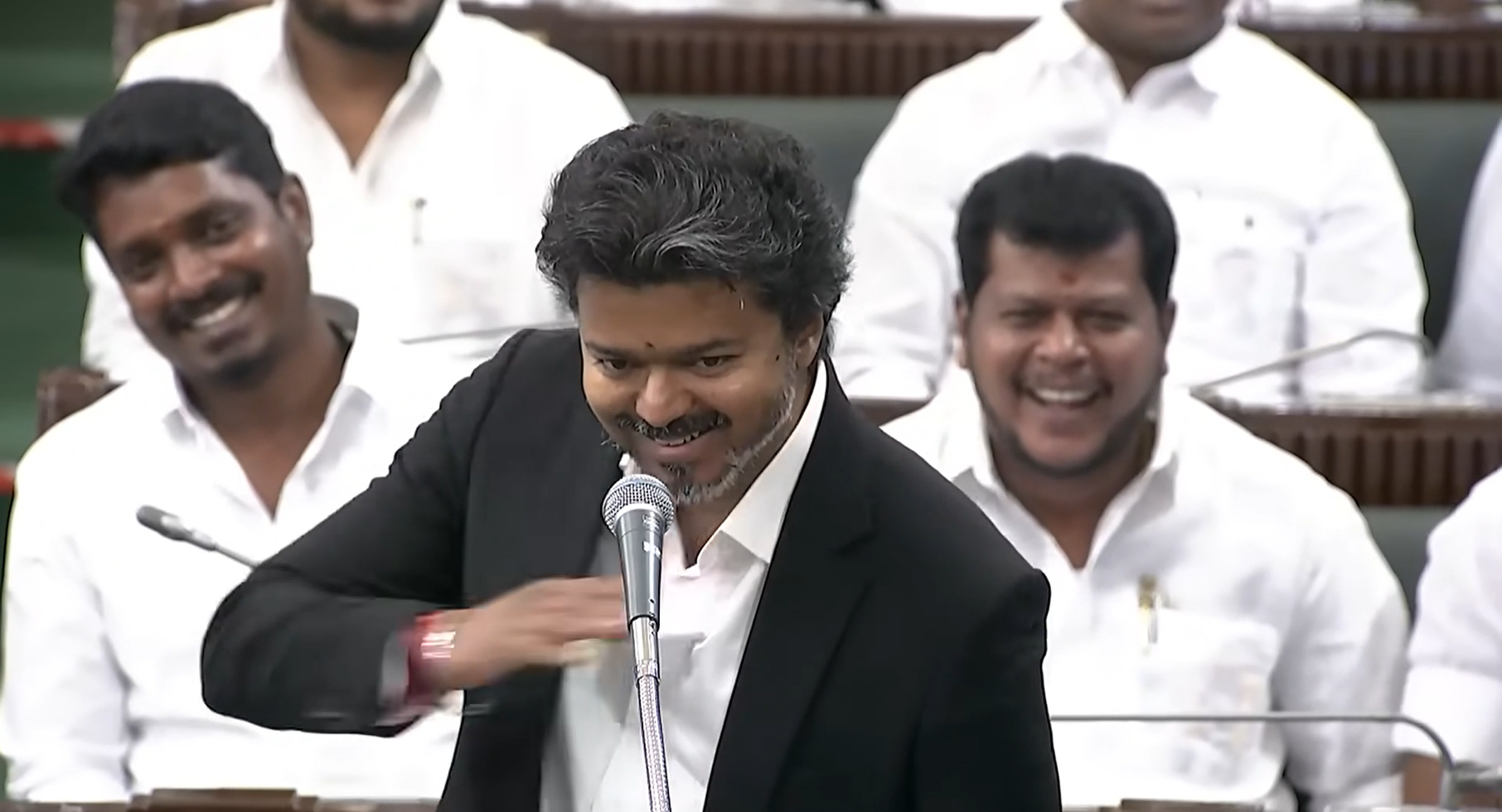
Chief Minister C. Joseph Vijay’s reply to the Motion of Thanks on the Governor’s Address during the first session of the 17th Tamil Nadu Legislative Assembly on June 22 was much more than a customary response to the Governor’s speech. It was a carefully structured political statement that sought to define his Government’s priorities, articulate his ideological position and, more significantly, project his politics beyond the boundaries of Tamil Nadu.
In his 40-minute address, it becomes evident that, for Vijay, Tamil Nadu is not merely the State he governs but the political platform from which he intends to build a larger national role. His speech was directed as much at audiences outside Tamil Nadu as at those within the Assembly. Throughout his address, he repeatedly linked State issues to larger constitutional questions concerning federalism, democracy, social justice and governance.
Vijay’s political message was his attempt to define the ideological identity of his Government. Declaring his core principles, he said: “Cooperative Federalism at the Centre and genuine State Autonomy for the States are our policy. Humanity, Social Justice, Equal Opportunity and Secularism are our fundamental principles.”
He went on to define his party’s political positioning in equally unambiguous terms: “We have also made it clear who our ideological opponent is and who our political opponent is. We are not the team of any political party. We are a team of people. We are the team of Social Justice. We are the team of Secularism.”
He further underlined the moral foundation of his politics by stating that “All human beings are born equal.” According to Vijay, it is this conviction that guides his Government.
Taken together, these statements form the central ideological framework of his speech. Rather than positioning himself merely as the head of a State Government, Vijay attempts to present himself as the advocate of a constitutional vision built around cooperative federalism, State autonomy, social justice and secularism.
One of the dominant themes running through the address is the evolving relationship between the Union Government and the States. Vijay does not directly seek confrontation with the Centre. Instead, he repeatedly argues that India’s federal structure can function effectively only when the constitutional rights of the States are respected.
However, his speech also makes it clear that conflict with the Centre could become unavoidable if policies affecting the States continue to be imposed without adequate consultation. The issue of language becomes the clearest illustration of this position.
Vijay strongly reiterates Tamil Nadu’s opposition to the compulsory imposition of a third language. In his view, such a policy violates the linguistic rights of the States and undermines the spirit of Indian federalism. Throughout the speech, language is presented not merely as a cultural question but as an issue of constitutional rights and State identity.
This emphasis extends to Tamil Nadu’s long-standing tradition surrounding Tamil Thai Vazhthu, which Vijay describes as inseparable from the identity, heritage and emotions of the Tamil people. According to him, official Government functions, educational institutions and State programmes should begin with Tamil Thai Vazhthu before the National Anthem, reflecting the State’s historical practice and cultural identity.
Education constitutes another major area where Vijay openly challenges the Centre’s approach. His disagreement with the National Education Policy is neither indirect nor symbolic. He raises the issue repeatedly, portraying it as another example of excessive centralisation.
His strongest criticism is reserved for the National Eligibility-cum-Entrance Test (NEET), which he rejects as unnecessary for students in Tamil Nadu. He argues that the examination disadvantages rural and economically weaker students, thereby violating the principles of equal opportunity and social justice that his Government seeks to uphold.
Vijay also uses the Assembly to reiterate Tamil Nadu’s long-standing demand that admissions to medical colleges should be based on Class XII marks and that the State should receive a permanent exemption from NEET.
Alongside his criticism of NEET, Vijay makes another cultural demand with national implications by urging the Union Government to declare the Tirukkural the National Literature of India. The proposal is intended not merely as recognition of a classical Tamil text but as an assertion of Tamil civilisation’s place within India’s national identity.
Throughout this section of the speech, Vijay repeatedly returns to a set of recurring political values that he seeks to associate with his Government: equality, social justice, equal opportunity, honest administration, secular politics, courage, patriotism and struggle. Rather than treating them as separate policy objectives, he presents them as integral components of his own political journey and the philosophy of his Government. This emphasis finds expression in one of the speech’s most direct declarations: “Everyone should receive everything. Every religion is our religion.” The statement encapsulates Vijay’s attempt to combine welfare, inclusiveness and secularism within a single political framework.
Yet the speech is not confined to ideology alone. Nearly one-third of his address focuses on corruption and administrative reform, signalling that clean governance will be one of the principal political themes of his tenure. Invoking a famous observation of M. G. Ramachandran (MGR), Vijay declares: “If any wrongdoing is committed knowingly, I will not spare the guilty—even if he were God Himself.”
He follows this with another unequivocal commitment, promising that every rupee allegedly looted from the State would be recovered and returned to the Government treasury.
The frequency of certain words used during the speech further reinforces the priorities Vijay seeks to project. “Tamil Nadu” is mentioned 32 times, “Language” 15 times, “Tamil Thai Vazhthu” seven times, “Social Justice” ten times, “Corruption” nine times, “Equal Opportunity” three times and “Secular” twice.
The names he invokes are equally revealing. Vijay refers to himself seven times, Dr B R Ambedkar five times, M G Ramachandran four times, Arignar Anna four times, Kalaignar Karunanidhi three times, and Periyar, Kamaraj, Veeramangai Velu Nachiyar and Anjalai Ammal twice each.
The pattern is significant. Together, these references suggest that Vijay has consciously assembled an ideological lineage that combines social justice, Tamil identity, welfare politics, administrative integrity and constitutional federalism. The speech leaves little doubt that he is seeking to construct a political narrative capable of extending beyond Tamil Nadu.
He reinforces that message by openly declaring that he has no place for political expressions shaped by undemocratic values or pseudo-religion. Read in its entirety, the address appears to be more than a statement of Government policy. It reads as an early blueprint for Vijay’s national political ambitions and, potentially, his positioning ahead of the 2029 Lok Sabha elections.
The tone of the speech is established from its opening itself, when Vijay thanks the people of Tamil Nadu for electing him and the legislators of Tamilaga Vettri Kazhagam: “In this glorious 17th Tamil Nadu Legislative Assembly, functioning under the guidance of great leaders and carrying a proud history, I express my heartfelt gratitude to all the people of Tamil Nadu, who are forever close to my heart with motherly affection, for electing me and the legislators of Tamilaga Vettri Kazhagam.”
He then extends his message to Tamils across the world, saying, “To my Tamil brothers and sisters living across the world, today I once again make a promise—Tamil is our lifeline. Tamil is our soul. We shall never forget it. We say it today, and we shall continue to say it in the future.”
From Actor to CM: Vijay Frames His Political Journey
Having outlined the ideological foundations of his Government, Vijay turns to his own political evolution. This is one of the most personal sections of the speech, as he attempts to counter the perception that his rise to power was sudden or solely the result of his popularity as a film star.
He begins by acknowledging the diversity of the new Assembly. “In this 17th Legislative Assembly, representatives of a record 12 political parties have been elected. Although our ideologies and political views may differ, serving the people is the foremost duty of all of us. The people have sent us to this House for that very purpose. Therefore, even if differences exist, if we work together for the welfare of Tamil Nadu, our State will continue to remain a leader in every field.”
He then shifts the focus to his own political journey. “Now I would like to say a few words about my political journey.”
Addressing critics who claim that he walked straight from cinema into politics, Vijay says: “Some people spread the propaganda that I came directly from a film shooting set and became the Chief Minister. I would like to reply to them in their own language—this is not merely Reel, it is Real.”
According to Vijay, his journey was gradual rather than instantaneous. “I began my life as an ordinary actor. I moved forward through honesty and hard work. But my success is not because of Vijay alone. Behind my hard work and my progress lies the immense love and affection of the people of Tamil Nadu.”
He adds: “Every household in Tamil Nadu accepted me as a member of their own family. That is the greatest blessing of my life bestowed upon me by God and by the people. Therefore, I repeatedly thank God, and the people of Tamil Nadu who are no less than God to me.”
Rather than presenting his political career as beginning with the launch of Tamilaga Vettri Kazhagam (TVK), Vijay traces it back nearly three decades. He argues that public service preceded formal politics.
According to him, the fan clubs formed during the 1990s gradually evolved into organised social work before eventually becoming Vijay Makkal Iyakkam, laying the organisational foundation of his political movement.
He recalls a series of public interventions to establish this continuity. In 2008, he says, the organisation observed a fast demanding an end to the Sri Lankan civil war and seeking justice for Eelam Tamils.
From 2009 onwards, Vijay says, Vijay Makkal Iyakkam undertook educational assistance, flood relief, COVID relief, free food distribution, blood donation drives, library projects, educational centres and several other welfare programmes across Tamil Nadu.
He also argues that his films themselves reflected his political concerns. “Through my films, I raised issues such as corruption, Social Justice, education and politics, because of which our films also faced several difficulties.”
He proceeds to list a series of public campaigns undertaken over the years. In 2011, Vijay says, a large public meeting was organised at Nagapattinam, highlighting the problems faced by fishermen and protesting attacks on them.
During the 2017 Jallikattu movement, he says, his organisation stood in support of Tamil culture and the cultural rights of the Tamil people. Following the 2018 Sterlite firing incident, he says, representatives of his organisation met affected families and expressed solidarity with them.
The speech also highlights the performance of Vijay Makkal Iyakkam in the 2021 local body elections, which he presents as evidence that public confidence in the movement existed well before the formation of TVK.
He further notes that meritorious Class X and XII students across Tamil Nadu were honoured with cash awards, certificates and recognition to encourage education.
The formal political journey, according to Vijay, began in 2024. “In 2024, we founded Tamilaga Vettri Kazhagam (TVK) and declared our clear opposition to the Citizenship Amendment Act (CAA). Thereafter, we organised the first State-level conference at Vikravandi and presented our political ideology before the people.”
Vijay says the party consciously built its ideology around five historical personalities. “We declared five great personalities as our ideological inspirations—Periyar, Kamaraj, Dr B R Ambedkar, Veeramangai Velu Nachiyar and Anjalai Ammal.”
He describes it as a significant departure from conventional political practice. “We are proud that, for the first time in India, a political party included two women leaders among its ideological guides.”
He then explains how TVK interprets the legacy of each of these figures. On Periyar, Vijay says: “We clearly stated that we accept Periyar’s views on social reform, women’s education, women’s rights and Social Justice, but we do not agree with his atheistic views.”
He immediately balances that position by affirming religious freedom. “We openly declared that we believe in God and that we do not oppose the religious faith of any individual.”
Ambedkar’s contribution, he says, lies in providing the principles of equality, social justice and equal opportunity that his Government seeks to follow. Kamaraj’s legacy, according to Vijay, is reflected in simplicity, honest administration and secular politics.
He further says that the courage, patriotism and fighting spirit of Veeramangai Velu Nachiyar, together with the ideals of sacrifice and public service represented by Anjalai Ammal, have become part of TVK’s political philosophy.
At one stage, Vijay remarks: “If I am speaking a little louder today, it is only because my words should clearly reach those people.”
The speech then turns towards women’s representation in politics. Questioning previous governments, he asks: “I would also like to ask a question to those who claim to be the greatest protectors of women. How many women did they appoint as Ministers during their tenure?”
He immediately contrasts this with his own Government. “In our Government, four women have been appointed as Ministers.” He presents this as evidence that his administration is practising, rather than merely preaching, social justice. “This is Social Justice. This is Equal Opportunity. This is the kind of politics of which we are proud.”
From there, Vijay delivers one of the strongest political messages of the speech. “To those whom the people rejected, to those whom the people removed from power, we have only one thing to say—We will not do wrong. We will not indulge in corruption. We will govern honestly. We will walk on the path of justice.”
He then returns to what he describes as the fulfilment of Ambedkar’s century-old dream. “Everyone should receive everything. Every religion is our religion. Social Justice and Secularism are our fundamental principles.”
He again repeats: “We also made it clear who our ideological opponent is and who our political opponent is.” Above all, he reiterates the principle that anchors his politics. “All human beings are born equal.” According to Vijay, this remains the fundamental philosophy with which his party entered politics.
The speech also places Arignar Anna and M. G. Ramachandran at the centre of TVK’s electoral philosophy. “At the Madurai Conference, we declared that we accept Arignar Anna and Puratchi Thalaivar M. G. Ramachandran (MGR) as the guiding leaders for electoral politics and governance.”
Vijay acknowledges that many people continue to dismiss him simply as an actor. “We struggled for a long time to earn the confidence of the people of Tamil Nadu, but even today some people mock us by calling me merely an ‘actor’ and our party an ‘actor’s party.'”
His response is straightforward. “It makes no difference to us, because our political journey has been completely transparent.” Vijay then recounts his party’s electoral breakthrough. “In the 2026 Assembly Elections, we contested alone without any alliance and, with the confidence of the people, secured 35 per cent of the votes and nearly 17.2 million votes, emerging as the largest single political party in Tamil Nadu.” He adds: “With that mandate and the support of allied organisations, today we are the ruling party in this House.”
However, Vijay insists that the transition to power was anything but easy. “Some people say that we formed the Government in just two and a half years, but they never saw our struggle, the restrictions imposed upon us, the pressure we endured, and the difficult journey of building an organisation.”
He adds: “Despite every obstacle, we remained among the people and earned their trust.”
The emotional high point of this section comes when Vijay recalls the Karur incident. “The greatest pain of this journey was the Karur incident, in which we lost 41 of our colleagues. That wound cannot be expressed in words. The saddest part was that an attempt was even made to place the blame for that incident upon us.”
Even while recalling that episode, he delivers another emphatic declaration. “Even so, I wish to say this clearly—this Vijay is prepared to endure every hardship for his people.”
According to Vijay, it was the support of the people and party workers that enabled his movement to survive these setbacks. He goes on to compare the 2026 verdict with earlier political milestones in Tamil Nadu. “After Annadurai in 1967 and M. G. Ramachandran in 1977, in 2026 too, an ordinary people’s Government came to power, and history repeated itself.”
He argues that the verdict demonstrated the ability of young people and women to reshape politics and emphasises that his movement does not belong to a single family. “Our politics does not belong to one family; it belongs to every family in Tamil Nadu.”
The section concludes by portraying the 2026 election as a rejection of politics based on religion, caste and money. Vijay declares that his Government is committed to Clean Governance and Good Governance, citing an editorial that, according to him, observed: “The source of corruption is being shut down.”
Invoking M G Ramachandran once again, he says: “If any person commits a mistake, no matter how great he may be, I will not spare him.”
According to Vijay, those who once questioned what a two-year-old political party could achieve now have their answer in the Government’s performance. Those who accused him of merely speaking, he says, can now see that his administration has begun changing the very character of power politics in Tamil Nadu. “Even now, I say—This is only the beginning.”
From Promises to Governance: Vijay Outlines Priorities
Having narrated his political journey, Vijay shifts to what he considers the real test of his Government—performance in office. He argues that while his Government had assumed office only 40 days earlier, it had already begun addressing problems that had accumulated over several years.
Acknowledging public impatience, he says: “Through this august House, I seek a little time from the people of Tamil Nadu.”
He immediately adds: “The previous Government left behind numerous administrative shortcomings and economic problems. We shall resolve each one of those problems, one by one.”
Responding to critics questioning his Government’s performance, Vijay remarks: “We have been in Government for only 40 days. Yet people ask, ‘What have you done?’ Very well. I shall explain everything, one by one.”
What follows is a detailed account of measures that his Government claims to have initiated within its first 40 days.
Among the earliest initiatives, Vijay says, was the constitution of the Singappen Special Force to strengthen the safety and security of women. His Government also implemented free electricity for domestic consumers up to 200 units and created a Special Task Force to intensify action against narcotic drugs.
In agriculture, he announces a special package of ₹134.83 crore for Kuruvai paddy cultivation.
The Government also closed 77 TASMAC liquor outlets located near temples, schools and bus stands. Vijay is careful to add that employees working at those outlets were accommodated elsewhere so that their livelihoods were not affected.
He says the neglected Amma Canteens have been renovated and revived, while strict measures have been initiated to curb corruption in the Property Registration Department.
According to Vijay, a new system is being developed to minimise unnecessary visits to Government offices while making property registration more transparent.
His Government has also strengthened monitoring of pre-pregnancy and post-pregnancy healthcare in both Government and private hospitals and introduced 40 new medical vehicles to improve healthcare services in rural areas.
For farmers, Vijay announces that cooperative bank loans amounting to ₹2,045 crore have been waived in the first phase. He also says that the stalled Jal Jeevan Mission has been revived after remaining inactive for two years and that work on Jal Jeevan Mission 2.0 has simultaneously commenced.
Industrial development occupies another important place in this section of the speech. According to Vijay, projects involving investments worth ₹18,500 crore have already been approved to create large-scale employment opportunities across Tamil Nadu.
He specifically mentions agreements relating to the Industrial Expansion Project in Kanchipuram district, the Electronics and Electronic Systems Manufacturing Project in Coimbatore and the expansion of the L&T Shipyard at Kattupalli in Tiruvallur district.
Administrative reform also receives considerable emphasis. Vijay says Government services are gradually being shifted to an e-Governance platform so that citizens receive faster, transparent and corruption-free public services.
His Government, he adds, has taken firm action against illegal stone quarrying and unauthorised transportation of minerals. Several illegal mines have already been sealed, while drone surveys, digital boundary mapping and modern monitoring systems are being introduced for better supervision of mineral resources.
Summarising the overall objective of these measures, Vijay declares: “Our objective is absolutely clear—A corruption-free, bribery-free and transparent Tamil Nadu.”
He immediately follows this with another emphatic reminder: “This is only the beginning.”
Having outlined his Government’s administrative priorities, Vijay returns to one of the defining themes of his speech—Tamil identity and language.
Reiterating the State’s established practice, he says: “It has always been the tradition of Tamil Nadu that Government functions, educational institutions and official programmes of the State Government begin with Tamil Thai Vazhthu.”
According to Vijay, his Government has already communicated its position to the Union Government and requested appropriate amendments to ensure that this long-standing tradition remains protected.
The discussion then returns to education, where Vijay once again launches a strong attack on the National Eligibility-cum-Entrance Test (NEET).
He states: “It is our considered view that because of NEET, students from rural areas and economically weaker families are not receiving Equal Opportunity, thereby affecting the very principle of Social Justice.”
He therefore reiterates his Government’s demand that admissions to medical courses should be based on Class XII marks and that Tamil Nadu should receive a permanent exemption from NEET.
The issue, as presented in the speech, is not merely educational but ideological. Vijay repeatedly links NEET with social justice, equality and federalism, arguing that States should retain the flexibility to design admission systems suited to their own circumstances.
The same argument extends to language policy. Recalling Tamil Nadu’s adoption of the Two-Language Policy under Arignar Annadurai in 1968, Vijay declares: “Tamil is our identity. Tamil is our Official Language. Protecting Tamil is our duty.”
He immediately balances this assertion with an acknowledgement of English. “At the same time, our students must also receive global opportunities through the English language.”
However, he draws a firm line against compulsory linguistic policies. “No language should ever be imposed upon Tamil Nadu by force.” He concludes this section by stating, “This is the clear policy of our Government. Our position regarding the Tamil language and the Two-Language Policy is absolutely clear. And it shall continue to remain so.”
Vijay then moves beyond State politics to outline the demands that his Government placed before the Union Government at the recent NITI Aayog meeting.
According to him, Tamil Nadu sought a Special Poverty Eradication Mission for the State, the establishment of two new AIIMS institutions, permanent exemption from NEET with admissions based on Class XII marks, special innovation and start-up centres focusing on Artificial Intelligence, expanded skill development and employment programmes for young people, dedicated initiatives to promote women leaders, and stronger measures to safeguard fishermen and secure the release of detained fishermen and boats.
The Government also sought special assistance to address the challenges posed by climate change, proposed the establishment of space manufacturing-related industrial centres in Tamil Nadu, called for strengthening road, railway and digital infrastructure, requested high-quality internet connectivity for every village and sought continued financial support for the Hogenakkal Combined Drinking Water Scheme and other drinking water projects.
Among the most striking proposals is Vijay’s demand that the Union Government declare the Tirukkural the National Literature of India. Although presented as one among several demands, the proposal is clearly intended to reinforce Tamil Nadu’s cultural identity within the broader national framework.
Vijay concludes this section by emphasising that healthy relations with neighbouring States are essential for both State development and national unity. According to him, Tamil Nadu wishes to cooperate with neighbouring States in areas such as water sharing, trade, education, culture, transport and development. Such cooperation, he argues, must rest upon mutual respect, respect for the federal structure and recognition of the constitutional rights of the States.
Throughout this part of the speech, Vijay consistently links governance with constitutional values. Administrative reform, anti-corruption measures, welfare programmes, language policy, educational reform and Centre–State relations are presented not as isolated policy decisions but as components of a broader political philosophy centred on federalism, social justice and transparent governance.
Tamil Identity and a National Political Message
The final section of Vijay’s speech returns to three recurring themes that run through his address—law and order, corruption and the constitutional rights of Tamil Nadu. Together, they provide the political conclusion to a speech that repeatedly seeks to balance governance with ideology.
Responding to concerns raised during the Assembly debate, Vijay states that his Government has no ambiguity regarding the maintenance of law and order. “There has also been extensive discussion in this House regarding Law and Order. I wish to state very clearly that our Government has absolutely no second opinion on maintaining Law and Order.”
He adds: “The law shall be equal for everyone. No matter how influential a criminal may be, action shall be taken against him.”
Particular emphasis is placed on crimes against women. “In particular, crimes committed against women shall never be tolerated by our Government under any circumstances.”
Referring once again to the Singappen Special Force, Vijay says: “It is with this objective that we have constituted the Singappen Special Force. This is not merely a scheme. It is a symbol of our Government’s commitment towards the safety and security of women.”
The campaign against narcotics, he says, will also continue without interruption. “Likewise, our Government is taking stringent action against the trafficking and spread of narcotic drugs. This campaign is not meant for just one day. It shall continue relentlessly.”
Vijay then argues that many of the problems confronting Tamil Nadu are structural rather than recent. “The problems that I have mentioned did not suddenly arise in May 2026. These problems have accumulated over many years. For a long time, they were ignored.”
Turning towards the Opposition, he suggests that its criticism is politically motivated. “Today, when the very same people question us regarding these issues, I find in them less concern for the people and more concern for politics. I see nothing but allegations. I see nothing but attempts to defame us.”
He illustrates his point by referring to the prolonged vacancy in the office of the Director General of Police. “For the past nine to ten months, the regular post of the Director General of Police (DGP) in Tamil Nadu remained vacant. We repeatedly urged that the appointment should be made. But nobody paid any attention.”
According to Vijay, those who ignored the issue are now questioning his Government after the narcotics problem has become more visible. The speech then moves to what is arguably its strongest political theme: corruption.
Listing what he describes as a series of financial irregularities and scandals, Vijay says: “One after another, numerous scams are now coming to light. Boxes filled with cash are being recovered. Cases of bribery are emerging. Networks involved in the illegal narcotics trade are being exposed.”
He goes on to make one of the most emphatic promises of his address. “The money that was looted from TASMAC in the name of the ‘Party Fund’ is being recovered by our Government and returned to the State Treasury, rupee by rupee.”
He immediately reinforces that commitment with another declaration. “Not even a single rupee belonging to the people shall be touched by us, nor shall we allow anyone else to touch it.”
And he adds: “Those who have previously laid their hands on the people’s money shall not be spared either.”
According to Vijay, each corruption case that comes to light is gradually exposing those responsible. “As each case of corruption comes to light, the masks are gradually falling from the faces of many people. The anxiety is clearly visible on the faces of many who are sitting here in this House.”
He also contrasts his Government with previous administrations. “Those who remained immersed in corruption for years never shared power with anyone. Whether they possessed an absolute majority or not, they never allowed anyone else to participate in governance.”
The speech briefly adopts a sarcastic tone when Vijay remarks: “To this day, I have never understood what exactly this ‘Sofa Model Government’ is.” He continues: “If anyone wishes to conduct the business of sofas, tables, chairs, tea-poys and furniture, they may do so outside. The Tamil Nadu Legislative Assembly should not be turned into a place for such business.”
The final substantive issue addressed by Vijay concerns the controversy over Tamil Thai Vazhthu, an issue that occupies a significant portion of his concluding remarks.
Referring to events on the day of the Governor’s Address, he says: “Before concluding this speech, I would like to speak on one extremely important subject.” According to Vijay, an established Assembly convention was altered. “After Tamil Thai Vazhthu, the National Anthem was sung. Then, the National Anthem was sung once again. This had never happened before in the history of the Tamil Nadu Legislative Assembly. An established tradition was altered.”
He then questions those whom he accuses of selectively invoking Tamil identity. “Today, I wish to ask just one question to those who portray themselves as the greatest protectors of the rights of the State and the guardians of Tamil tradition.”
Vijay recalls the centenary celebration of the Tamil Nadu Legislative Assembly on 2 August 2021, during which the President of India unveiled the portrait of Kalaignar Karunanidhi.
According to him, the programme itself announced: “First the National Anthem will be sung, followed by Tamil Thai Vazhthu.” He requests that this fact be formally recorded. “I would particularly like to draw the attention of the Hon’ble Speaker towards this fact. Kindly have this fact entered into the official records of the House.”
Vijay argues that Tamil Thai Vazhthu was placed after the National Anthem during that ceremony and notes that the National Anthem was again sung at the conclusion of the programme. “All this happened in this very Legislative Assembly. The complete details of the incident are recorded in the official proceedings of the Assembly. If anyone has any doubt, they may examine the official records of the proceedings of this House.”
Thanking the Minister who produced the relevant records, Vijay says that his political opponents now seek to justify the earlier programme by arguing that it involved the President of India and therefore cannot be compared with the present controversy.
Rejecting that explanation, he says: “They say one thing. They do another.” He continues: “They behaved the same way before the elections. They are behaving the same way after the elections.” According to Vijay, their political experience is being used only to attack him and the Government. “They are using their political seniority only to insult me and this Social Justice Government formed by ordinary people.”
He responds defiantly. “Let them do so. Let them do whatever they wish.” He then reiterates his Government’s constitutional position. “We do not require lessons from anyone on the rights of the States. Nor do we require anyone to educate us on language rights.”
Distinguishing symbolism and practice, Vijay says: “Unlike you, we are not people who merely shout, ‘Tamil… Tamil…’ from public platforms.” He adds: “Unlike you, we are not people who speak about language, culture and tradition while practising something entirely different.” And concludes: “We do not possess a double character.”
Returning once again to Tamils across the world, Vijay renews the promise with which he opened his speech. “To my Tamil brothers and sisters living across the world, today I once again make this promise—Tamil is our lifeline. Tamil is our soul. We shall never forget it. We say it today. And we shall continue to say it in the future.”
He also declares: “We shall always remain steadfast in protecting the rights of the State.” Should the issue arise again, he says: “If, in future, there is again a need to discuss this subject, I shall always be prepared to answer. I am not a person who retreats from any discussion or criticism.”
In the concluding portion of his address, Vijay broadens the message beyond party politics. “This Government is not the Government of one individual. This Government is not the Government of one family. Neither is this Government meant for one political party alone. This Government belongs to every citizen of Tamil Nadu.”
He defines political power in simple terms. “For us, power is not a privilege. It is a responsibility entrusted to us by the people.” He assures the House that his Government will discharge that responsibility: “We shall discharge that responsibility with complete honesty, complete transparency and complete dedication.” He then summarises the hierarchy of values guiding his administration. “For us, the people are supreme. For us, Social Justice is supreme. For us, the Tamil language is supreme. For us, the rights of Tamil Nadu are supreme.”
Vijay acknowledges that mistakes may occur. “We may make mistakes. If there is any shortcoming… If there is any error… If there is any constructive suggestion… We shall accept it with an open mind.” But he immediately draws two clear political red lines. “We shall never bow before corruption.” “We shall never bow before injustice. We shall never betray the trust that the people have placed in us,” he added.
He concludes with a final assurance. “I assure this House that the confidence with which the people entrusted us with this responsibility shall never be allowed to break.” Ending on an aspirational note, Vijay says: “For the development of Tamil Nadu… For the dignity of the Tamil language… For the protection of Social Justice… And for the bright future of the coming generations… We shall continue to work tirelessly.”
With those words, he brings to a close a speech that extends well beyond the customary reply to the Governor’s Address. Taken as a whole, the address is not simply an account of a new Government’s first 40 days in office. It is a carefully constructed political manifesto that seeks to define Vijay’s ideological identity, defend Tamil Nadu’s constitutional rights, project an agenda of social justice and clean governance, and position him as a leader whose political ambitions extend beyond Fort St George. Read in that context, the speech appears as much a roadmap for national politics as it is a statement of priorities for Tamil Nadu.


