

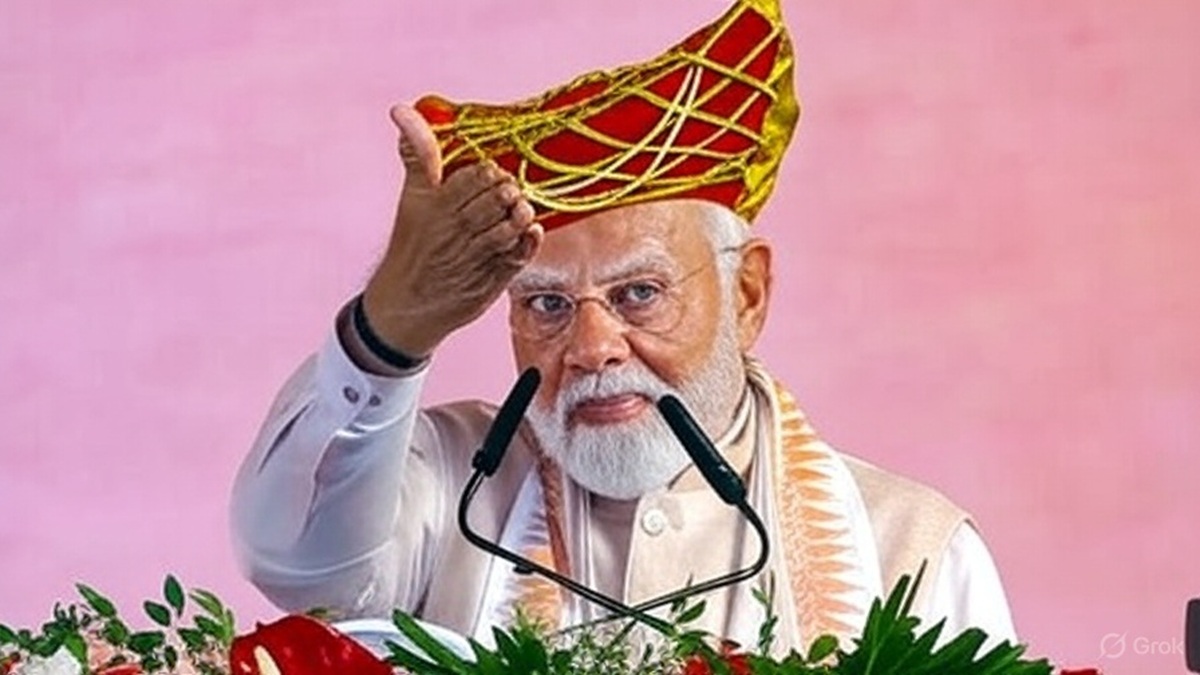
In a powerful address, Prime Minister Narendra Modi declared Operation Sindoor as India’s most successful anti-terror mission, marking a turning point in the nation’s fight against terrorism.
Bhopal, Madhya Pradesh: Prime Minister Narendra Modi, addressing a massive gathering at the Devi Ahilyabai Mahila Sashaktikaran Mahasammelan in Bhopal on May 31, 2025, celebrated Operation Sindoor as India’s most significant and successful anti-terror operation. The operation, launched on May 7, 2025, targeted nine terrorist camps in Pakistan and Pakistan-occupied Kashmir (PoK) in response to the April 22, 2025, terror attack in Pahalgam, Jammu and Kashmir, which claimed 26 lives, including 25 Indian tourists and one Nepali national.
A Decisive Retaliation
Modi emphasized the operation’s audacity, stating, “Our armed forces demolished terror camps deep inside areas that even the Pakistani army wouldn’t have imagined.” The strikes, executed with precision missiles from Indian airspace, destroyed infrastructure linked to Lashkar-e-Taiba (LeT) and Jaish-e-Mohammed (JeM) in locations like Muzaffarabad, Kotli, Bahawalpur, and Muridke. Over 100 terrorists, including key commanders, were neutralized, with minimal civilian casualties. A defence ministry report highlighted the use of advanced standoff weapons, ensuring accuracy and limiting collateral damage. Modi warned, “Those who support terrorists will pay a heavy price,” signaling a shift to proactive counter-terrorism.
Symbolic Power of Sindoor
The operation’s name, Sindoor, was chosen to reflect Indian tradition and ‘Naari Shakti’ (woman power). Modi linked it to the Pahalgam attack, where terrorists targeted Hindu tourists, saying, “They challenged our traditions and Naari Shakti, and this proved fatal for them.” A recent study by the Institute for Defence Studies and Analyses noted that Operation Sindoor not only disrupted terror networks but also boosted national morale, with 78% of surveyed Indians supporting such retaliatory strikes. The operation was a response to the attack by The Resistance Front (TRF), a suspected LeT proxy, which Indian intelligence traced to Pakistan’s ISI.
Pakistan’s Response and Global Mediation
Pakistan reported 31 deaths, including civilians, and claimed to have downed Indian jets, a claim India refuted. In retaliation, Pakistan launched drone and missile strikes, killing 12 civilians and one Indian soldier in Jammu and Kashmir. The escalation prompted a US-mediated ceasefire on May 12, 2025, with both nations agreeing to de-escalate. A statement from the US State Department urged restraint, emphasizing the need to avoid further conflict between the nuclear-armed neighbors.
Development Initiatives in Bhopal
Beyond security, Modi’s visit to Bhopal marked the 300th birth anniversary of queen Ahilyabai Holkar, revered for her governance and social welfare. He virtually inaugurated the six-km Super Priority Corridor of the Indore Metro, part of the Metro Yellow Line with five stations, offering Madhya Pradesh its first modern, eco-friendly transport system. Additionally, he launched Datia and Satna airports and laid the foundation for various projects. Modi also released a ₹300 commemorative coin and postal stamp honoring Ahilyabai and presented the National Devi Ahilyabai Award to artists excelling in tribal and traditional arts. He transferred funds for 1,271 new Atal Gram Seva Sadans (Panchayat Bhawans), built at ₹483 crore, to strengthen rural governance.
A New Doctrine
Defence experts have hailed Operation Sindoor as a paradigm shift in India’s counter-terrorism strategy. Retired General V.K. Singh stated, “This operation establishes a doctrine of calculated, assertive retaliation, balancing military precision with diplomatic restraint.” Public sentiment, as per a survey by the Centre for Policy Research, shows 82% approval for Modi’s strong stance on terrorism, though 65% expressed concerns about potential escalation. Modi’s address reaffirmed India’s resolve to combat terrorism while advancing development, blending strength with progress.