

Abhinav Mehrotra and Biswanath Gupta
Democracy is often hailed as the most legitimate form of governance, based on the principles of sovereignty, accountability and individual freedoms and this is largely true. However, history shows us the other side as well, where democracies do not only collapse through coups or violent upheavals; sometimes, their undoing begins slowly from within. Elected leaders may gradually interfere with the functioning of the institutions that keep them in check. It unfolds slowly through the politicisation of oversight bodies or subtle curtailments of dissent.
It is a global concern, one that international law increasingly recognises through the norms enshrined in the United Nations Charter, the International Covenant on Civil and Political Rights (ICCPR), and the Universal Declaration of Human Rights. Democracy, in this sense, has moved from being merely a political preference to being a principle of global governance.
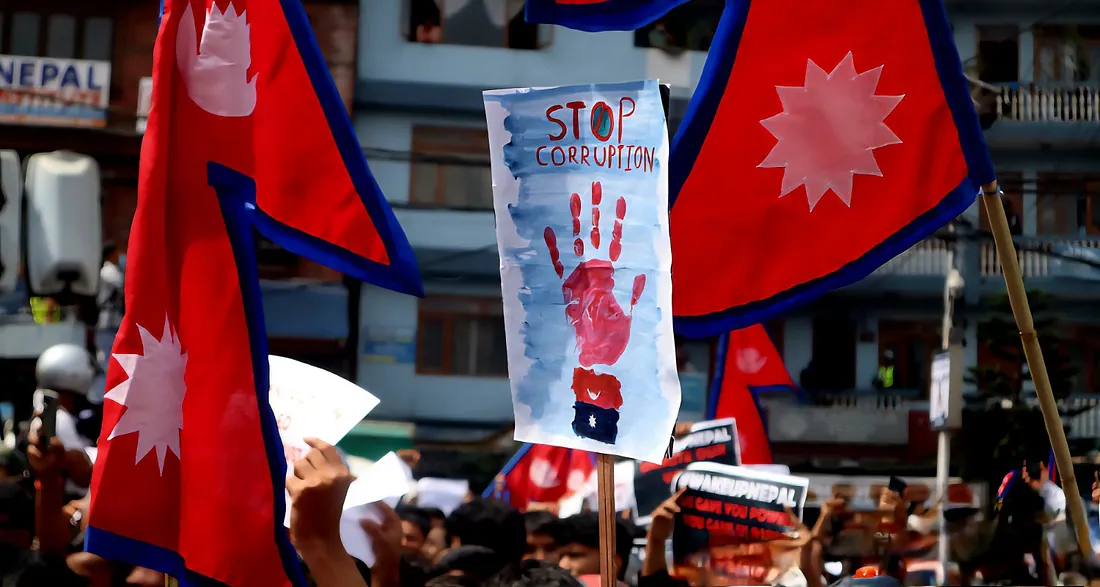
It is against this backdrop that the ongoing protests in Nepal acquire particular significance. The demonstrators who have taken to the streets embody not just discontent with specific policies or political outcomes, but also a universal demand that democracy must remain responsive, participatory and inclusive.
Democracy as a Global Norm
The notion that democracy is a “global value” is relatively recent in international law but it is gaining traction. Traditionally, the discipline emphasised sovereignty, namely the right of states to govern without external interference. Over the last three decades, however, there has been a shift, as international law and institutions increasingly frame democracy as an essential component of legitimate governance. Article 25 of the ICCPR guarantees citizens the right to participate in public affairs, directly or through freely chosen representatives. The UN Human Rights Committee, which oversees compliance with the Covenant, has underscored that this participation must be genuine and not merely formal. Nepal, as a member of the UN and a party to the ICCPR, is thus engaged in this wider conversation. The protests are not only about domestic governance; they also resonate with the global recognition that democracy has to be meaningful, which requires constant vigilance and renewal.
Thus, Nepal’s protests should be understood in this broader frame. They capture the anxieties of citizens who fear that democracy’s promise of voice, accountability, and fairness will erode if its institutions are not properly safeguarded. Importantly, these movements should not be seen as destabilising forces; rather, they are democratic correctives, reminding us that participation and protest are integral to democratic health.
In this sense, the protests in Nepal are not only about Nepal. They are part of a wider struggle to preserve democracy as a global value at a time when authoritarian tendencies are on the rise worldwide. They remind us that democracy is not static; it requires continual renewal, both domestically and internationally.
India’s Role and Responsibility
For India, Nepal’s developments carry particular resonance. As the world’s largest democracy, India is often seen not just as a state but as a symbol. Its democratic journey has inspired movements worldwide, and its own constitutional framework—based on the separation of powers, an independent judiciary, and fundamental rights—remains a reference point in the Global South.
India and Nepal share more than a border; they share deep historical, cultural and economic ties. Millions of people move freely across their frontier, and their societies are intertwined through language, religion and kinship. Without interfering with Nepal’s sovereignty, India can play a role in strengthening democracy in the region by championing global norms of accountability and participatory governance. This may be fostered through capacity-building efforts, parliamentary exchanges and legal education programmes, among other initiatives.
Moreover, India’s voice carries global weight. In multilateral platforms, from the United Nations to the G20, India has consistently highlighted democracy as central to sustainable development and peace. Extending this narrative to its neighbourhood is not only consistent with India’s values but also vital for ensuring regional stability and maintaining peace and security.
In South Asia, where political transitions are often contested and institutions remain fragile, India’s articulation of democracy assumes a dual role: as a normative commitment and as a strategic necessity. Democratic resilience in neighbouring states reduces the likelihood of authoritarian drift, political violence or external manipulation, all of which could undermine regional security and spill over into India’s domestic sphere.
Furthermore, India’s advocacy of democracy enhances its credibility as a responsible global actor. By doing so, India’s voice strengthens multilateral consensus on democracy as an indispensable pillar of peace and contributes to shaping global governance in a way that reflects both its values and strategic interests.
Looking Forward
Democracy’s greatest strength lies in its institutions, but its greatest vulnerability lies in the ease with which those institutions can be undermined. Nepal’s protests are a timely reminder of this paradox. They highlight the urgency of safeguarding democratic norms, not only for one country but for the global order itself.
For India, these developments are particularly significant. As a democracy that has long championed pluralism and the rule of law, India has both an interest and a responsibility in supporting democratic resilience in its neighbourhood. Moreover, fostering regional democratic resilience creates a buffer against instability, extremism and authoritarian influence, ensuring that South Asia evolves as a zone of cooperation anchored in shared democratic values.
(Abhinav Mehrotra is associate professor of law at O.P. Jindal Global University; Biswanath Gupta is also associate professor of law at O.P. Jindal Global University)