






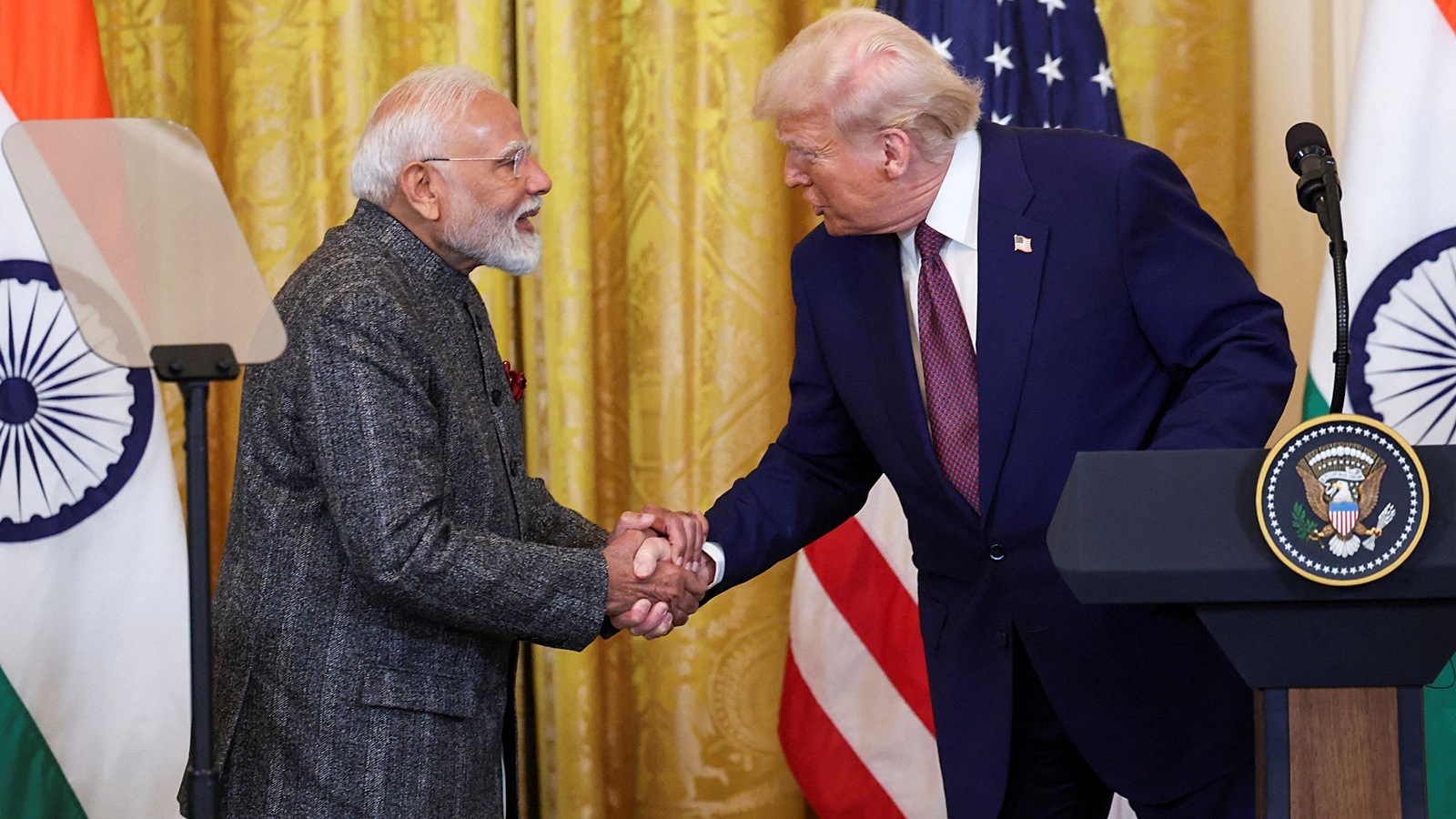
For months, Washington appeared determined to force New Delhi into a corner. Tariffs were announced, revised, and raised again. Public remarks from the White House grew increasingly sharp, often straying from trade into open disparagement of India’s economy and its leadership. The tone was unmistakable: pressure applied loudly, publicly and repeatedly, in the expectation that India would eventually yield.
That assumption proved wrong.
Instead of reacting, India absorbed the blows without theatrics. When, yesterday, Donald Trump finally announced the rollback of tariffs from a punitive 50 per cent to 18 per cent, it marked the end of months of uncertainty. More importantly, it marked a reversal of roles. The country expected to blink had not done so. The country applying pressure had recalculated.
This outcome did not emerge overnight, nor was it accidental. It was the result of a methodical strategy pursued quietly by Narendra Modi and his diplomatic team: refuse provocation, expand options and deny the other side the leverage that comes from being indispensable.
A Deliberate Refusal to Escalate
Trump’s negotiating style thrives on spectacle. He speaks first, speaks loudly and often speaks provocatively, counting on the resulting reaction to strengthen his hand. Many governments fall into this trap, mistaking public rebuttal for strength. India did not.
There were no retaliatory soundbites from New Delhi, no nationalist rhetoric aimed at a domestic gallery and no symbolic counter-tariffs designed to make headlines rather than change outcomes. India did not even offer public indignation. This restraint was not a weakness. It was discipline.
By staying silent in public, India denied Washington the feedback loop it sought. Pressure without reaction loses much of its force. The absence of outrage was itself a signal: New Delhi was not negotiating from anxiety.
The European Pivot
The most visible expression of this approach was India’s landmark trade agreement with the European Union, widely described by officials as the “mother of all deals”. Covering all 27 EU member states, the pact is expected to eliminate or sharply reduce tariffs on roughly 97 per cent of goods by value over time, opening one of the world’s largest markets to Indian exporters.
The economic implications are substantial, with tens of billions of dollars in trade and investment expected to follow. The diplomatic implications were even clearer. By deepening economic integration with Europe, India demonstrated that access to global markets did not hinge on American goodwill alone.
Crucially, this message was never delivered through press statements or political grandstanding. It was conveyed through signatures on paper and alignment of interests.
Diversification Beyond Europe
Europe, however, was only part of a broader recalibration. Over the past year, India has quietly accelerated its trade diplomacy across regions, reducing dependence on any single market. By late 2025, India had concluded at least eight free-trade or comprehensive economic partnership agreements covering 37 developed countries.
These included established partners such as Japan, Singapore, South Korea, Australia, and the United Arab Emirates. Each agreement served a dual purpose: opening markets for Indian goods and services, and signalling to the world that India’s economic future would not be hostage to tariff pressure from any one capital.
The Gulf provided a particularly telling example. India’s comprehensive partnership with Oman granted zero-duty access on over 98 per cent of tariff lines, creating fresh opportunities for sectors ranging from gems and jewellery to pharmaceuticals, textiles and automobiles. Similar logic underpinned agreements elsewhere: widen the export base, disperse risk and strengthen bargaining power.
Trade Numbers Tell Their Own Story
This strategy was not theoretical. Export data began reflecting the shift. As new markets absorbed Indian output, overall shipments of goods and services rose steadily, softening the impact of tariff volatility from the United States.
Even before Washington announced tariff reductions, Indian exports to the US were growing, rising nearly 16 per cent year-on-year. At the same time, total exports in late 2025 stood about 15 per cent higher than a year earlier, underscoring that diversification was not coming at the cost of growth in existing markets.
The implication was straightforward. India could afford patience because it had alternatives. Waiting, in this context, was not inertia. It was leverage.
The Washington Reversal
Against this backdrop, the shift in Washington’s tone becomes easier to understand. Within days of India finalising its EU deal and continuing negotiations elsewhere, Trump announced a new trade agreement with India, sharply cutting tariffs to 18 per cent.
The urgency to close a deal now lay with the White House. American exporters, facing the prospect of losing ground in India’s rapidly expanding market to European and Asian competitors, had their own reasons to press for a resolution. Pressure that once seemed unilateral had become costly to maintain.
This was not a concession extracted through confrontation. It was a recalibration forced by circumstance.
Beyond the Personality Clash
It is tempting to frame this episode as a clash of personalities: the voluble American president versus the taciturn Indian prime minister. That reading is incomplete. What unfolded was a contest between two methods.
Trump pushed, threatened and spoke. Modi listened, diversified and negotiated. One relied on escalation; the other on options. When escalation met indifference backed by credible alternatives, it lost effectiveness.
Critics may argue that India merely waited out an unpredictable president. That argument misunderstands the nature of waiting. Patience only works when supported by preparation. India’s silence was underwritten by deals signed, markets opened and partnerships strengthened.
A Shift in India’s Global Posture
The tariff rollback matters for exporters and investors. But its significance goes beyond percentages. In fact, the episode points to a broader transformation in India’s foreign economic policy. It demonstrates that India will not be hustled into submission, even by the world’s most powerful country, the United States. Nor will it broadcast resistance for applause.
The country is steadily shedding the habits of a defensive, reactive state and behaving more like a confident middle power. It no longer rushes to placate, nor does it feel compelled to respond to every provocation. It suggests an India that sees itself not as a supplicant in global trade and policy, but as a participant with choices. That confidence can be unsettling to those accustomed to dominance by pressure.
For Modi, often caricatured abroad as a leader focused on domestic theatrics, this outcome offers a counter-narrative. On the international stage, his approach has been marked less by bravado and more by caution and long-term calculation. And for India, the lesson is clear. The long game works, provided it is played with preparation and restraint.
This time, patience was not merely a virtue. It was a strategy, and it paid off.
(Bikash C Paul is a Delhi-based journalist. He is executive editor, New Delhi Post)


