


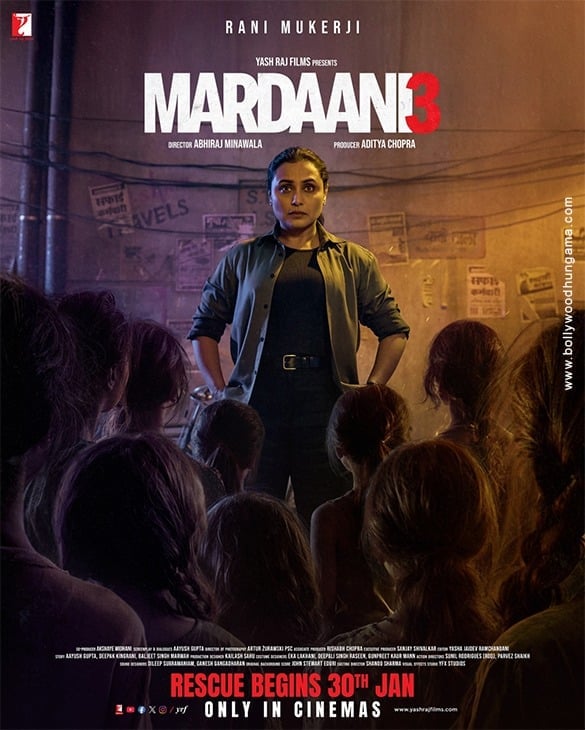
Like its earlier chapters, Mardaani 3 once again places police officer Shivani Shivaji Roy at the centre of a battle most societies prefer to ignore. Played with quiet ferocity by Rani Mukerji, Shivani confronts crimes against women that are often normalised, dismissed, or buried under silence and stigma.
Directed by Abhiraj Minawala and produced by Aditya Chopra under the Yash Raj Films banner, the film expands the Mardaani universe into a territory that is darker and far more disturbing. It lays bare how violence against women is not accidental but is instead enabled systematically by fear, conditioning, and wilful indifference. By drawing attention to trafficking as a deeply organised crime, the narrative highlights the role of money, logistics, and corporate greed. It also exposes illegal human trials, unethical vaccine development, and the exploitation of women as expendable test subjects.
This sequel raises the stakes considerably. The crime is graver, the mystery tighter, and the action more real. Mukerji shoulders the film with absolute authority. From the very opening sequence, she commands the screen with her restraint, physicality, and determined resolve, setting the tone for what follows over the next two hours. She is not just racing against criminals here; she is also battling bureaucracy, time, and a system that moves too slowly when it matters most.
The film opens deep inside Sundervan, amid a cartel that uses women as drug mules. Disguised as one of the captives, Shivani waits for her team of commandos to strike. When a GPS failure derails the plan, she is forced to act alone. What follows is a raw, brutal action set-piece that includes gunfights, hand-to-hand combat, and flashing knives and blades in close quarters, making it a gripping one-woman strike that frees the captives and dismantles the cartel.
Meanwhile, in New Delhi, a diplomat’s worst nightmare unfolds when his daughter and her caretaker’s daughter vanish while playing near a farmhouse in Bulandshahar. Aware of Shivani’s reputation, he pushes for her appointment to the case of his missing child. From this point on, the film becomes a relentless race against time, leading Shivani straight into the midst of a sprawling child-trafficking network.
Rani delivers one of the most convincing performances of her career, matched compellingly by Mallika Prasad as Amma, the chilling antagonist and mastermind behind the trafficking syndicate. Amma’s presence is unsettling. She is cold, ruthless, and terrifyingly calm, and she does not rely on theatrics. Against this, Shivani’s quiet intensity, her unwavering gaze, and measured dialogue often speak louder than rage and unnecessary gore.
The first half moves at a breakneck pace, stitching together clues with precision and keeping the audience constantly on edge. The mystery and suspense are built steadily, and as you reach the interval with the wicked smile of Prajesh Kashyap’s Ramanujam, you get a small glimpse of what is about to arrive in the latter half. The second half is a slow burn, but it is pleasantly predictable and runs almost like a typical masala film presentation.
Supporting the central narrative of Mardaani 3 is a strong ensemble that adds emotional depth to the film. Janki Bodiwala, as Constable Fatima Anwar, delivers a balanced and sincere performance. She is a young officer whose commitment and alertness reflect her approach and attitude towards her work and seniors. Jisshu Sengupta, as Dr Bikram Roy, brings warmth to the story from the family perspective of a cop. He creates an emotional balance without diverting the film’s intensity. Indraneel Bhattacharya, as the Indian Ambassador, depicts the anguish of a powerful man rendered helpless by personal loss, triggering the emotional stakes of the investigation.
With clarity and conviction, Mardaani 3 tackles human trafficking, institutional apathy, procedural gaps, gendered violence, and systemic exploitation. It is not just a crime thriller; it holds up an uncomfortable mirror to society and confronts how complicit it is in the suffering of its most vulnerable.
(Praveen Nagda is festival director, KidzCINEMA and Culture Cinema Film Festivals)