






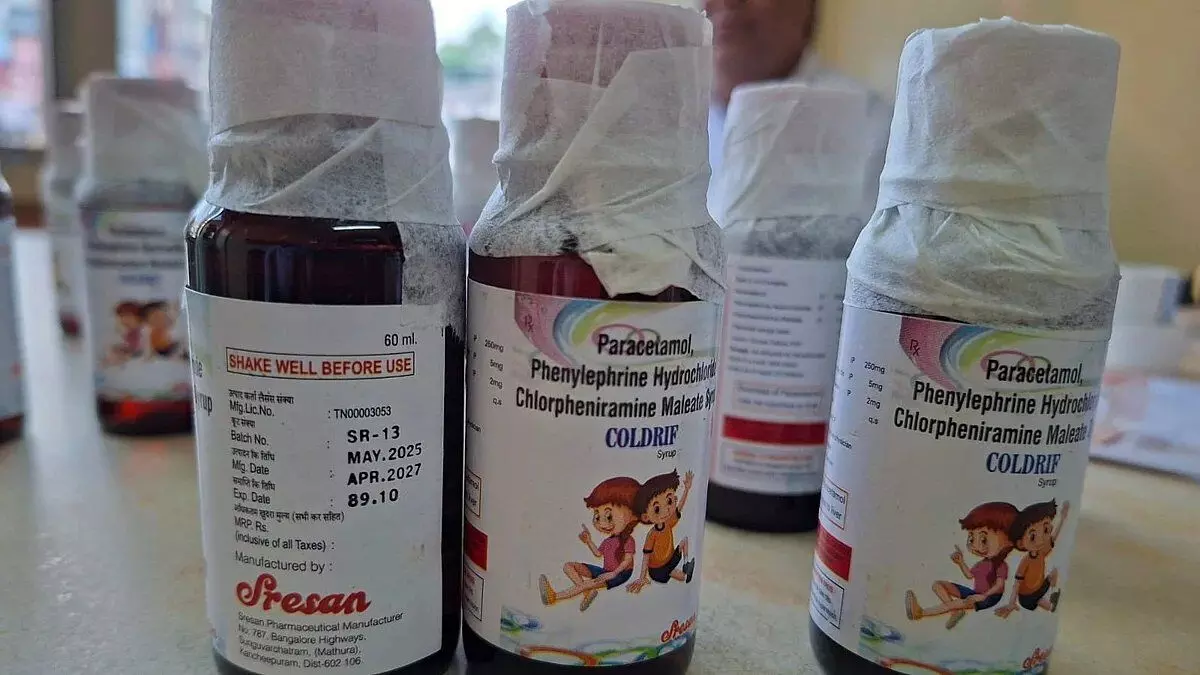
The cough syrup, Coldrif, meant to heal had turned into a slow, silent poison. By the time the state could even begin to respond, 25 children across Madhya Pradesh, mostly in Chhindwara, were dead.
The tragedy in Madhya Pradesh that has shaken the nation’s conscience was not sudden. It was waiting to happen in a state whose public healthcare system had collapsed long ago. Worse, despite repeated regulatory warnings, the Madhya Pradesh government stayed aloof, blind to the danger signs.
Behind every bottle of the tainted and poisonous cough syrup lies a trail of regulatory negligence and institutional apathy. The disaster mirrors a grim national pattern: the manufacturer’s carelessness, the regulator’s indifference, and the government’s paralysed response.
This is not merely about one bad batch; it is about a chain of systemic failures that allowed poison to move freely through the state’s medical network—unchecked and unchallenged. The children died not only because a cough syrup was toxic, but because a public health system failed to protect them at every step—from factory floor to hospital bed.
India’s drug safety framework is a patchwork of divided responsibility: state drug controllers issue manufacturing licences, while the Drugs Controller General of India (DCGI) sets national standards.
In the Coldrif case, each tier failed:
- Sresan Pharmaceuticals, the manufacturer, skipped mandatory batch-wise toxin testing.
- Tamil Nadu’s regulator, which issued the manufacturing licence, did not detect the lapse.
- Madhya Pradesh’s FDA failed to test incoming batches before they reached retail shelves.
- And the Centre’s periodic audits, meant to catch such lapses, never flagged the company.
The Madhya Pradesh Food and Drugs Administration later admitted that its own laboratory tests had failed to detect contamination earlier. It was only after Tamil Nadu’s drug testing lab confirmed the presence of diethylene glycol that the state moved to seize stocks and alert districts.
The CAG report of 2024, tabled in the Madhya Pradesh Assembly, painted an equally bleak picture. The Directorate of Health Services (DHS) failed to submit its Annual Drug Plan for five consecutive years—from 2017–18 to 2021–22. Without an Annual Drug Plan, the Madhya Pradesh Public Health Service Corporation Limited relied on outdated consumption figures and old rate contracts, ignoring real demand and bypassing essential safety checks. Procurement thus became a mechanical exercise, devoid of medical oversight, leaving the system blind to unverified suppliers, expired stock and contaminated drugs.
Across the state, the rot in healthcare runs deep and goes beyond regulatory lapses. The government-run hospitals are in shambles. Sayed Sawab Ali, father of seven-month-old Sehrish Fatima, recounted, “After she was given the cough syrup, her condition started deteriorating rapidly. We took her to the district hospital, and from there she was referred to Nagpur. She didn’t survive the night.”
Many of Madhya Pradesh’s 14 government medical colleges face the same fate: crumbling infrastructure, vacant faculty posts, and dysfunctional neonatal ICUs. The same 2024 CAG report flagged serious deficiencies in hospital maintenance, equipment and staffing. Even routine lab tests are often outsourced, causing delays in critical diagnoses.
These gaps in secondary and tertiary care turned a medical emergency into a death sentence. When public hospitals cannot offer timely care, families have no choice but to pay exorbitant fees at private clinics or undertake exhausting journeys hundreds of kilometres away. In several Coldrif cases, children died in transit—victims not just of a toxic syrup, but of a paralysed health system.
Nowhere is the crisis more apparent than in Chhindwara, where the government medical college, set up nearly a decade ago, still struggles with chronic shortages and outdated infrastructure. Shortages of paediatric specialists, ICU beds and diagnostic facilities have reduced it to little more than a referral centre.
Syed Swab Ali’s grief raises a stark question: why did a child from a district with its own medical college have to be taken across the border to Maharashtra?
Public health activists argue that this tragedy was the inevitable outcome of years of state neglect. “This clearly exposes the failure of governments in health system governance and their inability to provide quality health services,” says Amulya Nidhi, national convener of the Jan Swasthya Abhiyan. “Instead of strengthening public hospitals, governments are handing them over to private entities—offering free land for private medical colleges and letting profit take precedence over public welfare.”
Amid public outrage, the state government resorted to the familiar ritual of damage control. Chief Minister Mohan Yadav banned the sale and distribution of Coldrif and promised “the strictest action against those responsible for the deaths of innocent children.”
Several officials were suspended or transferred: Drug Controller Dinesh Maurya, Deputy Director Shobhit Kosta, inspectors Gaurav Sharma (Chhindwara) and Sharad Kumar Jain (Jabalpur). Yet the accountability chain remained murky and incomplete.
At the national level, experts say Coldrif is not an aberration but a symptom of systemic rot. India has over 10,000 small and medium pharmaceutical manufacturers, but fewer than 2,000 qualified inspectors nationwide. The World Health Organization has repeatedly warned that India’s drug regulation remains fragmented, underfunded, and inconsistent across states.
The tragedy also exposes a double standard between export and domestic drug oversight. After the Gambian cough syrup deaths in 2022, export testing rules were tightened—but domestic checks remained weak. As one health expert put it: “India’s export drugs must pass WHO scrutiny. The medicines our children take do not.”
In the end, the children were betrayed by a chain of institutions that should have stood guard—the manufacturer that cut corners, the regulator that looked away and the hospitals that couldn’t heal.
(Deshdeep Saxena is a Bhopal-based senior journalist with many years of experience)


