


The New Language of Caste Pride
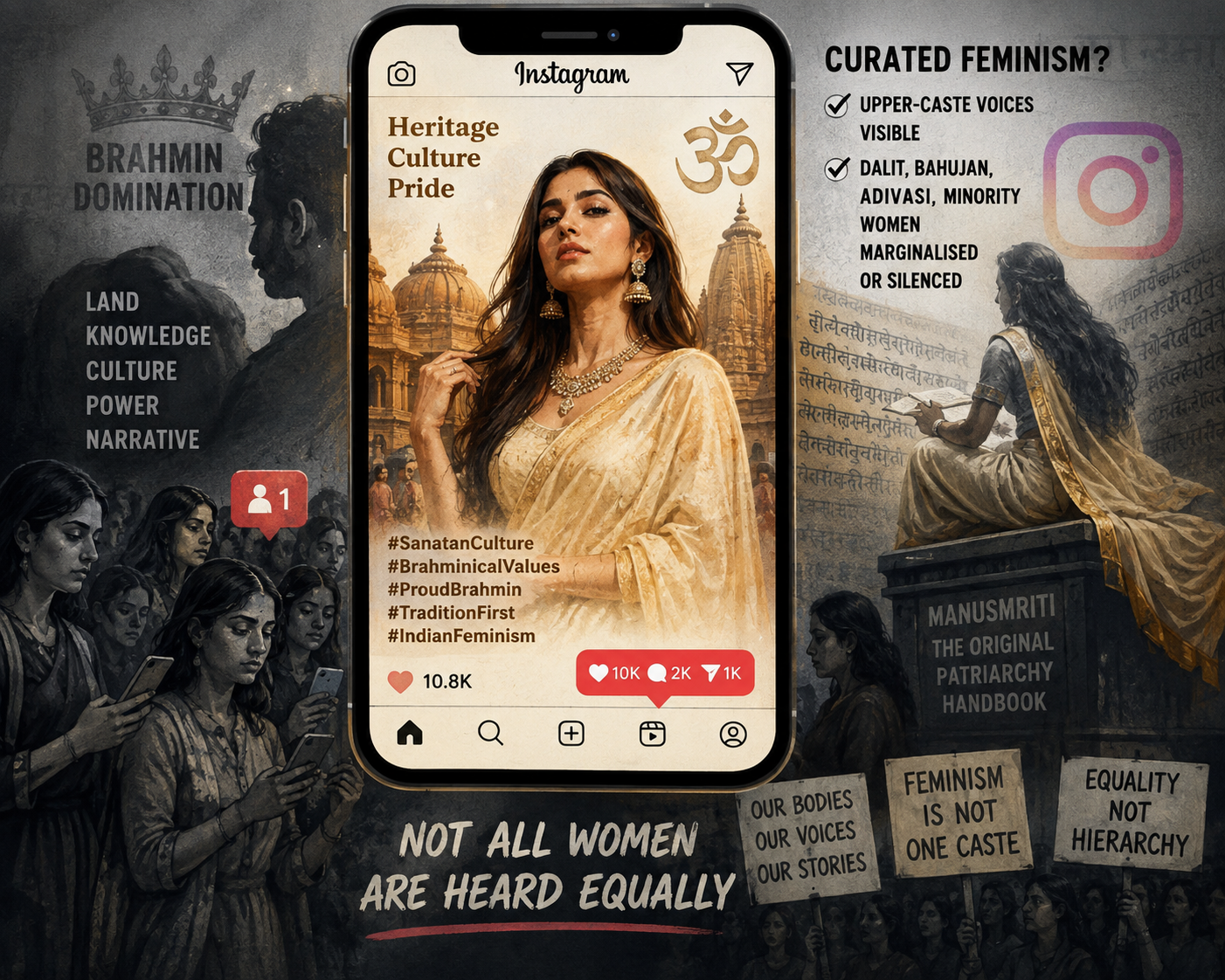
As I open Instagram, my feed is immediately inundated with reels that glorify Brahmin identity and exalt Brahmin pride. Today, Instagram has become a key digital arena where caste identity is performed, flaunted and repackaged, sometimes in increasingly sophisticated ways. Since 2024, the public assertion of caste identity, particularly Brahmin identity, on social media has gained significant momentum, drawing widespread attention, even though expressions of caste pride have existed for millennia.
Amidst this disquieting landscape, another video surfaced on Brut India’s Instagram handle, drawing attention to the tragic death of 27-year-old government school teacher Shrishti Bhandari in Dehradun. In the video, she is seen weeping, stating that she has endured torture for the past six months and can no longer bear it. She recounts being persistently humiliated and called “manhoos” or inauspicious by her in-laws. Her family has alleged that she died due to dowry-related harassment, and an FIR has been registered under Section 80(2) (dowry death) of the Bharatiya Nyaya Sanhita against her husband and his family members.
This incident must be situated within a broader context of gendered violence in India. According to data from the National Commission for Women (NCW), the commission receives around 25,000 complaints annually regarding crimes and rights violations against women. The most frequently reported categories include domestic violence, violations of the right to live with dignity and dowry harassment. In 2022 alone, the NCW recorded nearly 31,000 complaints, the highest number since 2014, with emotional abuse and domestic violence topping the list.
The contemporary assertion of Brahmin identity by women and the simultaneous rise in violence against women are not isolated phenomena. Rather, they are shaped by interconnected caste-patriarchal structures that co-exist within the same social order. The digital performance of caste pride and the material realities of gendered violence are mutually reinforcing. Both are rooted in a patriarchal system that upholds caste hierarchy and controls women’s bodies, sexuality and agency.
It must be remembered by all that the caste system is inherently patriarchal. It affects both upper-caste women and Dalit women. While this structure literally kills one woman, another woman may actively augment it, deriving a false sense of power by endorsing the very social order that ultimately harms women. The paradox becomes stark when upper-caste women may gain symbolic authority by performing caste pride, even as they remain complicit in a system that perpetuates violence against women across caste lines.
When Caste Pride Goes Algorithmic
In an article published by The Quint in March 2026, titled “Everyone Wants to Be Brahmin: Inside Instagram’s Caste Pride Economy”, the author notes how “dominant-caste superiority is being repackaged for the algorithm age under the label of ‘pride’.” The article refers to several distinctive profiles that also surfaced on my Instagram feed several times.
One of them is that of influencer Aradhya Diwedi, whose reel has 24.7K likes and has received huge support in the comments section. The scene captures Aradhya Diwedi approaching the camera in slow motion, while the corner of a white vehicle, appearing to be a Thar, remains visible in the shot. In the background, an audio track plays: “Brahmin na kabhi jhuka tha, na kabhi jhukega. Brahmin sarvochh tha, sarvochh rahega” (A Brahmin had never bowed, nor will a Brahmin ever bow. The Brahmin has been supreme, and will remain supreme.)
There is a phallic power to the way she walks towards the camera in slow motion. I was reminded of Sanjay Dutt or Ajay Devgan in Hindi action films, out to demolish criminal networks, having retributive power and moral authority. In another reel made by Vishi Pandit, she is seen exercising in a gym with a look of conviction on her face. The audio in the background says: “Ek din aap tarakki karoge, bohot tarakki karoge, upar jaoge, bohot upar jaoge lekin Brahmanno se upar nehi ja paoge.” (One day you will progress, you will progress a great deal; you will rise, you will rise very high, but you will not be able to rise above the Brahmins.)
One Instagram handle, run by a creator named Srishti (@_srishtiiie_samjhe), poses a direct question in her reel: “What have you gained by being a Brahmin?” Her reply is confident and self-assured: “Beauty, intelligence, and status.” This reel has 35.6K likes.
This sentiment is echoed across numerous reels that promote caste endogamy. Most of the reels carry the message that only a “beautiful Brahmin” looks appropriately matched beside a Brahmin man. Such discourses, linking beauty, perceived intelligence and social prestige to caste purity, are not new. They are age-old strategies used to maintain and legitimise the caste order. What is new is their medium: these narratives are now being reiterated, repackaged and amplified through the visually driven, algorithmically promoted format of Instagram reels.
The Illusion of Empowerment
The paradox, and the tragedy, is that many of these women hail from small towns, where Instagram posts afford them a sense of identity, visibility and power. Yet this power is largely illusory. For some, there is a genuine belief that the Brahmin community is under threat and must unite to preserve its heritage.
The deeper tragedy lies in the fact that these reels actively advocate for a Hindu nation in which upper castes remain dominant. These reels also reinforce hierarchies that have long marginalised Dalits, Adivasis and other oppressed groups. They reproduce the very structures of caste and patriarchy that constrain women’s freedom and agency, even as these young women claim to empower themselves.
Sadly, our country has offered these women little beyond the illusion of caste pride. In the absence of substantive opportunities, economic, educational or social, caste identity perhaps becomes one of the few resources they can claim as their own. What remains is not empowerment, but a performative assertion of hierarchy, where pride in caste substitutes for real empowerment and agency. Sadly, the same tools could be used for subversion and disruption; they could be used to question caste and gender oppression instead of legitimising them.
When Love Crosses the Caste Line
As I write this article, I read another news report that surfaces on my Instagram feed via the official handle of Strike (@strikeoriginalh), about an honour killing in which a Brahmin girl and a Dalit boy were burnt to death by the woman’s family for being in love. This incident occurred in June 2026, but the investigation is ongoing.
While all evidence points towards torture and murder, the police called it suicide in their report. The family of the murdered Dalit boy continues their relentless fight for justice. As Brahmin women flaunt their caste pride and endorse endogamy, they fail to realise how much they are harming their fellow Brahmin women and women in general.
I am reminded of the French feminist and philosopher Luce Irigaray, who spoke of the potential that female pleasure and desire have. It can unsettle the order of things. It can lead to free will and sovereignty. It can inspire one to cross boundaries, much like the love story of this Brahmin girl and the Dalit boy and many other couples who have dared to defy the rigid rules of the caste system.
These couples transgress what Arundhati Roy memorably termed the “Love Laws” in her novel The God of Small Things, the unwritten social codes that dictate “who should be loved, and how. And how much.” Ambedkar too emphasised inter-caste marriages and their potential to challenge endogamy and the caste system. Ambedkar believed these unions had the potential to disrupt the system and create multiple points of contact across castes, thereby annihilating the caste system itself.
Yet, tragically, contemporary society is retreating into regressive norms of caste purity and endogamy, often reinforced by modern technology and propagated by women.
Everyone Should Be a Dalit Feminist
However, it is heartening to witness many Brahmin women and other more privileged women on Instagram speaking out against caste and generating a counter-discourse. After the #reservationhataoandolan, a whole host of young women have come forward in support of reservation and have spoken against the social order of caste openly, while Dalit women have done this historically.
Yet, as I watched these videos, a lingering unease remained: could this, too, be another form of caste performativity? Is it possible to confront caste without acknowledging the historical privileges one has inherited and continues to benefit from? Nevertheless, I feel a sense of reassurance when such privileges are publicly acknowledged, when my own friends recognise their Savarna privilege, or when my students share how reading Dalit literature has transformed their understanding of caste, rendering them more conscious of their own positional advantages. I want to trust them, and I do.
As I reflect on women’s movements and feminist politics, I am reminded of Black American philosopher bell hooks. In Ain’t I a Woman, she writes: “Our struggle for liberation has significance only if it takes place within a feminist movement that has as its fundamental goal the liberation of all people.”
This universal quality of the liberation of all people can be found in Dalit feminism and its focus on the intersectional critique of caste, class and gender. Dalit feminism hence can expose multiple hierarchies and radically reframe gender justice. In the Indian context, caste and gender cannot be separated. At their intersections, both Dalit and upper-caste women suffer, though in different ways and degrees.
It is time we radically acknowledge Dalit feminism and embrace it, not to erase difference, but to honour it. One need not be a Dalit to be a Dalit feminist. It also doesn’t mean that Dalit women’s voices will be appropriated by mainstream feminists. But it definitely means that reinventing oneself as a Dalit feminist would transform individual women and feminists from isolated agents into oppositional and collective subjects, as Sharmila Rege suggests in her essay “A Dalit feminist standpoint”.
Embracing Dalit feminism is a reminder that women cannot speak of liberation and emancipation while remaining entrenched within the entitlements of caste structures. Hence, I firmly believe that it is time to declare: Everyone should be a Dalit feminist.