Venezuela’s collapse was not a descent into chaos. It was a conversion.
Over the past fifteen years, the country did not merely succumb to corruption; it underwent a functional transformation from a sovereign state into an integrated criminal platform.
This was not accidental. It was engineered. Institutions were not weakened; they were repurposed. The military ceased to function primarily as a defensive force and became a mechanism for controlling trafficking corridors. Customs, ports and airports stopped facilitating trade and began enabling illicit flows. Financial institutions no longer stabilised the economy but laundered and redistributed criminal revenue. By the mid-2010s, Venezuela had become what intelligence professionals describe as a state-enabled illicit logistics hub, a system offering protection, predictability and immunity to transnational crime.
This distinction matters. Corruption exploits the system. Criminal governance is the system.
The Architecture of Narco-Terrorism
Venezuela’s criminalised state rests on four interlocking pillars.
First, territorial control of drug corridors. Geographically positioned between Colombia’s cocaine-producing regions and global consumer and transit markets, Venezuela absorbed trafficking rather than interdicting it. Cocaine moves through the Apure–Zulia axis, via clandestine airstrips in Apure, Amazonas and Bolívar, and exits through ports such as La Guaira and Puerto Cabello or Caribbean routes. These are not rogue operations. They function through military flight permissions, managed radar blind spots, port clearances and selective law-enforcement inaction, turning trafficking into a regulated illicit economy.
Second, state-protected non-state armed actors. Colombian guerrilla dissidents, local criminal militias and foreign proxy actors operate inside Venezuelan territory not as enemies but as auxiliary assets. They enforce territorial control, intimidate populations, secure illegal mining zones and conduct cross-border influence operations. Violence here is not institutional failure; it is a governance tool.
Third, illegal resource extraction as a revenue replacement. As oil revenues collapsed and sanctions intensified, the state substituted legal income with illegal mining and trafficking—gold, coltan, rare earths, timber, fuel and arms. These activities are secured by military units and armed groups, then laundered through state channels. The result is structural dependency: dismantling criminal markets would dismantle the state itself.
Fourth, political and legal shielding. Judges, prosecutors, regulators and police commanders do not merely look away. They suppress cases, selectively prosecute, intimidate investigators and criminalise whistleblowers. Law ceases to restrain power and becomes its instrument.
Not Organised Crime, Narco-Terrorism as Governance
This is why Venezuela cannot be understood as a case of organised crime or state failure. Narco-terrorism here is not about drugs funding violence; it is about violence enforcing a political-criminal order. Criminal revenue replaces taxation. Armed groups replace institutions. Fear replaces legitimacy. Loyalty replaces law.
This is not a failed state. It is a repurposed one.
That is why diplomacy failed and there was no political system to negotiate with. Sanctions failed because the system no longer depended on legality. Elections failed because legitimacy was irrelevant. The system was not broken; it was functioning exactly as designed.
From Internal Collapse to External Exposure
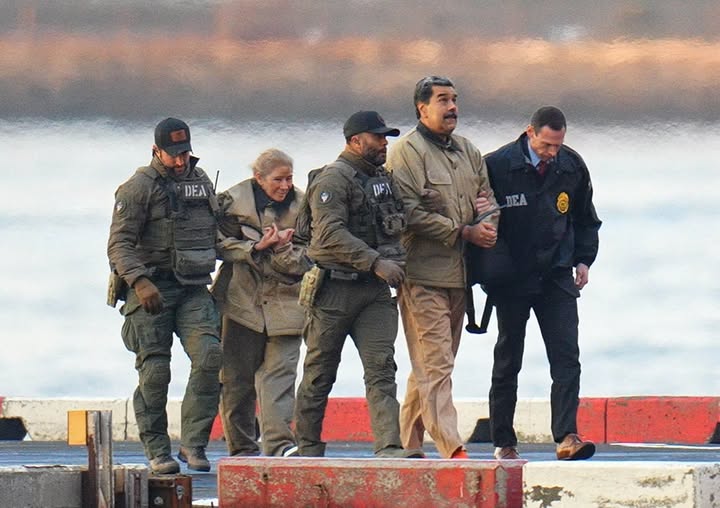
What unfolded in recent days was not merely a military episode or diplomatic manoeuvre. It was the externalisation of a long-visible reality: Venezuela no longer functions as a sovereign state but as a hybrid criminal operating system with political cover.
The intervention unfolded in phases. First came strategic signalling—airspace dominance and electronic warfare to shatter the illusion of sovereignty. Then targeted neutralisation of infrastructure that protected criminal operations: intelligence units, command centres, port security and select military-industrial facilities. The most decisive phase, however, was psychological. Mid-level officers, administrators and financial operators were confronted with the exposure of their communications, movements and supposed protection. Once trust collapses, networks fragment.
This was not an invasion or regime-change operation. It was a targeted disruption of an operational architecture combining state institutions, criminal networks, foreign intelligence services and transnational illicit markets. The objective was not to defeat the Venezuelan military, but to fracture its functional integrity and strip criminal networks of their protective shell.
Why Now, and Why It Matters
Three factors converged: the escalation of Venezuelan-linked criminal activity abroad; accumulated evidence implicating senior officials in transnational crime; and a geopolitical shift recognising criminalised states as systemic security threats rather than regional anomalies.
Venezuela crossed the threshold from humanitarian tragedy to global risk.
What the world confronted was not a political crisis but a new regime type, a state that no longer governs its people, only criminal flows. This model is not unique. Variants are emerging in parts of Central America, Africa and conflict zones where crime and governance merge.
This is the new frontier of global insecurity: not wars between states, but states becoming networks.
Conclusion: A Diagnosis, Not a War
What happened in Venezuela was not a war. It was a diagnosis delivered through force—the moment the international system acknowledged that Venezuela is not a political problem to be negotiated, but a criminal architecture to be dismantled.
The real question is not whether this intervention was justified. It is how many other states are already operating under the same logic, and how long the world will wait before confronting them. Because the age of criminalised sovereignty has begun. And Venezuela is not the exception. It is the prototype.
(The author is a global security and geopolitical risk expert. He is president, IOSI Global. His work focuses on transnational crime, narco-terrorism, state corruption, and the strategic impact of criminal networks on global security and governance)