






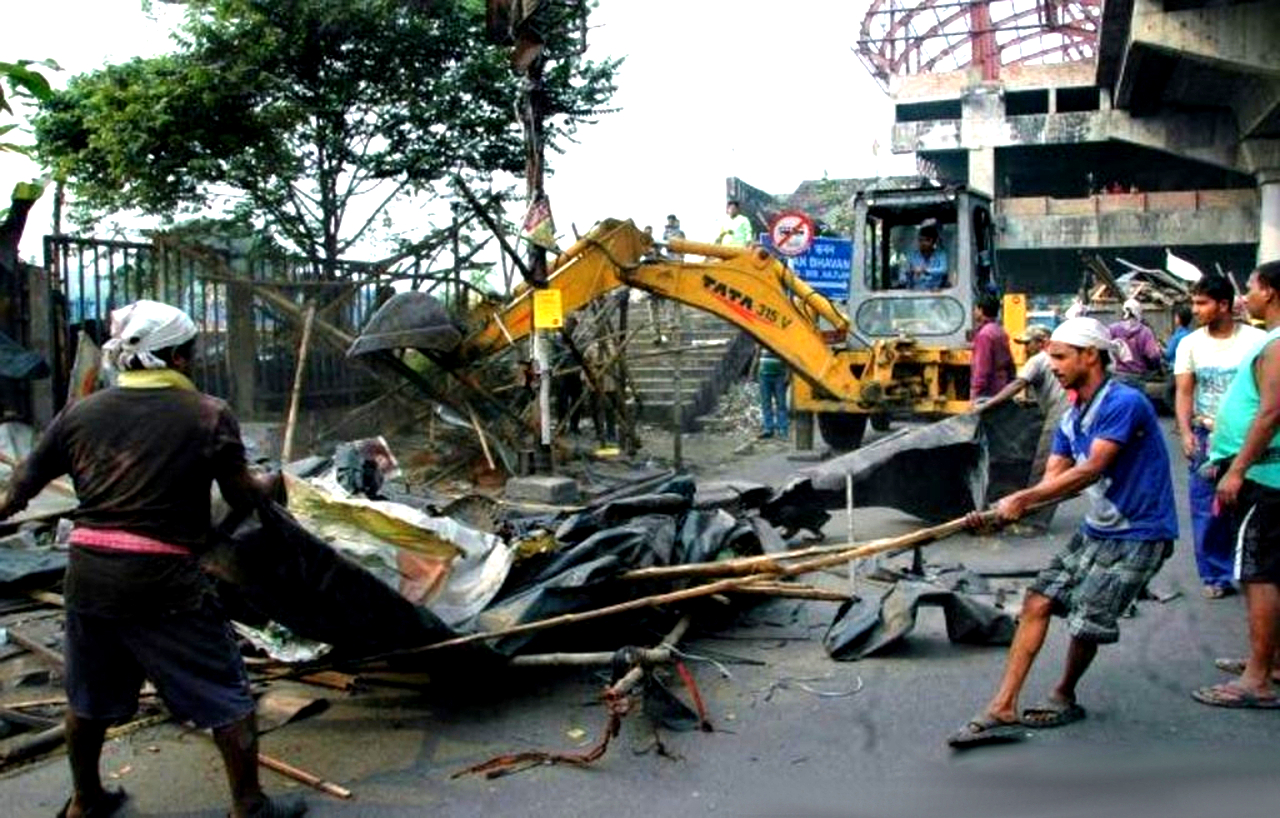
Public opinion on the recent eviction of hawkers from railway stations appears sharply divided. One side argues that hawkers have occupied railway property illegally, have no ownership, title or formal contract, and therefore have no right to remain. The other argues that evicting people without rehabilitation is unjust, especially when their livelihood depends on that space.
Ownership Is Not the Only Right
The first mistake in the pro-eviction argument is the assumption that only ownership creates rights. In almost every legal system, ownership and the right of use are treated as distinct. This distinction is essential wherever the property in question is durable. If ownership and use were always the same, one could not buy a car and rent it out. A farmer could not lend or lease a tractor to another person. In the case of short-lived goods, however, such a distinction is unnecessary. If I buy a dozen bananas, I am both the owner and the user. But land, houses and other durable property are different.
In matters of land and housing, the law is considerably more complex. A tenant may not own the house, but tenancy law still recognises certain rights of use. Similarly, a landlord may own the property, but the law regulates how that ownership can be exercised. Ownership does not confer unlimited power.
Even where one builds or inherits a house, the matter is not entirely straightforward. One may own the house, but the land on which it stands remains subject to the state’s authority. The state, in the final instance, retains sovereign power over land. That is why it can acquire land, remove occupants or reorganise land use. However, the state cannot simply do this without justification. In practice, it must provide reasons, follow due process and, in many cases, offer compensation. The reason is simple: even if one does not possess absolute ownership, one may still possess a legally recognised right of use.
This distinction matters because the hawker question cannot be reduced to the absence of title deeds. The law recognises not only ownership, but also possession, use, occupation, legitimate expectation and livelihood.
Significance of Long Possession
There is another relevant legal principle: the rights that may arise from long possession. In India, this is generally discussed under the doctrine of adverse possession. Under the Limitation Act of 1963, if someone remains in possession of property for a long, continuous period, the original owner may lose the ability to recover that property after the limitation period expires. For private property, this period is generally twelve years; for government property, it is thirty years.
Of course, this does not mean that every hawker automatically becomes the owner of railway land. Nor does it mean that anyone can occupy public land and immediately claim legal rights. What it does mean is that long-standing occupation cannot be dismissed as legally meaningless. The claim that hawkers have no ownership documents and therefore no rights is an oversimplification. It ignores the way the law itself treats possession and long-term use.
This is particularly relevant in the case of railway-station hawkers. Many have occupied and worked in these spaces for years, sometimes decades. Their presence was never invisible. The authorities knew they were there. Customers bought from them. Local economies grew around them. If the state tolerated, regulated, benefited from, or informally accommodated such activity for years, it cannot suddenly pretend that these people appeared yesterday and deserve to be removed overnight.
This is why the legal argument for eviction is not as strong as its supporters suggest. It may be legitimate to regulate hawkers. It may even be necessary to clear certain passages for safety and public movement. But eviction without rehabilitation raises an altogether different legal and moral question. That is where the opposing argument becomes considerably stronger.
When Law Gives Way to Politics
The issue becomes even clearer when we move from law to politics. When the law is not properly applied, or when its strict application produces an inhuman result, people are forced to go beyond the courtroom and into the streets. This has happened repeatedly in India. In Singur, the question was not merely whether the state possessed the legal power to acquire land. The real question was whether such an acquisition was just. In citizenship and documentation disputes, the issue is not merely whether papers are in order, but whether genuine citizens can be excluded because they lack the “proper” document. In voter-list controversies, the issue is not merely one of technical correction, but the possibility that genuine voters may be removed in the name of procedure.
In such moments, law alone cannot settle the matter. Politics enters because justice has not been achieved through the legal process.
This is why Gandhi’s civil disobedience movement was not simply an appeal for legal correction. It was a political movement. It asserted that when the law becomes unjust, or when it is applied unjustly, obeying it is no longer a moral duty.
The hawker eviction issue has now become political in precisely this sense. It has given the opposition a cause. Whether that cause gathers momentum, however, depends on the strength of the opposition and the public mood. At present, the opposition outside the Assembly appears more visible on the streets than its representatives inside it. Those who are formally present in the Assembly often seem fragmented and absent from the actual public struggle. This may explain why the government does not appear to be taking the protests very seriously.
It is also possible that the government is testing public sentiment. If it concludes that commuters are more irritated by hawkers than sympathetic towards them, more such drives may follow. The ruling side may be calculating that the inconvenience commuters face will carry greater electoral weight than the suffering of those who have been evicted.
Our Own Contradictions
That is where the public must make its own calculation. When we walk through a crowded station or along a footpath, hawkers can inconvenience us. There is no point denying this. They occupy space. They slow pedestrian movement. They can make already congested public areas even harder to navigate. Yet the same hawkers also allow us to buy goods cheaply. The commuter who complains about them may still purchase tea, fruit, snacks, umbrellas, bags, phone covers or household items from them. They are not merely encroachers; they are also an integral part of the everyday economy of the poor and the lower middle class.
This contradiction cannot simply be wished away. We want clean public spaces, but we also want inexpensive goods. We want the law to remove inconvenience, but we do not always ask what happens to those whose survival depends on the informal economy. We condemn illegality when it inconveniences us, yet often benefit from the same informality when it serves our interests.
The same is true of property law more broadly. When we are tenants, we seek protection from landlords. When we become landlords, we complain that tenants enjoy too many rights. When our parents or grandparents were refugees, many of us benefited from laws and political arrangements that enabled the growth of colonies and settlements. Yet once we become secure property owners, those same legal protections can begin to seem inconvenient.
These two realities cannot be separated. They are like Siamese twins. The law that protects the vulnerable may inconvenience the powerful. The informality that creates disorder may also make survival possible. The rights that once protected us may later constrain us.
Justice, Not Just Eviction
Therefore, the hawker question cannot be answered simply by saying, “Remove them,” or “Leave them alone.” The real question is whether the state will regulate with justice or demolish with force. If hawkers obstruct essential public movement, there should be regulation. If stations require safety measures, there should be proper planning. However, eviction without rehabilitation is not governance; it is the exercise of state power against those least able to resist.
A democratic state cannot treat people on low incomes as temporary clutter to be cleared away whenever they become inconvenient. If hawkers have been allowed to exist for years, if their labour has become part of the local economy, and if the public has benefited from their presence, then their removal must involve due process, negotiation and rehabilitation. The law is not as simple as the bulldozer makes it appear. Indeed, politics begins precisely where the bulldozer seeks to end the conversation.
(Mousumi Roy is a columnist. She writes on politics, material culture and economic history)


