






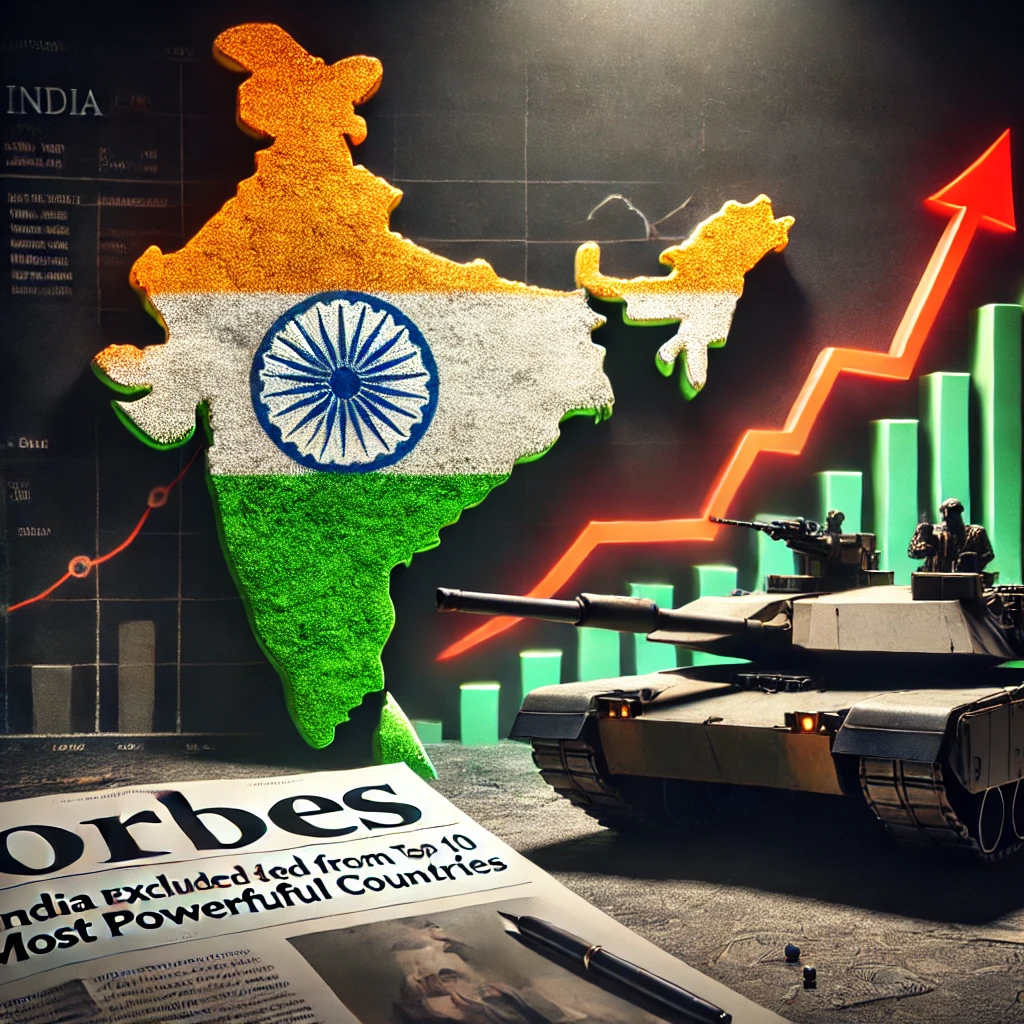
In a surprising development, India has not been included in Forbes’ latest ranking of the world’s top 10 most powerful countries, igniting widespread discussion about the nation’s global standing and the metrics used to assess power.
Given India’s global strength, its exclusion from this list is undoubtedly a topic of debate. India has one of the largest armies in the world, with an advanced missile program and nuclear capabilities. India has rapidly become the world’s fifth-largest economy and is projected to reach the third position in the coming years. India plays an active role on international platforms, has chaired the G20, and holds influential positions in organizations like BRICS and QUAD.
In this context, it is natural to question Forbes’ ranking methodology. It is possible that the criteria used in this ranking placed more emphasis on factors that do not fully reflect India’s true strength.
This could also serve as an opportunity for India to further strengthen its global image and focus more on its military and economic strategies.
India’s removal from Forbes’ latest ranking of the top 10 most powerful countries carries significant political implications, both domestically and internationally. The development raises questions about India’s geopolitical influence, economic trajectory, and military positioning. .
“The recently published list by Forbes, dated February 1, 2025, identifies the United States, China, Russia, the United Kingdom, Germany, South Korea, France, Japan, Saudi Arabia, and Israel as the top 10 most powerful nations. Notably, India, which has often been featured in such rankings, is conspicuously absent.”
Forbes’ rankings are based on a methodology developed in collaboration with US News & World Report, the BAV Group, and researchers from the Wharton School of the University of Pennsylvania. The assessment considers five equally weighted attributes: leadership, economic influence, political influence, strong international alliances, and a robust military. Historically, India has been recognized as a significant global player, owing to its substantial economic growth, strategic geopolitical position, and considerable military capabilities. In previous years, India has featured in various global power rankings, reflecting its rising influence on the world stage.
The exclusion has prompted a range of reactions from experts, policymakers, and the public. Some analysts suggest that the criteria used may not fully capture India’s multifaceted strengths. For instance, while India’s GDP is substantial, its per capita income remains lower compared to other nations in the top 10, which could impact perceptions of economic influence.
Additionally, India’s military, while large in terms of personnel, faces challenges in modernization and technological advancement, potentially affecting its ranking in terms of military strength. Political influence and international alliances are also areas where India is continually evolving, with efforts to strengthen ties with various countries and participate actively in global forums.
“As of now, there has been no official statement from the Indian government regarding the exclusion. However, it is anticipated that policymakers will review the factors contributing to this development and strategize on enhancing India’s standing in future assessments.”
The news has sparked discussions among citizens, with many expressing surprise and disappointment. Social media platforms are abuzz with debates on the criteria used and the broader implications for India’s global image.
India’s exclusion from the top 10 most powerful countries list serves as a moment of reflection for the nation. It underscores the importance of addressing areas that may be hindering its perception as a global power, such as economic disparities, military modernization, and diplomatic engagements.
While rankings are indicative, they do not encapsulate the complete picture of a nation’s capabilities and potential. India’s trajectory remains upward, with ongoing initiatives aimed at economic reform, infrastructure development, and strengthening international partnerships.
As the global landscape continues to evolve, India’s role and influence are poised to expand, potentially leading to its reinstatement in future power rankings.
“This exclusion could become a major talking point in political debates. The opposition may use it to criticize the ruling government, arguing that India’s global standing has diminished due to ineffective foreign policy, economic slowdowns, or strategic miscalculations.”
BJP is likely to counter these criticisms by discrediting the ranking criteria or emphasizing India’s real-world power, irrespective of such lists. The government may also highlight its diplomatic successes, infrastructure growth, and defense advancements to reassure the public.
India’s exclusion may trigger a wave of nationalist sentiment, with calls for strengthening military capabilities, economic self-reliance, and diplomatic assertiveness. Political leaders may use this as an opportunity to rally citizens around the idea of a “stronger India” and push for policy changes.
“Forbes’ ranking considers economic and military power as crucial factors. If India has been excluded due to shortcomings in these areas, it could impact foreign investors’ confidence and military deterrence perceptions. This might push India to expedite defense modernization, economic reforms, and global trade agreements.”


