


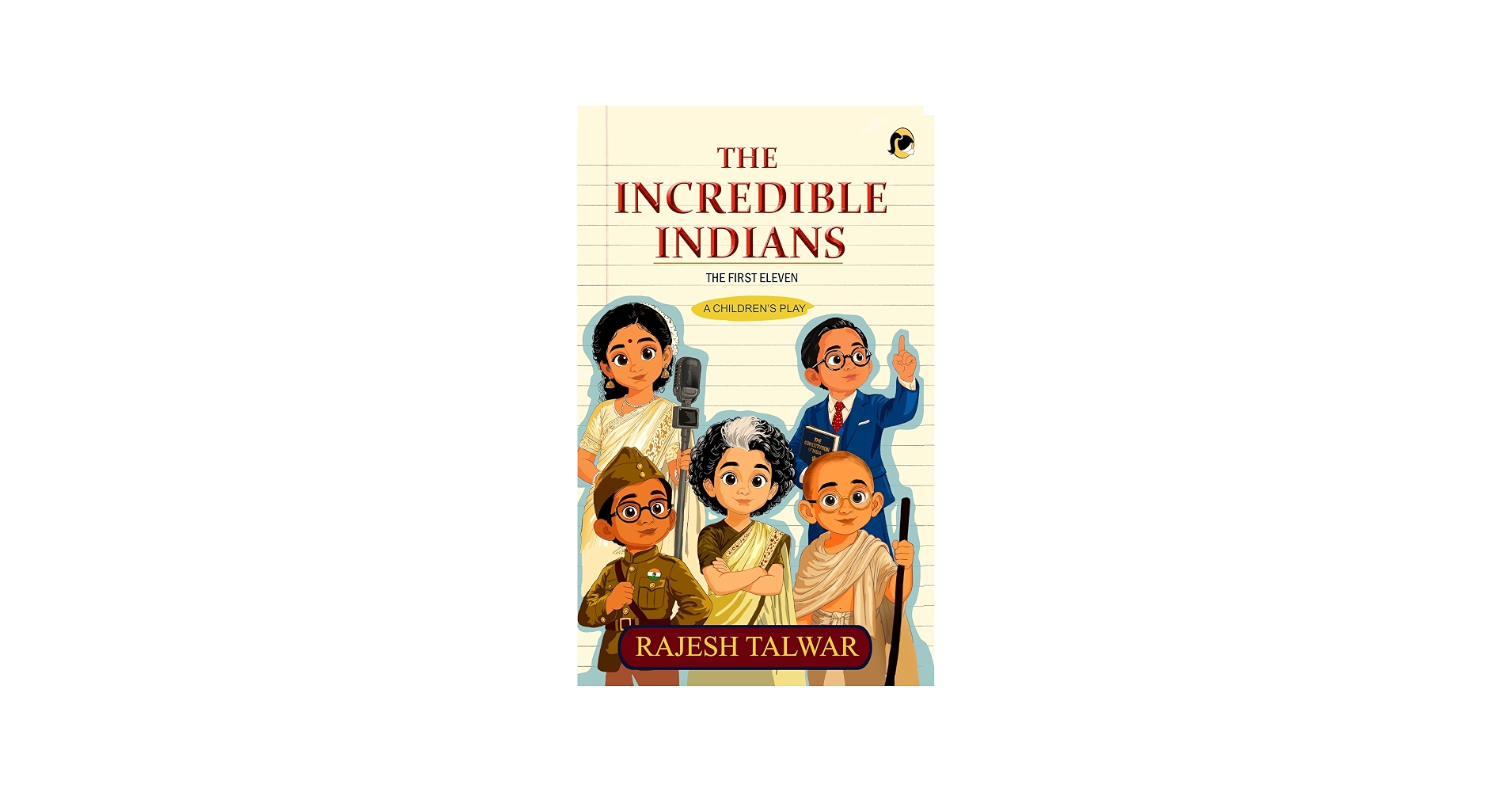
About the book
Rajesh Talwar’s book “The Incredible Indians” is an engaging children’s play. Eleven of India’s most iconic personalities are brought vividly to life through the eyes of The Creative Five, a group of schoolchildren working on a class project. Rather than simply recounting facts, the children dramatise the struggles, setbacks and triumphs that shaped these remarkable individuals at different stages of their lives.
Readers will witness Dr B R Ambedkar confronting discrimination in his childhood, M S Dhoni overcoming obstacles in his youth, and Field Marshal Sam Manekshaw and Prime Minister Indira Gandhi grappling with the challenges of leadership.
They will discover how Mohammad Rafi’s early experiences helped shape one of India’s greatest singers, and how Ratan Tata’s compassion and generosity defined one of the country’s most respected industrialists. The play also explores the childhood of legendary singer Asha Bhosle. It follows President A P J Abdul Kalam through key moments in his life, including one of his happiest memories.
The collection pays tribute to national icons such as Mahatma Gandhi, Subhash Chandra Bose and Babasaheb Ambedkar, whose contributions were instrumental in India’s freedom struggle. It also celebrates inspirational figures, including Amitabh Bachchan and Asha Bhosle, whose achievements continue to resonate across generations.
Together, these eleven stories reveal that greatness is forged through perseverance, courage and conviction. More than a celebration of extraordinary lives, this play offers young readers an inspiring glimpse into the people who helped shape modern India and left an enduring legacy.
About the author
Rajesh Talwar is an internationally acclaimed and award-winning author whose body of work encompasses 45 books across fiction, non-fiction, plays, children’s literature and self-help. His writing explores a broad spectrum of themes, including social justice, law, culture, human rights, terrorism, aesthetics, and the complexities of Indian society and the legal system. While his plays range from contemporary socio-political realities to historical retellings, his novels examine issues as diverse as identity, conflict and justice.
Among his notable non-fiction works are Courting Injustice: The Nirbhaya Case and Its Aftermath (Hay House, 2013) and The Mahatma’s Manifesto: A Critique of Hind Swaraj (Om Books International, 2025). His acclaimed children’s books include The Bearded Prince, The Three Greens and The Boy Who Wrote a Constitution. His latest release, Bollywood, Hollywood and the Future of World Cinema, explores the evolving intersections of global cinema and cultural storytelling.
Beyond his literary career, Talwar served in senior positions with the United Nations across three continents over a period of two decades. He has studied at some of the world’s leading institutions, including Harvard University, the University of Cambridge, the University of Oxford, the University of Nottingham, and Hindu College, University of Delhi. He also trained in filmmaking at the London Film Academy and is currently co-directing Smoky Sky Songs, an AI-generated animated feature film. In recognition of his contributions to literature, public policy and social issues, Talwar was recently honoured with the India–UK Achievers Award 2026 at the British Parliament. He also received the International Alumni Laureate Award from the University of Nottingham.
EXCERPTS:
(July, 1971. New Delhi. The Cabinet Room near the Indian Prime Minister’s Office at South Block, Secretariat Building. There is a conference table with high-backed chairs. There is little decoration in the room as it is meant for serious business. Enter INDIRA GANDHI, followed by SAM MANEKSHAW, and Defence Minister JAGJIVAN RAM.)
Indira Gandhi: Come in, gentlemen. Please be seated. As I mentioned, we have an extremely important issue to discuss today.
Jagjivan Ram: Yes, Madam.
Sam Manekshaw: Yes, Madam Prime Minister.
Indira Gandhi: Foreign Minister Swaran Singh should also be with us soon.
(There is a knock on the door.)
Indira Gandhi: Come in!
(Enter Foreign Minister SWARAN SINGH.)
Indira Gandhi: Welcome, Foreign Minister.
Swaran Singh: Apologies for being late, Madam.
Indira Gandhi: No problem. Please be seated. (Pause.) Gentlemen, as you know, we have very powerful enemies. Our neighbour Pakistan is at war with itself. What was known till today as East Pakistan intends to break away.
Swaran Singh: And the reason, Madam, is…
Indira Gandhi: And the reason, Sardar Swaran Singh, is clear. Not long ago, the Pakistanis held an election and the Awami League, a party led by Sheikh Mujibur Rehman, won th elections with a clear majority. The generals in West Pakistan did not like the idea of a Bengali from East Pakistan becoming the Prime Minister of their country, because till now, from 1947 onwards, it has been West Pakistan that has been ruling.
Jagjivan Ram: (nodding) And therefore, I understand the Bengalis wish to separate and have their own nation which they wish to call Bangladesh. They have the Mukti Bahini that is fighting for independence.
Indira Gandhi: Yes, Defence Minister. Under the circumstances, that demand appears completely fair and legitimate to me. (She turns to SAM MANEKSHAW.) What do you think, General?
Sam Manekshaw: So it would appear to me too, Prime Minister – even though I am no expert in political matters.
Indira Gandhi: In that case, General, let’s do something about it.
Sam Manekshaw: What would you suggest, Prime Minister?
Indira Gandhi: We need to make sure that there is no refugee crisis at our borders. (Pause.) We also need to make sure that there are no rapes and no wanton killing of innocents by the Pakistani military.
Sam Manekshaw: With respect, Madam, in order to ensure that, we would have to enter the territory and go to war with Pakistan.
Indira Gandhi: (resolute) If it means war, then so be it. Let there be war. (Pause.) Unless, General, you are of the view that now is not a good time.
Sam Manekshaw: You are very astute, Madam. (Pause.) It is my belief that right now it is not a good time. We need to wait.
Indira Gandhi: There is never ever a perfect time to go to war, General, but let me know what are the reasons why you believe we should wait.
Sam Manekshaw: Right now, Madam, it is the harvest season. The roads will be full of farmers taking the grain to the markets. On the other hand, I need a clean and clear route for my men to march into East Pakistan. If we don’t allow the farmers to carry their produce, it could lead to food shortages. The Minister of Agriculture may need to be consulted in this regard.
Indira Gandhi: You make a fair point, General. We will seek the minister’s input in this regard. (Pause.) But is there any other reason?
Sam Manekshaw: Yes, there is, Madam Prime Minister. We are now approaching the monsoon season. This is clearly the worst time in the year for my men to be entering East Pakistan. The roads will all be water logged. It will be a nightmare for my forces to try and enter.
Indira Gandhi: (thoughtfully) Thank you, General, for another excellent point. (Pause.) I judge from your expression that there may be yet other considerations.
Sam Manekshaw: (smiling) There is indeed, Prime Minister.
Indira Gandhi: Please enlighten us.
Sam Manekshaw: At this time of the year the snows are melting in the upper reaches of the Himalayas that separate us from China. Now as the Foreign Minister well knows, Pakistan and China are allies. Now if the Chinese were to launch an offensive in support of Pakistan, I fear that we would then have to fight a war on two fronts.
Swaran Singh: (leaning forward) Is it your view, General, that the Chinese could threaten us in this manner in support of Pakistan?
Sam Manekshaw: I believe that they could very well do so, Foreign Minister. Whether they will actually do so is for you and the defence minister to assess. I am merely pointing to a possibility and a risk. (Pause.) I look forward to your advice in this regard.
Indira Gandhi: This is all food for thought. (Pause.) Gentlemen, let us all reconvene in the afternoon.
Swaran Singh: (standing up) Thank you, Madam.
Jagjivan Ram: (also standing up) Thank you, Prime Minister ji.
Indira Gandhi: Thank you, gentlemen. (She turns to SAM MANEKSHAW.) General, could you please stay back.
(Exit JAGJIVAN RAM and SARDAR SWARAN SINGH.)