


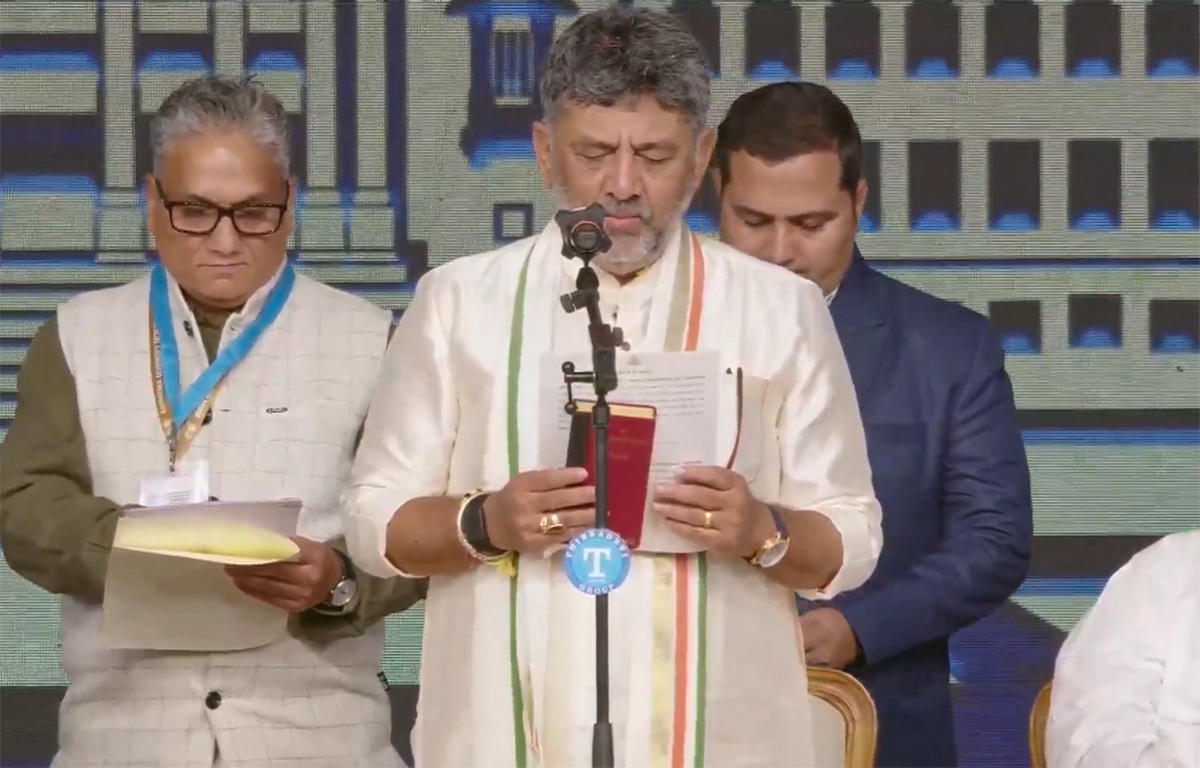
On June 3, 2026, Doddalahalli Kempegowda Shivakumar, better known as D K Shivakumar or DKS, finally climbed the steps of the Vidhana Soudha to take the oath as the 18th chief minister of Karnataka.
On the face of it, it was a textbook transition. In the presence of Congress stalwarts Rahul Gandhi and Mallikarjun Kharge, the ceremony sent a clear signal to Siddaramaiah’s camp that Shivakumar’s ascent had the blessings of the high command. The Congress leadership hoped the mid-term power-sharing formula would inject fresh energy into the party ahead of the 2028 Assembly elections.
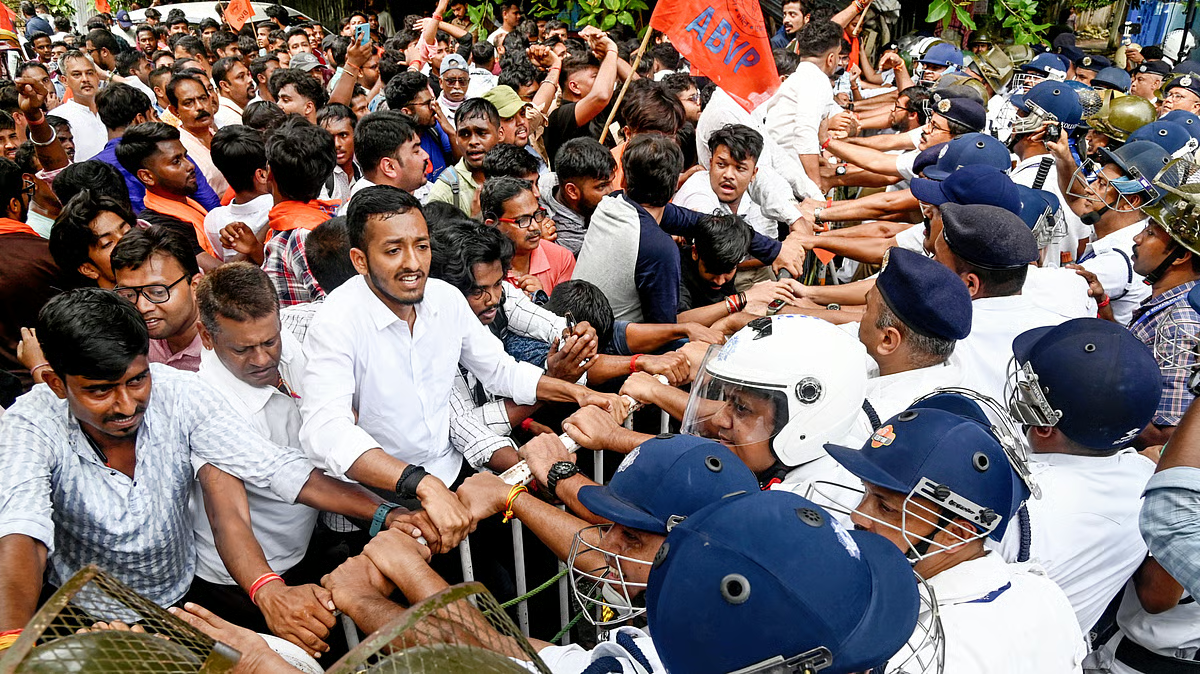
Yet even before Rahul Gandhi and the senior leadership returned to Delhi, the celebrations had begun giving way to dissent. The first cracks appeared in cabinet formation.
>> Battle for Bengaluru
To understand how deep the fault lines run, one needs to look no further than Bengaluru. In Karnataka politics, control over the capital city remains the ultimate prize. It means influence over infrastructure spending, real-estate clearances and immense corporate leverage.
Veteran leader and eight-time MLA Ramalinga Reddy has long regarded Bengaluru as his political turf. Being denied the Bengaluru in-charge ministership became a direct provocation. Reddy claimed that Shivakumar explicitly promised him the portfolio of Bengaluru development during the transition negotiations. Instead, he was shifted to the Major and Medium Irrigation Ministry, while Krishna Byre Gowda was handed the city development portfolio.
Even that arrangement appeared incomplete. The most powerful levers of urban development—the Bengaluru Development Authority (BDA) and Bengaluru Metropolitan Region Development Authority (BMRDA)—remained under Shivakumar’s control. Displeasure was visible as Krishna Byre Gowda reportedly delayed taking charge of his portfolio for several days after the oath-taking ceremony.
The rebellion escalated quickly. Within twenty-four hours of the swearing-in, an angry Ramalinga Reddy tendered his resignation from the cabinet, plunging a two-day-old government into crisis.
What followed was frantic firefighting. A late-night meeting involving Shivakumar and AICC General Secretary Randeep Singh Surjewala eventually persuaded Reddy to withdraw his resignation. But few within the party believe the issue has been settled.
By publicly acknowledging that the high command’s decision could not be altered, Shivakumar exposed the limits of his own authority. Reddy’s open defiance sent a message across the party: legislators with sufficient political weight can still arm-twist the leadership.
Others quickly took note. Zameer Ahmed’s supporters protested in Bengaluru, demanding cabinet representation. Similar rumblings emerged from several quarters, including BDA chairman N A Haris and senior leaders such as H K Patil and R V Deshpande.
H K Patil openly backed Reddy, describing his resignation as a “massive wake-up call” and urging the leadership to resolve the matter fairly.
The discontent was not confined to one faction. Dinesh Gundu Rao, widely expected to be part of the first ministry, was left out. His wife publicly questioned the selection criteria on social media, asking whether merit, performance, competence, loyalty and integrity still mattered in politics.
The laddus prepared by Shivakumar’s supporters to celebrate his elevation suddenly tasted bitter. The honeymoon had not survived the first weekend.
Many Congress insiders believe the roots of the problem lie in Delhi. The initial list of fourteen ministers was largely shaped by AICC leaders Randeep Surjewala and K C Venugopal. Shivakumar found himself carrying the political burden for decisions that many legislators viewed as centrally imposed.
Three visits by Rahul Gandhi within a week helped contain some of the damage. Sources indicate that Rahul personally spoke to several disgruntled leaders. Yet the need for repeated intervention from Delhi highlighted a larger problem. Instead of allowing the new chief minister sufficient room to accommodate competing regional interests, the high command tightly scripted the transition.
The result was predictable. Large sections of the Old Mysuru region, the traditional Congress stronghold that played a crucial role in the party’s 2023 victory, felt overlooked. Senior leaders from Mysuru, Mandya and Chamarajanagar found themselves excluded from the initial power structure.
Kolar veteran K.H. Muniyappa openly expressed dissatisfaction after being assigned the Food and Civil Supplies portfolio instead of Social Welfare. Reports suggest that Rahul Gandhi personally intervened to calm the situation.
While Delhi may view these interventions as successful crisis management, depending on the high command to settle routine portfolio disputes is hardly a sustainable model of governance.
>> Siddaramaiah’s Shadow Looms Large
If cabinet formation exposed the first fissures, the second challenge comes from a familiar source: Siddaramaiah. Despite stepping down under the power-sharing arrangement, the former Chief Minister remains a formidable political force.
When this correspondent visited Siddaramaiah’s residence after Shivakumar’s swearing-in, the scene resembled an alternative power centre. Ministers, former ministers, MLAs, disappointed aspirants and party workers queued for hours seeking an audience.
Lobbying was intense. Many within the Congress increasingly believe that political ambitions in Karnataka still require Siddaramaiah’s blessings alongside approval from Shivakumar and the high command. This was precisely the scenario many observers had predicted: the emergence of dual power centres.
While Shivakumar occupies the chief minister’s chair, Siddaramaiah remains the undisputed mass leader of the AHINDA coalition of minorities, backward classes and Dalits that forms the backbone of the Congress vote base.
The consequence is an uncomfortable reality for the new Chief Minister. Shivakumar may control the government machinery and key departments, but he continues to operate under the long political shadow of his predecessor. For Shivakumar, the runway to establish authority is dangerously short.
On June 18, Karnataka heads into crucial elections to the Rajya Sabha and the Legislative Council. The cabinet expansion expected before then will determine whether the Chief Minister can successfully balance competing ambitions or whether fresh rebellions erupt.
The first round of discontent was managed largely through the authority of the Congress high command. But if Shivakumar continues to rely on Delhi to resolve every internal dispute, he risks weakening the tough political image that helped him reach the state’s highest office.
Shivakumar built his career as the Congress party’s ultimate troubleshooter—the man trusted to rescue governments, protect legislators and navigate political crises.
Today, however, the crisis is inside his own house. Winning the chief ministership was supposed to end a long political struggle. Instead, it may have marked the beginning of a far more difficult one. How Shivakumar handles the turbulence leading up to June 18 will determine whether his tenure becomes a decisive chapter in Karnataka politics or a prolonged exercise in managing factional warfare.
For now, one thing is clear: Shivakumar may have won the throne, but the battle for control of Karnataka Congress is far from over.
(Vijay Grover is a Karnataka-based journalist and political analyst)