






One image defined Mamata Banerjee’s rise to power. Injured and wheelchair-bound during the 2021 election campaign, she raised a clenched fist before thousands of supporters and declared herself a Royal Bengal Tiger. It captured the carefully crafted paradox that defined her politics: fierce enough to take on formidable opponents, yet familiar enough to remain simply “Didi”, Bengal’s elder sister. That image helped deliver three consecutive electoral victories. By 2026, however, it was no longer enough to sustain her government.
Much of the commentary on the BJP’s victory has focused on familiar explanations, including anti-incumbency, corruption scandals, Hindutva and Narendra Modi’s enduring popularity. Each explains part of the outcome. Yet the election also revealed a deeper transformation in Indian politics: the victory of organisational politics over personalistic politics.
For nearly fifteen years, Mamata Banerjee and the Trinamool Congress were almost indistinguishable. The party’s identity was inseparable from hers. Welfare schemes carried her political imprint, campaign slogans revolved around her persona, and governance itself was narrated through the language of kinship. She was not merely the Chief Minister but “Didi”, whose legitimacy rested on intimacy rather than institutional authority. The slogans “Ma, Mati, Manush” and “Bangla Nijer Meyekei Chai” transformed electoral competition into a relationship between family and protector rather than between citizen and state.
This strategy proved remarkably successful while Mamata remained the insurgent challenging the Left and resisting the BJP. But personalistic leadership contains an inherent vulnerability. When political authority is concentrated in one individual, political failures become personal failures. Recruitment scandals, corruption allegations and accusations of political violence did not merely damage the Trinamool government’s administrative credibility; they also weakened the emotional bond between Mamata and ordinary Bengalis. A party built around a single leader struggles when that leader’s credibility comes under strain because there are few independent institutions capable of absorbing public dissatisfaction.
Narendra Modi represents a different model of political leadership. Like Mamata, he is an immensely charismatic leader whose personal image dominates election campaigns. Yet Modi’s charisma operates within a highly institutionalised political machine. The BJP is not simply Modi’s party. It is supported by an extensive organisational ecosystem stretching from the RSS to thousands of booth-level workers, ideological affiliates, social organisations and digital volunteers. Electoral mobilisation does not depend solely on Modi’s popularity but on an organisation capable of translating leadership into votes across villages, towns and urban neighbourhoods.
This distinction proved decisive in West Bengal. While Mamata increasingly personalised governance, the BJP steadily institutionalised its presence in the state. Over the past decade, it invested heavily in building district committees, recruiting local leaders, cultivating defectors from rival parties, strengthening booth management and expanding ideological networks beyond election campaigns. By 2026, the BJP had become far more than an external challenger directed from its national leadership. It had developed a durable organisational presence capable of contesting Bengal constituency by constituency.
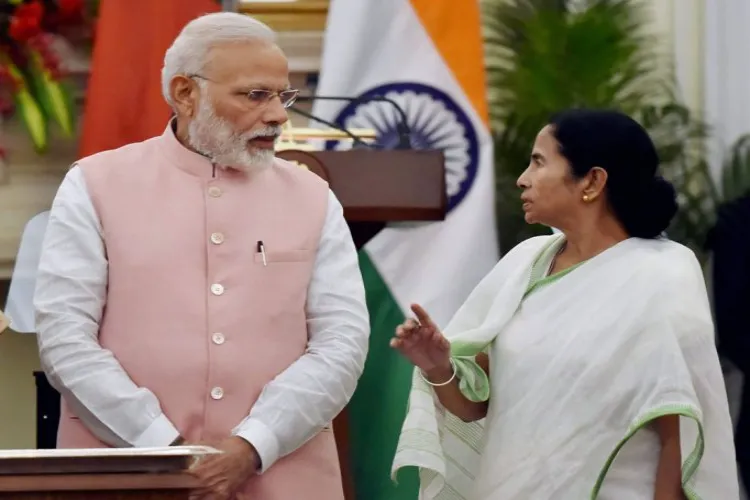
The contrast reflects two different understandings of political power. Mamata relied on relational authority. Her politics rested on trust, proximity and emotional connection with voters. Modi relied on organisational authority. His leadership remains highly personalised, but it is embedded within institutions that outlive individual election cycles. Where Mamata asked voters to trust her, Modi asked them to trust a movement, a party and a national project.
Gender also forms an important part of this story. Mamata consciously built her political identity around the language of kinship. As “Didi”, she transformed qualities traditionally coded as feminine – care, sacrifice and accessibility – into political strength. Modi’s leadership projects a different register: discipline, purpose, sacrifice and national mission. Yet framing the election primarily as a contest between contrasting leadership styles risks overlooking the more important institutional lesson. Personalised leadership is not inherently weaker than organisational leadership; it becomes vulnerable when charisma substitutes for party-building rather than reinforcing it.
West Bengal therefore offers a broader lesson for Indian politics. Charismatic leaders might win elections, but enduring political dominance increasingly depends on organisational capacity. The BJP’s victory was not simply Narendra Modi defeating Mamata Banerjee. It was an organisational ecosystem defeating a political movement that had become overly dependent on the authority of a single leader.
As incumbency eroded Mamata Banerjee’s personal appeal, the Trinamool Congress lacked sufficiently institutionalised party structures to absorb the political costs of anti-incumbency. Although Abhishek Banerjee increasingly assumed responsibility for the party’s organisation and succession, the transition exposed the limits of a party that remained overwhelmingly centred on Mamata’s personal legitimacy. Unlike the BJP, whose organisational strength rests on a broad cadre-based structure and layered leadership, the TMC struggled to translate dynastic succession into organisational consolidation. The BJP’s advantage lay not merely in Narendra Modi’s popularity but in a party apparatus that continued to expand irrespective of individual leaders.
The 2026 election might ultimately be remembered less as the defeat of “Didi” than as the moment Indian politics demonstrated that charisma alone is no longer enough. In an era of permanent campaigning, the leaders who endure will be those whose authority is reinforced, rather than replaced, by strong political organisations. More than personality or even ideology, that explains why Modi’s model prevailed in Bengal.
The lesson from Bengal extends well beyond one state or one election. It suggests that Indian electoral politics is entering a phase in which party organisation increasingly outweighs personality, and where disciplined party structures, cadre networks and institutional depth matter more than even the strongest individual leader. Charisma might still win campaigns, but institutional organisation is increasingly winning elections. If the 2026 West Bengal verdict tells us anything, it is that India’s evolving electoral landscape is witnessing the gradual triumph of organisational politics over personalistic politics, a shift that could define the next phase of democratic party competition.
(Dr Garima Sarkar is assistant professor of Comparative Politics and Public Policy and assistant dean of International Collaborations at Jindal School of International Affairs, O.P. Jindal Global University. Mathilde Stanier, a researcher at Deakin University, Australia and research intern (CARE) at Jindal School of International Affairs, O.P. Jindal Global University)


