



South Asia has witnessed four youth-driven political movements since the Covid-19 pandemic subsided. Sri Lanka’s Aragalaya forced out the president amid economic collapse in 2022. Bangladesh’s 2024 student movement toppled the 15-year-old Awami League government. Nepal’s September 2025 Gen Z uprising, ignited by a social-media ban, saw protesters burn down Parliament and led to the installation of an interim government within five days.
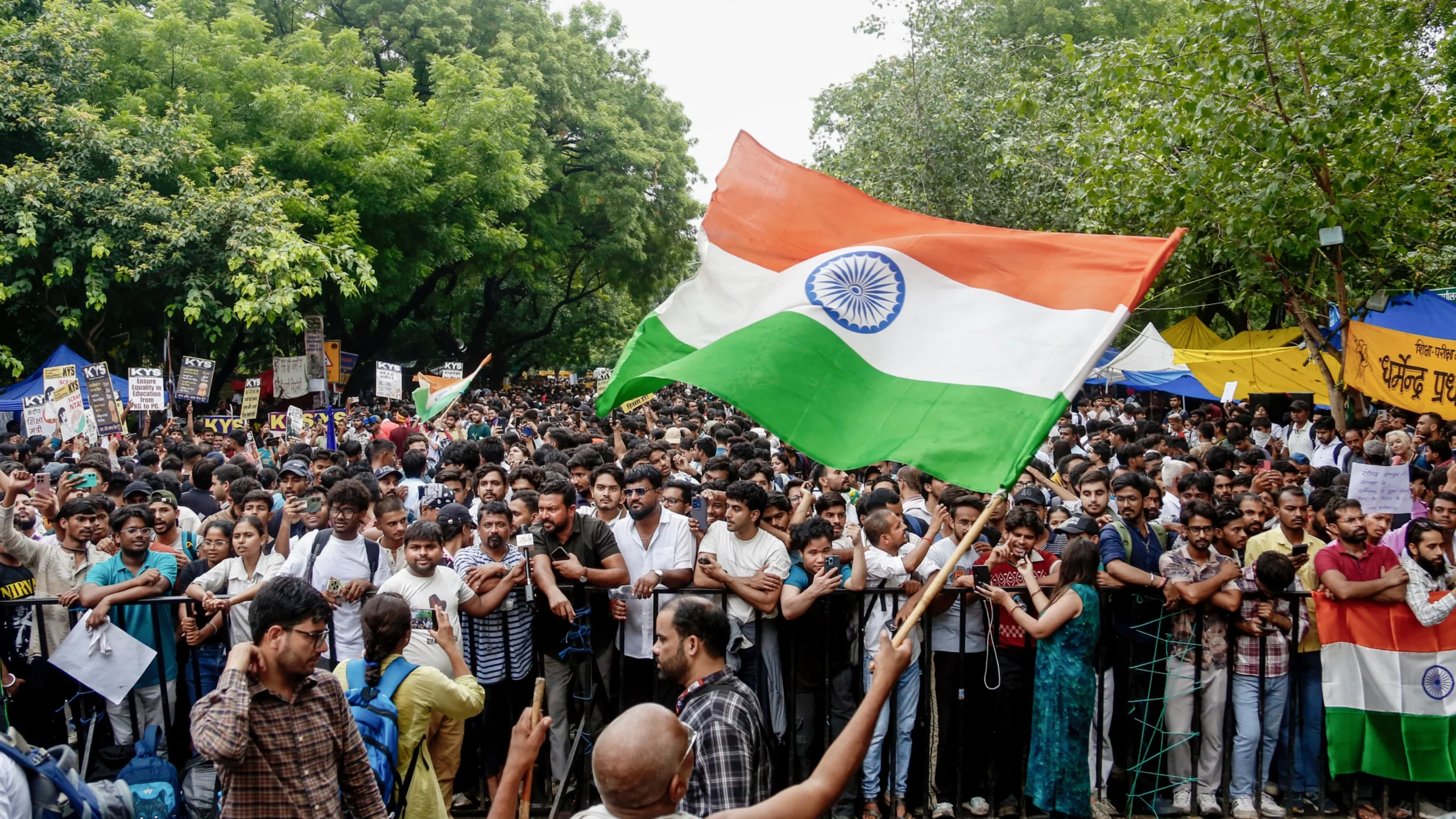
A year later, in June 2026, a youth mobilisation operating under the satirical banner of the Cockroach Janta Party (CJP) emerged at New Delhi’s Jantar Mantar, driven by widespread student outrage over NEET-UG paper leaks and CBSE marking irregularities. It escalated sharply following Sonam Wangchuk’s hunger strike and subsequent hospitalisation. Thereafter, a “March to Parliament” on July 20 turned violent in central Delhi, leaving 118 security officers and 60 protesters injured. For four days, street agitation and clashes spilled into multiple urban centres across the country, finally subsiding when Union Education Minister Dharmendra Pradhan submitted his resignation on July 25. This sudden escalation and continued agitation raise a critical question: is India slowly moving down the same trajectory?
The short answer is no. However, a far more academic perspective emerges through the analytical model of mobilisation and civil conflict formulated by Barbara Harff and Ted Robert Gurr in Ethnic Politics in World Politics (2nd ed., 2004), a foundational text in the Dilemmas in World Politics series. Their framework separates three analytically distinct layers: discrimination and group identity, classified as prerequisites, which generate grievance; the political environment, group cohesion and state response, which constitute the facilitating context that transitions grievance to mobilisation; and economic conditions, external support, state capacity and discrete events that convert latent anger into civil unrest, the triggers. My earlier work applying this triad, with the added lens of crosscutting versus reinforcing cleavages, to South Asia’s ethnic conflicts from 1948 to 2013 found that reinforcing marginalisation across religion, the economy and culture leads to more violence than any single cleavage in isolation (Das, 2019). The study also found that religious and/or economic marginalisation alone can increase the probability of violence in some cases. The India 2026 case, however, does not map cleanly onto that ethnic template, and the mismatch itself is analytically useful.
Why Youth Anger Spreads
As in Bangladesh and Nepal, the prerequisite originated as a governance demand in India. Youth outrage over paper leaks and administrative failures in competitive national examinations, along with suicides linked to examination paper leaks and mismanagement, fuelled calls for the resignation of Union Education Minister Dharmendra Pradhan, as reported by the BBC. However, as student protests expanded, the original peaceful sit-in underwent a structural shift towards violent stoning, lynching and vandalism. Opposition political factions, left-wing student unions and sections of the intelligentsia co-opted the movement, reorienting it from administrative reform towards an explicit anti-Bharatiya Janata Party campaign. Core educational demands were diluted by unrelated ideological banners, including caste representation, gender equity and opposition to the aboration of Article 370, a highly sensitive matter for Indian national security. While expanding a protest platform widens numerical participation, absorbing polarising political agendas dilutes core governance grievances and fragments grassroots cohesion, a dynamic that is reflected in the CJP’s student-led movement.
Why India Holds
The Indian case diverges sharply from Sri Lanka, Nepal and Bangladesh at this stage. Those states had facilitating weaknesses, including heavy remittance dependence, thin fiscal capacity and, in Nepal’s case, a leaderless, digitally organised opposition operation against a comparatively fragile security and party apparatus. But consolidated democracies possess high structural absorbency, enabling them to accommodate non-violent civic protest without risking regime breakdown. India’s institutional depth, larger and more diversified economy, and entrenched multi-party competition constitute exactly the kind of state-capacity buffer that Harff and Gurr (2004) identify as a facilitating context for insurgency risk. Its presence here, however, cuts against the prospect of a Nepal- or Bangladesh-style collapse.
The empirical validity of this absorbency hypothesis in India is illustrated by data from the Armed Conflict Location & Event Data Project (ACLED). An analysis of the aggregated ACLED data reveals a strong capacity for civic mobilisation in India. In fact, demonstration events surged from 10,642 in 2016 to 17,949 in 2019, reaching an all-time peak of 22,130 in 2024 and remaining elevated at 20,600 in 2025. However, a comparative evaluation against political violence and civilian casualty metrics demonstrates a stark contrast between civic mobilisation and violent conflict. Political violence events peaked at 5,361 in 2019 and subsequently followed a downward, contained curve, dropping to 2,123 in 2021 and settling at 2,954 in 2025. Notably, 2019 and 2024 were the years of national parliamentary elections in the country.
This divergence, in which public demonstrations surge while political violence and civilian fatalities remain contained, offers robust empirical evidence of democratic resilience. In the state-capacity literature, political scientists argue that institutionalised states maintain political order not by suppressing public voice, but by possessing the administrative capacity to contain violent escalation while absorbing peaceful protest (Huntington, 1968; Besley and Persson, 2011; Acemoglu and Robinson, 2012). Empirically, in the Indian context, high demonstration volumes reflect a functional democratic space where citizens express grievances, whereas low fatality rates suggest state capacity for conflict containment.
This institutional flexibility is clearly reflected in the state’s dual-track mitigation strategy. To de-escalate tensions, the Indian government initiated formal mediation through Union Health Minister J.P. Nadda, alongside multi-party legislative appeals to activist Sonam Wangchuk to conclude his fast. However, following an escalation of mob violence on the night of July 22, the state rapidly deployed Central Reserve Police Force (CRPF) battalions to the protest site in New Delhi. This dual approach exemplified the way high-capacity states combine democratic absorbency with targeted coercive containment to prevent widespread civil unrest.
Whereas Bangladeshi Prime Minister Sheikh Hasina authorised lethal force against student demonstrators in 2024, Indian Prime Minister Narendra Modi articulated a normative framework of democratic engagement during his parliamentary address, highlighting a stark regional contrast in state-response repertoires. Reinforcing this responsiveness, he took to social media, sharing video messages on Instagram, and announced the creation of fast-track courts to punish exam-leak offenders and safeguard student futures on X on July 23. Two days later, amid ongoing talks, demonstrations and linked arrests across several states, Union Education Minister Dharmendra Pradhan resigned, providing a key political safety valve. This combination of executive discourse and legal redress illustrates how state capacity relies on democratic absorbency and a dual-track mitigation strategy to resolve underlying grievances.
Strategic Imperatives and Key Takeaways
From an electoral standpoint, the Union government is heavily insulated against short-term political shocks. Holding 312 of the 543 Lok Sabha seats and governing 21 of 28 states, the NDA coalition enjoys an overwhelming institutional footprint. With national elections not due until 2029, this electoral buffer allowed the state to absorb political unrest and deploy its dual-track mitigation strategy without facing legislative vulnerability during the CJP-led movement. Yet, while state capacity ensured institutional resilience against civil conflict, the soft-power costs became non-trivial. Extensive global coverage surrounding internationally recognised activists like Sonam Wangchuk has inflicted some damage on Prime Minister Modi’s Vishwaguru image. While high state capacity prevented street agitation from threatening regime stability in the world’s fourth-largest economy, prompt internal party recalibration and systemic governance reform will be essential for preserving India’s international prestige.
Nepal’s trigger was a social-media ban, while Bangladesh’s was a quota-reservation ruling. India’s sequence included allegations of corruption and irregularities in the education system, a youth campaign and a hunger strike, all culminating in violent clashes in the capital, showing the same pattern of an initially narrow grievance being widened by dramatic escalatory events in the Indian subcontinent. However, assessing the political condition through the lens of conflict studies and state-capacity literature reveals that structural and institutional conditions in India are not conducive to civil conflict or a regional domino effect.