



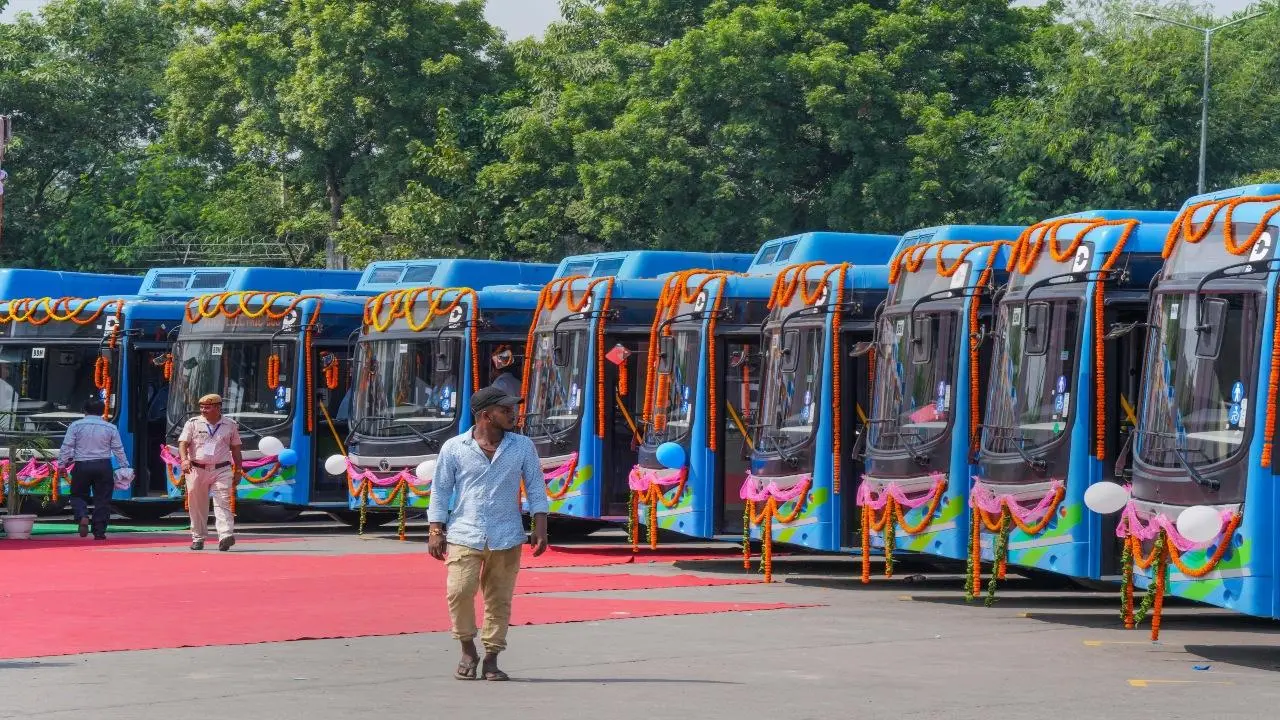
India’s electric commercial vehicle sector has reached a moment of inflection. After years of pilots and early-adopter risk-taking, national programmes, notably FAME-II, PM E-DRIVE and PM E-Bus initiatives, have created tangible momentum. Grants under FAME-II supported 6,862 e-buses; PM E-DRIVE extends support to 14,028 e-buses and 5,643 e-trucks; and some 13,800 e-buses have already been allocated for phased deployment in major cities. Yet momentum alone will not deliver the scale required to decarbonise road freight and bus transport. To convert this promising foundation into a mass transition, policies must now address three stubborn bottlenecks: affordable finance, skilled manpower and easier operating conditions for commercial fleets.
Why the commercial segment matters
Commercial buses and trucks account for a disproportionate share of urban and intercity transport emissions — around 14 per cent of India’s GHG emissions. Electrifying these fleets delivers outsized benefits: lower lifecycle emissions, reduced operating costs, quieter cities and improved air quality. Unlike personal two- and three-wheelers, the commercial sector offers predictable routes, centralised depots and concentrated charging needs. These characteristics make electrification operationally attractive. The challenge is not technical feasibility; in fact, e-buses and e-trucks exhibit strong lifecycle economics. The problem is transitional: high upfront capital costs, short, high-interest loan tenors and the “valley of death” in the first four to five years of operation.
Targeted finance to bridge the gap
Lower-cost finance is the single most powerful lever to accelerate adoption. Interest subvention, a time-bound reduction in borrowing costs of 3–5 per cent for loans used to buy electric buses, trucks and charging infrastructure, would materially improve project viability. Unlike a one-time capital subsidy, interest subvention is disbursed over the loan period and only to borrowers who actually operate the assets, thereby aligning fiscal outlay with deployment performance and reducing the risk of misuse.
Importantly, this support should be extended to private operators who invested in e-buses over the last five years. Early private adopters assumed outsized risk; granting them parity preserves fairness and prevents penalising pioneers. Coupling subvention with compliance with safety and performance standards and linking benefits to domestic value addition under “Make in India” will also strengthen the manufacturing ecosystem while supporting demand.
Reclassifying EV lending as infrastructure
A decisive, system-level intervention would be to classify loans for electric buses, trucks, charging depots and battery-replacement infrastructure as “infrastructure” under the Harmonised List prepared by the Department of Economic Affairs. Infrastructure status unlocks multiple advantages: access to infrastructure-focused lending windows, External Commercial Borrowings on favourable terms, long-tenor funds from pension and insurance investors, and eligibility to borrow from institutions such as IIFCL. It also opens the door for the Viability Gap Funding (VGF) mechanism for public-private partnerships, which could de-risk charging network investments currently hindered by uncertain utilisation.
Infrastructure designation sends a sovereign signal that the EV ecosystem is strategic and long-term. That signal matters for credit ratings, the willingness of global ESG funds to invest, and lowering perceived risk premiums across the financing stack. Given India’s target of 30% EV sales by 2030, formalising a clear, comprehensive EV infrastructure classification, covering manufacturing, fleet operations and charging networks, would be one of the most potent levers to reduce capital costs across the value chain.
Priority sector lending to expand credit access
In parallel, recognising commercial EV lending under the Reserve Bank of India’s Priority Sector Lending framework would broaden access to institutional credit and encourage banks and NBFCs to develop dedicated products for electric fleets. A joint NITI Aayog–RMI report has already recommended including EV lending within priority sector recognition. This would be particularly impactful for buses and freight vehicles, where lifecycle returns are attractive but upfront financing constraints persist.
Viability Gap Funding
India’s private intercity bus sector, which supplies roughly 93% of the country’s bus services, remains largely outside national incentive programmes designed for state transport undertakings. This is a major missed opportunity. Private operators already run commercially viable routes; their barrier is transition finance, not revenue potential. Viability Gap Funding (VGF), provided either as upfront capital support or time-bound operational grants, can reduce sticker shock and make e-bus purchases feasible for small and mid-sized operators.
VGF could be structured to cover a significant portion of the capital cost (for example, 20–40 per cent in specific cases) and to support mid-route fast-charging depots on key national corridors. Currently, e-buses typically offer ranges of 250–300 km, but viable intercity operations require 600–700 km with opportunity charging en route. No single private operator can fund a network of mid-route fast chargers. After all, Tata Motors and Maruti Suzuki do not build petrol pumps. VGF for depots on the 40 most important corridors would enable longer-range operations, be treated by lenders as a form of credit enhancement, and thereby lower financing costs.
Battery-as-a-Service and battery-swap finance
Batteries account for roughly 35–40 per cent of an electric bus’s cost. Battery-as-a-Service (BaaS) and battery-swapping models reduce upfront vehicle costs and improve operational uptime. A dedicated financing window for battery replacement, swapping infrastructure and BaaS models would help scale these solutions where technically viable. The draft Battery Swapping Policy already recognises the role of swap infrastructure; extending focused finance and risk-mitigation tools would accelerate adoption.
Build skills, save lives, protect assets
Electric buses and trucks require a different skill set: high-voltage systems, battery diagnostics, fire safety, depot charging management and preventive maintenance. A national network of dedicated skill centres, built through ITIs, polytechnics and Automotive Skills Development Council partners, would create a pipeline of certified technicians, drivers and emergency responders. The Ministry of Heavy Industries’ e-bus fire-safety training programme with GIZ, CESL and ASDC shows the model works. Scaling it up will support employment, reduce safety risks and improve fleet reliability.
Make cities welcoming to e-fleets
City-level approvals, land access for depots and local operating permissions often determine the pace of deployment. Delays in bus deployment under PM E-Bus Seva attest to this. A model advisory from the Central government for state and municipal bodies would harmonise registration, depot approvals, route permits and charging permissions. Cities should consider designated zero-emission freight windows, priority permits, streamlined depot clearances and faster approvals for charging infrastructure. Such facilitation would reduce local friction and accelerate fleet electrification.
Transparent implementation and accountability
These measures should be operationalised through coordinated ministry guidelines, engagement between the Ministry of Finance and the RBI, and structured deployment under existing EV programmes. A time-bound framework with clear eligibility criteria, performance-linked safeguards and digital monitoring of vehicle uptime, battery safety and service delivery will ensure public funds are well utilised and give confidence to lenders and investors.
Conclusion
India has set the stage. What remains is the hard work of converting potential into scale through policy reforms that reduce the cost of capital, de-risk private investment, build skills and make cities friendlier to electric fleets. Reclassifying EV investments as infrastructure, providing interest subvention and priority-sector recognition, deploying targeted VGF for private intercity operators, and financing battery-swapping and BaaS models together form a coherent policy package. This is not charity; it is smart, targeted public investment that leverages private capital, protects early adopters and unlocks rapid decarbonisation of road transport. If implemented with clarity and accountability, these measures can pave the way for clean transport for a nation grappling with oil insecurity in a VUCA (Volatile, Uncertain, Complex and Ambiguous) world.
(Satish Mishra is a senior corporate affairs manager based in Delhi, with expertise in public policy, electric mobility, aviation, and sustainable business strategy)