


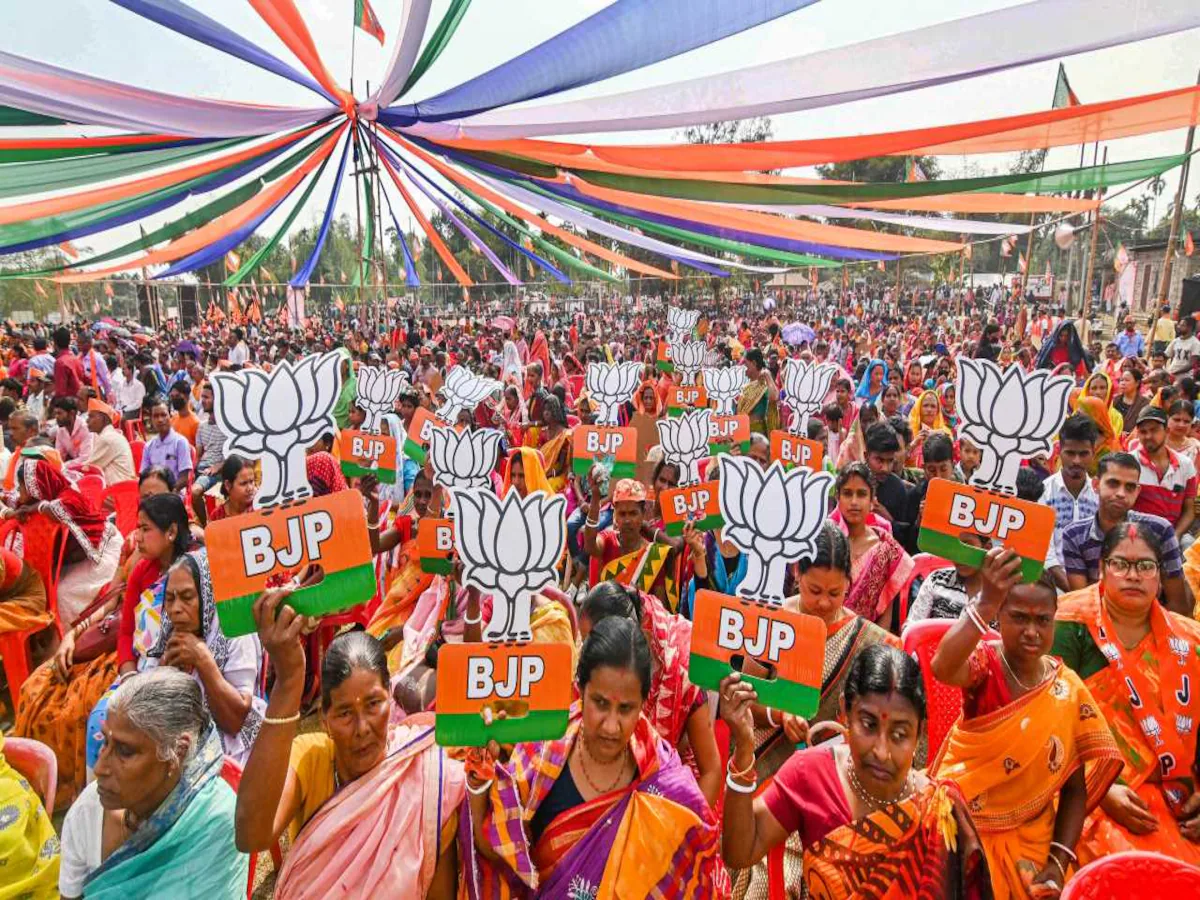
There is a seductive story doing the rounds in Indian politics now: the Bharatiya Janata Party is losing its “core vote bank”. The evidence does not quite support it.
However, something important is certainly happening to the BJP’s social coalition. The 2024 Lok Sabha election and the CJP movement have exposed previously obscured weaknesses. But calling it a collapse of the BJP’s core vote bank is analytically sloppy. The more revealing conclusion is almost the opposite: the BJP’s traditional core remains unusually durable, while some of the additional constituencies that transformed it from an upper-caste party into India’s dominant electoral machine are becoming less automatic in their allegiance.
That distinction matters because the BJP’s future will depend less on whether its old supporters desert it than on whether voters who were brought into the party’s coalition over the past decade continue to believe that the BJP is the most effective vehicle for their aspirations.
Modi’s great success was to make the BJP much bigger than its old base. The BJP’s transformation after 2014 cannot be understood simply as the mobilisation of upper castes. Its larger achievement was social expansion. The party made major gains among OBCs, sections of Dalits and Adivasis and among poorer households that had never been natural BJP constituencies. Welfare became an important part of that expansion. So did the politics of Hindu identity and Narendra Modi’s personal appeal.
This was a profound change in Indian politics. For years, caste parties had been able to tell voters that the BJP represented the interests of particular privileged groups while they represented the interests of the socially disadvantaged.
The BJP broke that political monopoly without abolishing caste. It offered another way of organising political identity. That distinction became increasingly important. The 2024 election in Uttar Pradesh exposed the BJP’s vulnerability. Its formidable coalition of upper castes, non-Yadav OBCs and non-Jatav Dalits began to fray. CSDS-Lokniti data showed BJP support among non-Yadav OBCs falling to 59 per cent from 72 per cent in 2019. Among Kurmi-Koeri voters, it fell to 61 per cent from 80 per cent, and among non-Jatav Dalits to 29 per cent from 48 per cent.
The point is not that Hindutva stopped working. It did not. Rather, it was no longer sufficient to hold every section of the coalition together. The reservation and Constitution debate exposed the fault line: sections of lower-caste voters began asking what Hindu unity meant for their share of power, jobs and representation.
That question has not gone away. The government’s decision to include caste enumeration in the ongoing Census is therefore politically significant. It also reflects the success of the opposition’s post-2024 strategy, particularly Rahul Gandhi’s demand that political power and economic opportunity be assessed alongside caste composition.
For much of the Modi era, the BJP sought to place caste beneath a larger Hindu identity. By agreeing to enumerate caste, it has acknowledged that caste representation remains too important to ignore. The BJP has not surrendered to caste politics; it has adapted to it.
Then came the CJP movement, significant because of its constituency. This was neither a conventional farmers’ agitation nor a caste-based or party-led movement. It brought together young, educated Indians protesting over examinations, competence, corruption and jobs, and expressing a wider sense that the system was indifferent to them.
The movement eventually forced Education Minister Dharmendra Pradhan’s resignation, while the government conceded major demands on examinations and the treatment of protesters. Politically, this matters because the BJP has been adept at managing conventional adversaries. A youth movement centred on competence and opportunity is harder to neutralise. It need not oppose the BJP or Hindutva; it can simply ask whether the state is functioning. For a government built on claims of administrative capacity and national transformation, that is a far more uncomfortable question.
There is another emerging issue that deserves more attention than it gets in national political debate: the quality of routine public services. Indian politics has long rewarded governments for announcing big schemes. Less attention goes to the daily experience of using the state: getting an examination conducted without a scandal, receiving a certificate, finding a functioning government school, obtaining healthcare without paying high out-of-pocket costs, getting a road repaired or dealing with an official without repeated visits.
A political system can absorb disappointment over a GDP figure. It struggles far more with repeated experiences of institutional failure. That frustration cuts across caste and religion and is harder for the BJP’s traditional political machinery to contain.
Yet the electoral evidence does not suggest exhaustion. In recent times, in Bihar, caste alliances, welfare, the NDA’s organisation and opposition weakness produced a sweeping victory. In Assam, the BJP remains deeply entrenched. In West Bengal, it converted Hindu consolidation, anti-incumbency against the Trinamool Congress and targeted mobilisation into a historic breakthrough. An organisation capable of this cannot be described as electorally spent.
The BJP’s challenge is subtler. Its Hindu coalition is now broader, and therefore carries a wider range of expectations. Upper-caste voters want stability and a competent state; OBCs want representation, reservation and mobility; Dalits want dignity and opportunity; the poor want welfare; the young want jobs and fair examinations; farmers want income security; and the middle class wants growth to translate into household prosperity.
These demands can collide. More reservations can unsettle another group; welfare can expand without generating enough productive jobs; a strong central state can still be judged on accountability. The political question is therefore no longer simply BJP versus Congress or Hindutva versus secularism. It is whether one coalition can satisfy voters whose expectations are becoming more specific as India becomes richer, more educated and more connected.
The next phase may be less about ideology and more about performance. That does not mean the end of Hindutva. Its political imprint is too deeply embedded to disappear because of a caste census or a youth protest. But ideology works differently when voters feel economically insecure. A voter may remain culturally aligned with the BJP while becoming more demanding about jobs, examinations, services and household prosperity.
That gap between national rhetoric and personal experience could become politically consequential. GDP growth reached 7.8 per cent in April-June 2026, according to the latest government estimate, but the debate over whether employment, investment and household incomes are keeping pace shows why headline growth has limits. Voters do not live inside GDP figures; they live inside households.
So, is the BJP losing its core? No, not on the evidence available today. Its upper-caste support remains formidable, its ideological base powerful and its organisation unmatched. But its supporters are becoming more demanding. They compare promises with delivery, one caste’s gains with another’s, welfare with employment and national prestige with everyday competence. They may punish the government on specific issues without abandoning its larger ideology.
That is why the 2024 setback, the caste-census shift and the CJP movement belong to the same story. They signal a changing relationship between citizen and state. The BJP remains strong enough to win elections even as that relationship evolves.
Its vulnerability, therefore, is not an immediate collapse of its vote bank. It is the emergence of a voter who remains culturally close to the BJP but is increasingly willing to say no when government performance falls short. That voter is not leaving the BJP. Not yet. But that voter is no longer giving it a blank cheque.
