

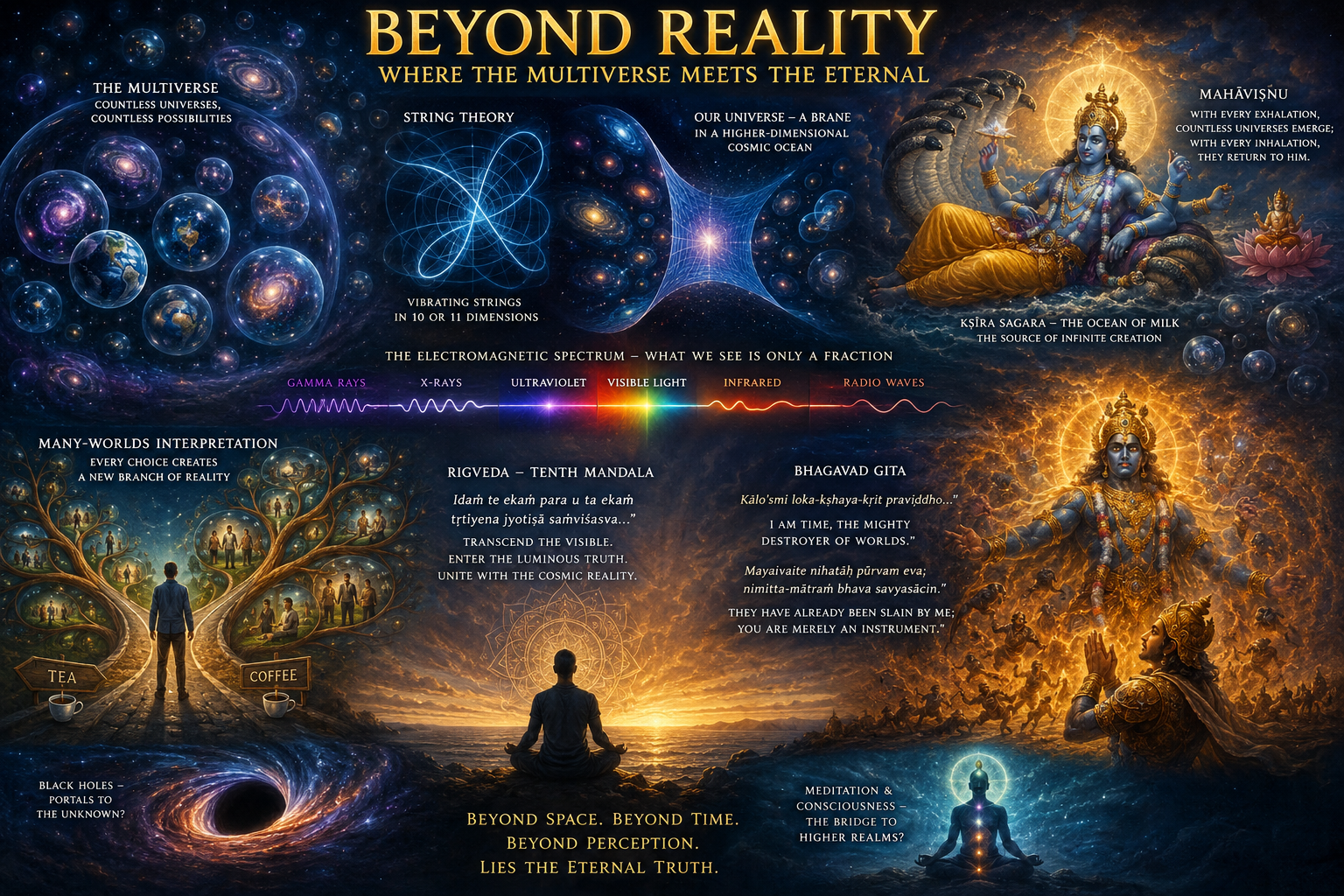
What if the universe we experience is only a small part of a much larger reality? Modern physics is beginning to ask the question in its own language. Ancient Indian thought had been asking it for thousands of years
On a clear night, when the stars seem to stretch endlessly across the sky, it is difficult not to wonder whether the universe we see is all that exists. We live within a small corner of an immense cosmos, on a planet orbiting an ordinary star, itself one among billions in the Milky Way. Beyond our galaxy lie billions more. The distances are so vast that even light, travelling at nearly 300,000 kilometres a second, takes millions or billions of years to cross them. Yet even this extraordinary universe may represent only a fraction of what exists.
Modern physics has entertained the possibility that our universe may be one among many. The idea of a Multiverse remains hypothetical, and there is no experimental evidence establishing that other universes exist. But several influential ideas in theoretical physics have opened the door to such possibilities. If they are eventually shown to describe nature correctly, the universe we inhabit could be only one part of a much larger structure of reality.
The idea becomes even more intriguing when considered alongside an ancient Indian conception of existence. Long before telescopes could reveal distant galaxies or instruments could detect radiation invisible to the human eye, Indian sages were asking whether the visible world represented the whole of reality. Their methods were not those of modern science. They turned inward, using meditation, austerity and self-inquiry to investigate consciousness and the nature of existence. Their descriptions belong to a metaphysical and spiritual tradition, not to modern physics, yet some of their questions have a striking resonance with questions being asked today.
The important point is not to claim that ancient Indian texts predicted modern physics. They did not formulate theories of quantum mechanics or mathematical models of extra dimensions. The more interesting comparison is that both ancient Indian philosophy and contemporary theoretical physics challenge a very ordinary human assumption: that the reality we experience through our senses is necessarily the whole of reality.
A world larger than the visible
The limitations of human perception are easier to appreciate when we look at something as familiar as light. Human beings can see only a narrow portion of the electromagnetic spectrum, roughly from 380 to 750 nanometres. Beyond that small window are infrared and ultraviolet radiation, X-rays, gamma rays and radio waves. They are all part of the physical world, but our eyes cannot see them.
We know about them because science has developed instruments capable of detecting what our senses cannot. A radio telescope can receive signals from regions of space that are invisible to the human eye. X-ray observatories reveal violent processes around stars, galaxies and black holes that ordinary optical telescopes cannot see. Infrared instruments can detect objects hidden behind clouds of dust. What we call the visible universe is therefore already only a small part of the universe that science can investigate.
This does not mean that every invisible phenomenon belongs to another dimension or that beings must exist beyond the range of human vision. It does, however, provide a useful reminder of how limited our natural senses are. Human beings experience reality through a biological system that evolved for survival, not for revealing the deepest structure of the cosmos.
The ancient Indian sages approached this limitation from another direction. A mantra from the Tenth Mandala of the Rigveda begins: “Idaṁ te ekaṁ para u ta ekaṁ tṛtīyena jyotiṣā saṁviśasva…”
The verse has been interpreted in different ways, but the author sees in it an invitation to move beyond the immediately visible towards subtler levels of existence and, ultimately, towards a higher luminous reality. Whether understood literally, symbolically or spiritually, the idea reflects a recurring theme in Indian thought: ordinary perception does not necessarily exhaust reality.
That proposition is philosophical rather than scientific. But it leads naturally to a question that modern physics has also made difficult to ignore: what lies beyond the limits of what we can observe?
The universe may have more dimensions than we know. One of the most ambitious attempts to describe the fundamental structure of nature is String Theory. In its broadest form, it proposes that the most basic constituents of matter are not point-like particles but extremely small vibrating strings. Different modes of vibration would correspond to different particles and physical properties.
Some versions of String Theory require more dimensions than the three dimensions of space and one dimension of time with which human beings are familiar. Depending on the formulation, the mathematics involves ten or eleven dimensions. These additional dimensions are not dimensions that we can simply look towards in the way we look north or south. They are theoretical features of the mathematical framework and, if they exist physically, are generally thought to be hidden from ordinary observation.
Related ideas in theoretical cosmology have gone further. Brane-world models have proposed that our observable universe could be a three-dimensional “brane” embedded in a higher-dimensional space. Other branes, in such models, could potentially exist alongside ours. If such a picture were correct, parallel universes might occupy the same larger reality while remaining inaccessible to our ordinary senses.
This is where the imagination begins to run ahead of the evidence. We should resist the temptation to turn theoretical physics into proof of a Multiverse. Extra dimensions have not been experimentally established, and there is currently no confirmed observation of another universe existing beside our own. These are possibilities explored through mathematical models and theoretical reasoning.
But they are nevertheless important because they show how far modern physics has moved from the common-sense picture of reality. The universe may not have the simple structure that human intuition suggests.
What if there is another you?
Quantum mechanics presents an even stranger possibility. In everyday life, we think of events in terms of definite outcomes. You toss a coin and it lands heads or tails. You choose tea or coffee. You take one road rather than another. Once the choice is made, the alternatives become possibilities that were not realised.
The Many-Worlds Interpretation of quantum mechanics, associated with physicist Hugh Everett, offers a radically different way of thinking about quantum outcomes. In this interpretation, the quantum state does not collapse into one single outcome. Instead, different outcomes correspond to different branches of reality.
The popular imagination has extended this idea into the possibility of innumerable versions of ourselves, each living a different life. In one universe, you may have taken one job; in another, you may have moved to another city. In one branch, you may have married a particular person; in another, your life may have taken a completely different direction.
It is an arresting idea, but it needs to be treated carefully. Many-Worlds is an interpretation of quantum mechanics, not established evidence that alternate versions of every human being are living in parallel universes. The idea remains part of an ongoing debate over how quantum mechanics should be understood.
Yet even as an interpretation, it changes the way we think about reality. Instead of imagining existence as a single line running from the past into the future, we can imagine it as a vast branching structure, with different possible histories emerging from quantum events.
The image is difficult to reconcile with ordinary human experience. We live one life and remember one history. We do not experience the roads not taken. But perhaps that limitation tells us more about the way consciousness works than about the total structure of reality.
The cosmic breath of Mahāviṣṇu
There is an extraordinary parallel, at least at the level of metaphor, in the cosmology of the Śrīmad Bhāgavata Purāṇa. It presents Mahāviṣṇu reclining upon the Kṣīra Sāgara, the Ocean of Milk, with countless universes emerging from Him. With His exhalation, universes come into being; with His inhalation, they dissolve.
Each universe is described as possessing its own Brahmā, its own creation and its own cycle of time. Creation is therefore not a single event. It is an immense and recurring process of emergence, existence and dissolution.
This is not a cosmological model in the scientific sense, and it should not be presented as an ancient scientific prediction of the Multiverse. Its language is theological and metaphysical. Yet the image is powerful because it refuses to imagine existence as a single, finite event. It presents a reality containing innumerable universes and cycles of creation.
Modern cosmology has explored theories in which the history of the universe may involve cycles of expansion and contraction or successive cosmic phases, although no cyclic model has been established as the definitive description of our universe. The resemblance to the cosmic breathing of Mahāviṣṇu is therefore best understood as a philosophical or poetic parallel rather than a scientific equivalence.
The distinction matters. Science seeks explanations that can ultimately be tested against observation. Metaphysics asks questions about the nature and meaning of existence that may not be reducible to experiment. The two can speak to each other without becoming the same discipline.
The mystery of Time
The most profound part of this journey into reality, however, may not be the question of how many universes exist. It may be the question of what time itself really is.
On the battlefield of Kurukṣetra, Arjuna is granted a vision of Kṛṣṇa’s Viśvarūpa, the Cosmic Form. What he sees is not simply an enlarged human figure. He sees a terrifying vision of creation and destruction, of countless beings entering and disappearing within the cosmic form. Overwhelmed by what he is witnessing, Arjuna asks Kṛṣṇa who He is.
The answer is one of the most powerful passages in the Bhagavad Gita:
“Kālo’smi loka-kṣhaya-kṛit pravṛiddho…”
“I am Time, the mighty destroyer of worlds.”
Time here is not merely the ticking of a clock or the movement of one second after another. It is the force within which life, death, creation and destruction unfold. Kṛiṣhṇa then tells Arjuna that the warriors he sees have already been slain and that Arjuna is merely an instrument in what is already destined to occur.
For Arjuna, the battle has not yet happened. From the perspective revealed through the Viśvarūpa, however, its outcome already exists.
That creates a profound problem for our ordinary understanding of time. Human beings experience existence sequentially. We remember the past, experience the present and anticipate the future. But what if that sequence reflects the limitations of our consciousness rather than the ultimate structure of reality?
Physics has its own complicated relationship with this question. Einstein’s theory of relativity replaced the idea of a universal clock ticking at the same rate everywhere with a conception of space and time as interconnected. Different observers can disagree about the ordering or simultaneity of events depending on their relative motion. This does not prove the theological idea that the past, present and future are simultaneously visible to a higher consciousness, but it does remind us that everyday notions of time are not as fundamental as they appear.
Consider a creature living on a sheet of paper. It can move across the surface but has no way of moving above or below it. A person standing beside the paper can see the entire surface at once.
Now imagine extending the analogy. We experience three dimensions of space and one dimension of time. We move through time in one direction and cannot step outside it to look at our entire existence from the outside.
A hypothetical being with access to an additional dimension might, purely as a thought experiment, perceive our four-dimensional space-time from a different perspective. What appears to us as a sequence of events could appear to such an observer as a complete structure. Birth, adulthood and death would not necessarily be experienced as separate moments but could be seen as different points within a larger whole.
There is no evidence that human beings can enter such a fifth dimension, nor that meditation can literally transport consciousness into one. But the analogy helps illuminate the philosophical significance of the Viśvarūpa. Kṛṣṇa’s vision presents Arjuna with a perspective radically different from ordinary human awareness. What Arjuna experiences as an unfolding event appears within the Cosmic Form as something already encompassed by a larger reality.
Perhaps this is why the idea of transcendence has occupied Indian philosophy for so long. The goal is not necessarily to escape the physical universe but to recognise that ordinary consciousness may not reveal the whole of existence.
Between physics and metaphysics
It is tempting to draw a straight line between these ideas and declare that ancient Indian sages had already discovered the Multiverse, higher dimensions or quantum mechanics. That would make for a dramatic claim, but it would also weaken the argument.
The ancient texts were not doing modern physics. They did not use particle accelerators, telescopes or mathematical models to investigate the universe. Their inquiries were directed towards consciousness, existence, the self and the relationship between the individual and the cosmic order.
Modern physicists work differently. Their theories have to confront mathematical consistency, observation and experiment. Many of the ideas discussed here, including the Multiverse, String Theory’s extra dimensions and Many-Worlds, remain theoretical or interpretative rather than established descriptions of reality.
The value of bringing the two traditions into conversation lies elsewhere. Both encourage us to question the assumption that the world revealed by ordinary experience is the complete story. Modern physics does so by exposing the strange behaviour of matter, space and time at fundamental scales. Indian philosophy does so by questioning the nature of consciousness and the limits of perception.
They are not saying the same thing. But they are asking questions that meet at an important point: human beings may not have access to the whole of reality.
The unanswered question
Perhaps one day science will find evidence of another universe. Perhaps it will discover that extra dimensions are physically real. Perhaps observations of black holes will reveal something fundamental about the relationship between space, time and information. Or perhaps many of today’s most imaginative theories will eventually be discarded, replaced by ideas we cannot yet imagine.
There is another possibility that is more difficult to test: that consciousness itself has depths we have not understood.
Indian traditions have long treated meditation not merely as a relaxation technique but as a method of examining the nature of the self and consciousness. Whether altered or heightened states of consciousness provide access to some deeper reality remains an open philosophical question, not an established scientific proposition.
That uncertainty should not diminish the value of the question. In fact, it may be the most important part of the discussion.
We have repeatedly discovered that the universe is larger and stranger than we once believed. The Earth was not the centre of the cosmos. The Sun was not the centre of the universe. Our galaxy is not unique. Visible matter is not all the matter we know exists. Space and time are not as absolute as everyday experience suggests.
It is entirely possible that our present understanding of reality will undergo further transformations.
The ancient Indian image of countless universes emerging and dissolving with the breath of Mahāviṣṇu, the quantum image of reality branching into different possibilities, and the modern search for extra dimensions are separated by thousands of years and radically different intellectual traditions. They should not be collapsed into a single theory. Yet each, in its own way, asks us to loosen our grip on the assumption that reality must look the way it appears to us.
The night sky has always been an invitation to that humility. We look upwards and see stars. Science tells us that those points of light are suns, galaxies, explosions and remnants of events that happened long before human beings existed. Beyond what our eyes can see are wavelengths we cannot detect, objects we cannot reach and distances we can barely comprehend.
And beyond what we can observe may lie questions that neither science nor philosophy has yet answered.
Perhaps there are other universes. Perhaps there are dimensions beyond the ones we experience. Perhaps time is not quite the river we imagine it to be. Perhaps consciousness has possibilities that remain hidden from us.
Or perhaps the greatest mystery is simpler: we are still trying to understand what it means for anything to exist at all. That question belongs to physics, philosophy and metaphysics alike. And for now, the boundary between what we know and what we can only imagine remains one of the most fascinating frontiers of human thought.