


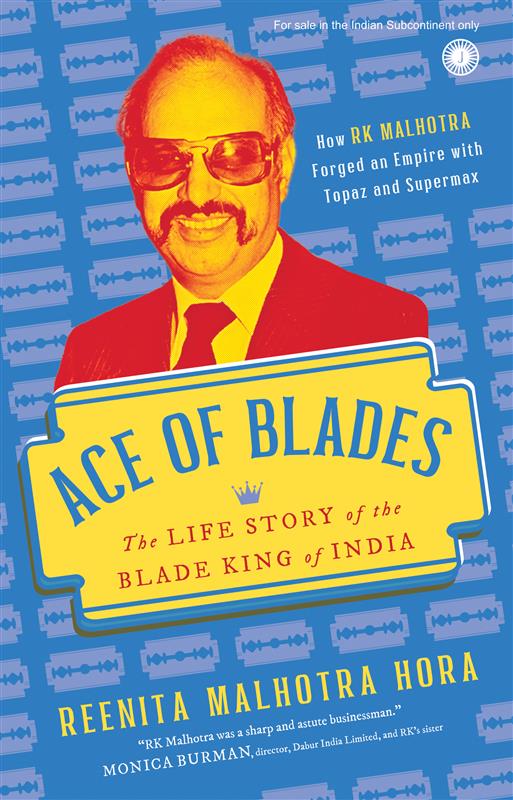
ABOUT THE BOOK
Ace of Blades chronicles the ascent of Rajinder Kumar Malhotra, the driving force behind India’s razor blade brands Topaz and Supermax, through a tightly drawn narrative of ambition and control. Written by his daughter, Reenita Malhotra Hora, the book follows how an uncompromising pursuit of quality transformed a modest manufacturing venture into a formidable FMCG enterprise that challenged global incumbents and embedded itself in the daily routines of millions of Indian men.
The account moves beyond corporate milestones to examine the temperament that powered the business: intensity, risk-taking and an almost obsessive attention to detail. It also confronts the trade-offs that accompanied success, including family strain, internal rivalries and the personal toll of sustained dominance. By situating Malhotra’s story within the broader evolution of India’s consumer goods sector, the book offers insight into a formative period of indigenous entrepreneurship.
Part business biography and part family narrative, Ace of Blades presents a clear-eyed study of leadership and legacy, capturing both the scale of the achievement and the price paid to secure it.
ABOUT THE AUTHOR
Reenita Malhotra Hora is a Mumbai-born, California-based novelist and screenwriter whose work foregrounds the South Asian experience with narrative range and cultural depth. Her award-winning historical romance Vermilion Harvest – Playtime at the Bagh, set against the backdrop of the 1919 Jallianwala Bagh massacre, won the Overall Grand Prize at the Chanticleer International Book Awards. Reenita’s young-adult romantic comedy Operation Mom has also received widespread recognition, including selection for the Sundance Institute Development Slate, The Writers Lab, the Eric Hoffer Book Award, and the IndieReader Discovery Award, among others. LA Weekly has described her as a leading indie writer reshaping Indian culture and comedy for global audiences.
Before turning to long-form fiction and screenwriting, Hora worked as a journalist with Bloomberg and RTHK, and her reporting has appeared in The New York Times, CNN and Bloomberg.
EXCERPTS
Monkey Business
In a relatively short time after RK returned to India, he had developed a range of industrial blade prototypes—hacksaws for cutting thin metal and pipe, bandsaws for cutting thick metal and hard plastics, circular saws for cutting wood, and a line of engineer’s files. Unfortunately, these innovations wouldn’t find a place in the market until the BT Road factory was formally established a few years later, in 1962.
At the same time, HL remained unyielding in his determination to ignite RK’s interest in razor blades. And after numerous failed attempts, he finally struck upon the one incentive that would prove irresistible to the young entrepreneur—a shipment of used machinery.
Nestled within the confines of the Belur factory, the machinery had been procured with a singular purpose in mind—the production of razor blades. And upon the arrival of the wooden crates, RK’s pre-existing project was promptly abandoned as he turned his full attention to the newly acquired equipment.
With the fervor of a man possessed, RK worked tirelessly to bring the machinery to life. And as the hum of the factory floor began to fill the air, it became clear that a new chapter in the Malhotra family’s razor blade saga was about to be written ahead.
HL supported his son’s effort 100 percent. He saw the need to stay aggressive and keep expanding the business. Neither Dahanukar nor Ujjain were having any luck getting their products off the ground, which left the door wide open for the Malhotras. And if they managed to pull off a coup and get their premium blade onto the market before anyone else, HLM & Co. would become the first world-class blade company in post-independence India. The only question was how to effectively crush the competition, and the easiest way to do that was through more acquisition.
HL’s gaze was fixed unwaveringly on his next target—the acquisition of Vidyut Metallics, an enterprise that would be a valuable addition to the Malhotra Group of companies. But he knew all too well that such a lofty dream demanded an exorbitant amount of capital, more than he could muster, and he loathed the prospect of being fettered by a burdensome line of credit.
Yet, in the face of this daunting challenge, HL remained steadfastly resourceful. He scoured the landscape for a lucrative opportunity that could swiftly generate the funds required to fuel the razor blade venture’s continued growth. Eventually, he landed upon a somewhat unconventional yet highly profitable scheme—the export of rhesus monkeys to the United States, where they were utilized in research for the development of the polio vaccine.
HL gathered his three sons together, his tone filled with enthusiasm as he addressed them, “It will be a new business for us. India has one of the largest populations of rhesus monkeys. It might even be the largest. Western countries are in a race to develop a vaccine for polio and infantile paralysis. They are desperate to get these animals.”
