


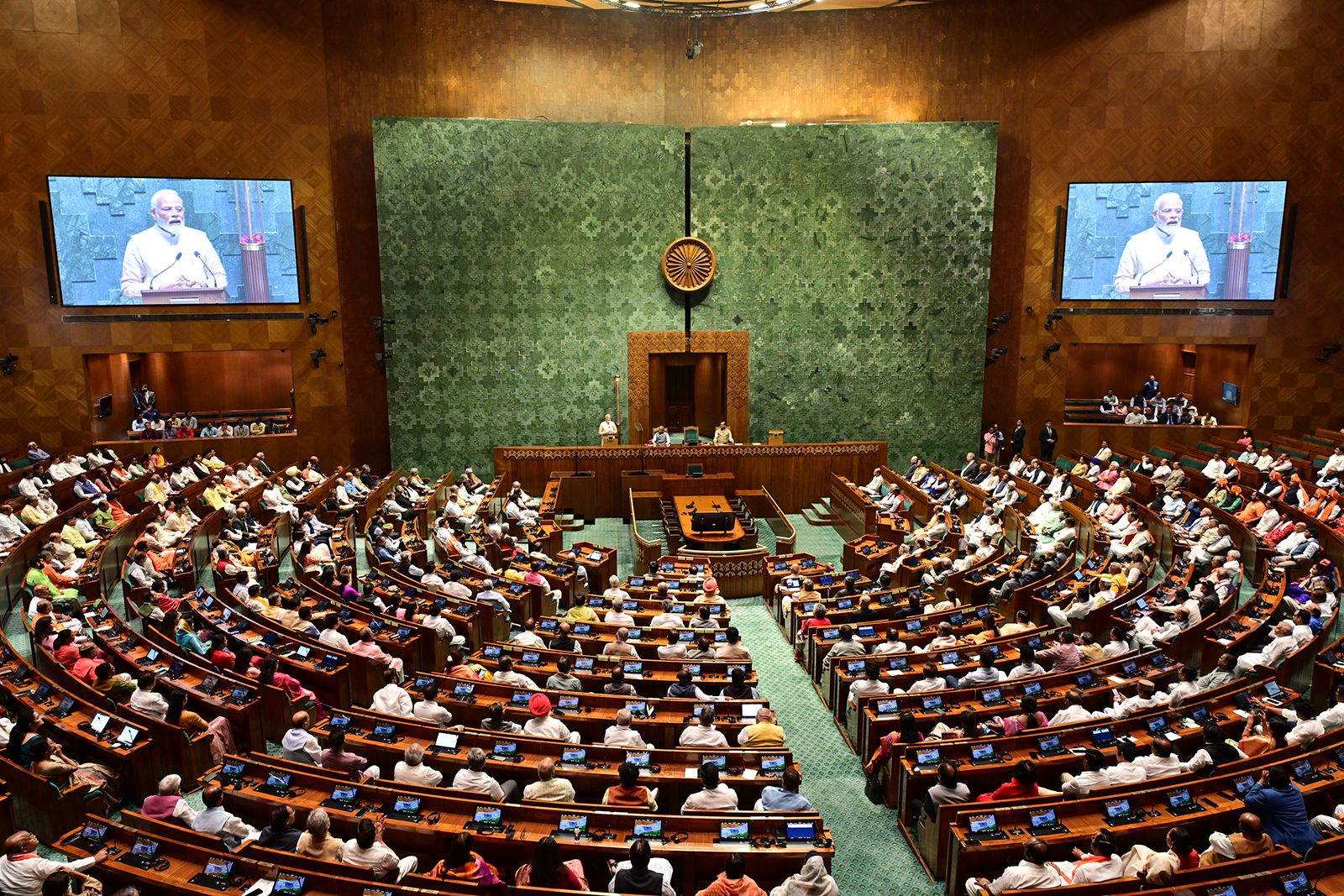
The Monsoon Session of Parliament began on July 20 and concluded on August 13, 2026, after 19 sittings. It has already answered one question: despite repeated disruption, the government can continue to transact legislative business. It has left another unanswered: what must Parliament contribute to a bill before it becomes law?
The immediate evidence is striking, but the issue is larger than the bills themselves. The Prevention of Insults to National Honour (Amendment) Bill, 2026, was passed by the Lok Sabha after a brief 14-minute discussion. The Registration of Births and Deaths (Amendment) Bill, 2026, completed passage through both Houses within six days of its introduction, without committee examination. The Foreign Contribution (Regulation) Amendment Bill, 2026, remains pending in the Lok Sabha. Three different measures, serving three different purposes, expose the same institutional question: when passage is swift, what has the legislature added to the proposal placed before it?
What a Legislature Adds
A bill is introduced in Parliament after the executive has determined its policy, obtained legal vetting and secured Cabinet approval. The government therefore arrives with both a proposal to pass and, ordinarily, the numbers to prevail. Parliament is not assembled merely to reproduce that internal agreement in public. Its distinctive work begins where executive agreement ends.
Article 107 governs the introduction of ordinary bills and their passage through Parliament. Article 75(3) states that the Council of Ministers is collectively responsible to the Lok Sabha. Taken together, the provisions suggest that a majority vote merely certifies the government’s right to legislate. Parliamentary scrutiny determines whether the government can defend the particular law it has chosen to enact.
That defence matters in three ways. Debate tests whether the legal means correspond to the stated object. Representation introduces knowledge that an administrative file may not contain: how a uniform rule will operate in a border district, a crowded court or a poorly staffed municipality. Amendment converts criticism into craftsmanship. Parliament need not defeat a bill to improve it. Often, its most useful work enables the government to prevail with a better law than the one it introduced.
A minister’s reply is therefore not a procedural conclusion to debate. It is the point at which objections acquire an official answer. It clarifies the government’s understanding of the power it seeks and explains to citizens why the resulting burden is considered proportionate. When the reply does not engage with the objections raised, the House may have voted, but the law remains publicly underexplained.
The contraction of this explanatory space is measurable. According to PRS Legislative Research, 58 per cent of 179 bills passed by the 17th Lok Sabha were enacted within two weeks of introduction, and 35 per cent received less than an hour of discussion. Only 16 per cent were referred to committees for detailed scrutiny. Excluding constitutional amendment bills, merely 9 per cent saw even one recorded vote.
None of these figures proves that the resulting laws were defective. Minutes are not a measure of rationality, nor is parliamentary committee examination an assurance of consensus. The figures establish something narrower but consequential: institutions designed to discover defects had fewer opportunities to do so. Speed may coexist with sound legislation. It cannot, by itself, demonstrate that competing arguments were heard and answered.
The Argument for Speed
The government offers a serious response. Parliamentary time is limited, its mandate rooted in democracy, and interruptions can squander the very hours later cited as evidence of insufficient debate. A government cannot be expected to forsake its legislative agenda simply because the opposition has rendered orderly proceedings impossible. Moreover, not every bill warrants the same treatment: a technical correction and a statute granting broad new discretion do not rationally deserve an equal amount of time.
This argument defeats any mechanical insistence upon a minimum number of hours for every bill. It does not defeat the case for proportionate scrutiny. The relevant inquiry is not merely the duration of Parliament’s discourse, but whether it fulfilled the responsibilities that legitimise its participation in the dialogue. Were the principal objections identified? Did the minister answer them? Were amendments put to the House? Where the consequences remained uncertain, was specialised evidence sought? A concise debate can satisfy these tests. A long procession of speeches can fail them.
The opposition must accept its share of responsibility. Disorder may command attention, but it also relinquishes the instruments through which a minority can influence law: the focused amendment, the motion for committee reference, the demand for a division and the question that obliges a minister to choose between explanation and silence. The government controls the legislative calendar and possesses the official information. Its responsibility is therefore greater, but it is not exclusive. Scrutiny cannot credibly be demanded in principle and disabled in practice.
There is a further reason to preserve Parliament’s deliberative autonomy. Article 122 prevents courts from questioning parliamentary proceedings merely on the ground of procedural irregularity. In Raja Ram Pal v. Hon’ble Speaker, Lok Sabha (2007), the Supreme Court distinguished procedural irregularity from substantive unconstitutionality, which is not insulated from judicial review. Nevertheless, legislation does not become unconstitutional merely because it was inadequately explained or subjected to limited debate. The judiciary may review the resulting law for legislative incompetence, violation of fundamental rights, or other constitutional infirmities, but it ordinarily does not assess the adequacy of Parliament’s deliberations.
More Consequential Parliament
The answer is not simply a longer calendar. Article 118 grants both Houses of Parliament the authority to create their own rules for managing internal procedures and conducting legislative business. Reform need not await another statute. The parliamentary calendar should distinguish routine legislation from measures that impose criminal liability, enlarge administrative discretion, or materially affect rights and property. The Business Advisory Committees already allocate time for government business. That allocation should reflect the contested features of a bill, not merely the number of speakers to be accommodated. Before consideration concludes, the minister should address the principal objections and amendments on record.
Parliamentary committee scrutiny should be similarly selective rather than automatic. The Speaker (Lok Sabha) and the Chairman (Rajya Sabha) already have the authority to refer bills to the relevant Departmentally Related Standing Committee (DRSC). Where specialised evidence is necessary, a short and clearly scheduled reference is preferable to either perfunctory passage or indefinite delay. The pending Foreign Contribution (Regulation) Amendment Bill, 2026, offers an immediate opportunity to use the existing machinery before the House votes.
The opposition, for its part, would strengthen its case by concentrating on a few consequential clauses, filing amendments in advance and seeking recorded divisions on them. Even when the numerical outcome is certain, a division reveals who accepted a disputed legislative choice; a reasoned ministerial reply reveals why. Neither obstructs the government’s mandate. Both make it accountable for the form in which that mandate becomes law.
A majority determines whether a bill passes. Parliament’s larger purpose is to determine what the bill becomes before it does. If the explanation comes only after enactment, what, beyond the arithmetic of its majority, has Parliament contributed to the law?
