


They came as traders, built churches, schools, businesses and landmarks, and became part of the city’s social fabric. Today, fewer than 150 Armenians remain in Kolkata. Their story is not simply about a community that disappeared, but about a city that slowly forgot the people who helped build it.
The River Hooghly, meandering through Kolkata, carries in its bosom stories that are centuries old. A wave rises like a sorrowful sigh, as it recalls the times its ebb and flow carried communities that arrived, settled, prospered and slowly faded away. The footsteps of the Armenians still echo along its banks.
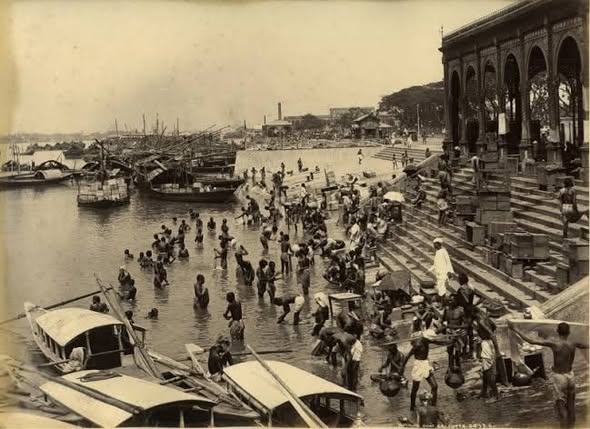
A first-time visitor to Kolkata is a bit surprised to see an Armenian Ghat on the river. Gradually sauntering along Burra Bazaar along a dusty, crowded street, one is further surprised to read the name “Armenian Street”.
The Hooghly glints in the sunshine, smiling. The Armenians had come to India even before the British, during the reign of the Mughal ruler Akbar the Great, who even had an Armenian wife! It was in the late 17th century that they came to Calcutta (Kolkata) not to conquer but to settle down and prosper. The Armenian Ghat was built in 1734 by Manvel Hazaar Maliyan, an Armenian merchant. As their numbers grew, they built dwellings, roads, churches, educational institutions and their legacy remains in the many historic buildings. Today, they are barely a micro-minority of Kolkata.
The Legacy Endures in Stone
Walking down Armenian Street, one glimpses the oldest church in Kolkata. The Armenian Holy Church of Nazareth, whose elegant white spire kisses the skies, continues to hold services to date. It was built in 1724 on the site of an earlier wooden structure. Adjoining it is the cemetery that holds the remains of so many Armenians who lived and made a success of their life in Kolkata. One cannot but mention the other two churches: Saint Mary’s Church and the church of Saint Gregory the Illuminator.
At a short distance stands the Armenian College and Philanthropic Academy, founded in 1821, by Astvatsatur Muradkhanian and Mnatsakan Vardanian. It is also known as ‘the Armenian Humanitarian Gymnasium.’
An eminent leader of the Australian Armenian community and former Mayor and Councillor of the City of Ryde, Mr Sarkis Yedelian OAM, says: “The Armenian community of Calcutta became one of the most prosperous and influential Armenian diasporas in the world. Beyond preserving its own identity, it made a lasting contribution by supporting Armenian education, churches, charitable institutions, and publishing, while also serving as an important commercial and cultural bridge connecting Armenian communities across Asia and beyond. The Armenian Boarding School, Armenian Humanitarian Gymnasium, still serves as a respected educational institution attracting students from the Armenian diaspora from the Middle East and Armenia. Since 1999, it has been under the administration of the Mother See of Holy Etchmiazin in Armenia.”
Besides providing free education to Armenian youth around the world, it also serves students from Iran and Iraq, providing free boarding and preserving cultural traditions. While the focus is on Armenian culture and religion, their perspective is global. It was largely funded by Sir Catchick Paul Chater, a legendary Armenian philanthropist who was born in Kolkata.
Much of the Edwardian visual landscape around Park Street was built by wealthy Armenian merchants. The famous Queen’s Mansion on Park Street was originally known as Galstaun Mansion. It was built by the real estate tycoon Aanescared Galan more than 100 years ago. He also built Nizam Palace and the Freemason’s Hall.
The Oberoi Grand, fondly known as the Grande Dame of Chowringhee, was redeveloped by the Armenian entrepreneur Arathoon Stephen.
The Literati and Glitterati
Eminent Armenian-Australian Sarkis Yedelian OAM tells us about the father of Armenian journalism: “Harutyun Shmavonian is rightly regarded as the father of Armenian journalism. In 1794, in Madras (now Chennai), he founded Azdarar, the world’s first Armenian-language periodical, laying the foundations of the Armenian press and fostering intellectual, cultural, and national awareness among Armenians throughout the diaspora. His statue stands in the Armenian Church of the Holy Nazareth in Kolkata.”
One cannot overlook some notable women of Armenian descent in India. In 1902, Gauhar Jaan became the first artist in India to be commercially recorded on a 78 rpm gramophone record. Born in 1873 as Angelina Yeoward, she was an amazing singer and dancer. Her father, Robert William Yeoward, was Armenian, married to Adeline Victoria Hemmings, who was an Anglo-Indian. After that marriage ended, mother and daughter Angelina converted to Islam. Angelina was given the name of Guhar Jaan. They moved to Kolkata in 1883, where they spent decades, and Gauhar built a career as a singer of Thumri and Khayal. She used to end her songs with the words “My name is Gauhar Jaan.”
Another well-known lady was Violet Smith, popularly known as the eccentric grande dame and the “Duchess of Sudder Street.” She was the daughter of Armenian refugees who arrived in Kolkata in 1933. Violet ran the Fairlawn Hotel that hosted many celebrities. She passed away in 2014. The motto of her hotel was, “meet tourists as guests and send them away as friends.”
Food Glorious Food
As the camaraderie between Armenians and the local community blossomed, mixed marriages took place, and there was obviously an exchange of food ideas. The delicious Armenian dish, potoler dolma, influenced Bengali cuisine, and they started making their own version of “potoler dorma”, which has become very popular with the Bengali community. They made it with pointed gourd and filled it with soaked gram flour, spices and peanuts. Their dish has several variations.
Where Have the Kolkata Armenians Gone?
The Kolkata Armenians, who had settled in the region since the late 16th century, started leaving in large numbers after India’s independence in 1947. While many moved to the United States, Canada, and the Soviet-era Republic of Armenia, a very large number immigrated to Australia. Ex-Mayor and Councillor of the City of Ryde, eminent Armenian Sarkis Yedelian, gives us an interesting insight. According to him: “Gregory David Galstaun deliberately used his Singapore-based Armenian newspaper, Usumnaser (“The Scholar”), to encourage Armenians to migrate to Australia during the Victorian gold rush.
He was the founder and editor of Usumnaser, the first Armenian newspaper published in Singapore. It circulated among Armenian communities throughout Southeast Asia and India. Through his paper, Galstaun argued that the Australian colonies offered exceptional opportunities for Armenians and called on Armenians in the East to settle in Australia, particularly after the discovery of gold in Victoria. His paper regularly included news from Melbourne and updates on the goldfields, reinforcing his campaign to attract Armenian settlers.
His proposal for a mass Armenian migration to Australia was strongly criticised by the Calcutta-based Armenian editor Mesrop Thaghiadian, who believed Armenians were already prosperous in India and should not abandon their established communities. In June 1853, Gregory Galstaun himself sailed from Singapore to Melbourne with several Armenian companions, hoping to establish a permanent Armenian colony in Australia. Tragically, he contracted dysentery and died in Melbourne on January 27, 1854, at about 39 years of age, ending his ambitious migration project.
Now, there are hardly 100 to 150 Armenians left in Kolkata, including the students. Among them, about 50 to 60 are elderly permanent Indian-Armenians of mixed descent. They still celebrate Christmas on 6th January and try hard to keep up their culture. The micro-minority community has almost vanished.
The River Hooghly wistfully flows onwards from the Armenian Ghat, holding sweet memories of the footsteps that no longer echo. Like the Armenians who left Kolkata to find a place in the wide world, she is moving on to merge into the saline waters of the Bay of Bengal.
