

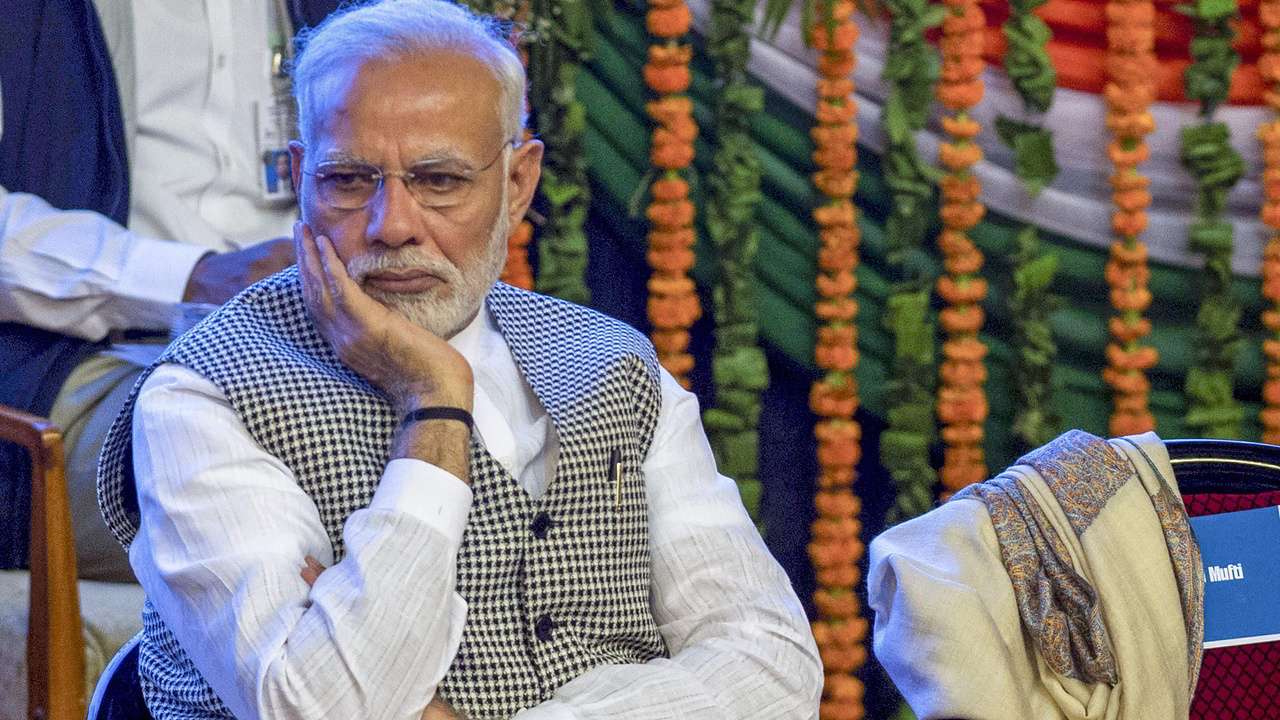
There is no revolt against Modi. No succession battle. No leadership crisis. But the CJP agitation has raised uncomfortable questions inside the BJP and RSS: Was the movement misread? Why did the government engage only after pressure mounted? And has Modi’s highly centralised system become better at containing dissent than detecting it?
THE MODI ERA
When power is built on the presumption of control
For more than a decade, Narendra Modi has enjoyed something rare in Indian politics: an extraordinary concentration of personal authority that has kept both his opponents and, at crucial moments, his own party on the defensive. Since the BJP’s sweeping victory in 2014, Modi has not merely been the prime minister or the party’s principal campaigner. He has become the central political reference point for the entire organisation. Elections have been fought in his name, governments have been projected under his leadership, and even setbacks have rarely been serious enough to unsettle his position at the top. His electoral record has given him something political leaders value almost as much as popularity: the presumption of command.
That authority has also shaped the way the BJP functions. As the party repeatedly returned to power, its political machinery increasingly revolved around Modi’s leadership. Ministers, chief ministers and party functionaries understood that major political decisions were ultimately controlled at the top. Several BJP leaders familiar with the organisation’s functioning have privately described a system in which centralised decision-making became increasingly pronounced as Modi’s electoral stature grew. As long as the prime minister continued to win, there was little incentive for others to question that arrangement openly.
Disagreement did not disappear, but it became politically expensive to express. Ministers could be criticised, state units could be questioned and organisational decisions could be debated internally, but Modi’s own authority remained largely outside the zone of serious contestation. Even within the wider Sangh Parivar, his electoral record made it difficult to openly challenge the centrality of his leadership. The opposition, meanwhile, repeatedly sought to make Modi himself the political issue, but attacks on him often reinforced the perception among his supporters that the contest was fundamentally between Modi and his opponents.
That has been the strength of the Modi brand: not merely popularity, but the perception that he remains firmly in control and that neither
political setbacks nor sustained opposition can easily force him into retreat.
THE STREET CLIMBDOWN
How a youth agitation broke the script
Then, suddenly, came the “cockroaches”, seemingly from nowhere. The Cockroach Janata Party (CJP) agitation has altered the political equation in “Modinama”, if one may put it that way. The agitation and the Modi government’s subsequent climbdown have not destroyed the BJP’s political dominance, nor have they produced a crisis of leadership within the party. But they have done something more subtle and potentially more consequential: they have punctured the perception that the Modi government is almost impossible to force into a political retreat.
For the first time in years, a movement outside the established political system sustained pressure long enough to compel the government to negotiate, consider concessions and eventually accept the resignation of a senior Cabinet minister. The episode has consequently triggered a debate within the BJP not over Modi’s immediate political survival, but over political judgement and the limits of a governing style built around control.
The BJP has confronted major protests before, including the anti-CAA mobilisation, the farmers’ agitation and the protests against the Agnipath recruitment scheme. But CJP presented a different kind of challenge. It was younger, more diffuse and less dependent on established political or social organisations. For a party accustomed to dealing with organised opposition, the movement was harder to read and contain through conventional political channels.
According to people familiar with discussions inside the BJP, the initial expectation was that the agitation would eventually lose steam if the government did not give it political oxygen. Instead, it gathered momentum. “The agitation refused to disappear, the opposition kept the issue alive, young people continued to mobilise, and an examination controversy gradually became a wider argument about jobs, accountability and the credibility of institutions,” a political observer tracking the movement said.
As the protest continued, the government’s initial assessment became increasingly difficult to sustain. Inside the BJP, the question gradually changed from whether the protesters could be ignored to how much political damage the continuing confrontation was causing. Party sources involved in the subsequent assessment say that the delay in resolving the matter had begun to affect Modi’s image, although they did not believe it had yet translated into measurable
electoral damage. The immediate concern was the weakening of a political perception that had served the government well for years:
that it could withstand pressure and determine the terms on which a confrontation ended.
Insiders say Union Home Minister Amit Shah pushed for direct political engagement with the protesters rather than allowing the confrontation to continue to be handled primarily through administrative channels. Modi agreed. Senior ministers J P Nadda and Jitendra Singh were then tasked with reaching out to the protesters, leading to several rounds of negotiations.
The talks, however, did not produce an easy way out. The protesters refused to settle for assurances and insisted on accountability, including the resignation of Education Minister Dharmendra Pradhan. One option under consideration was to move Pradhan to another ministry, allowing the government to bring the immediate controversy to an end without conceding the protesters’ principal demand, sources say. The protesters rejected the idea as cosmetic and refused to withdraw. With the agitation continuing, the room for manoeuvre narrowed. Pradhan eventually resigned.
The significance of the resignation lies less in any suggestion of personal culpability than in the circumstances in which it took place. For an administration whose political authority has long rested on firmness and control, the optics were difficult to ignore.
THE RSS TWIST
When Bhagwat’s intervention changed the political reading
There is another layer to the story, and this is where the BJP’s discomfort becomes more pronounced. The RSS has often served as a sounding board for the BJP, sometimes publicly and sometimes through private channels. Its criticism does not automatically translate into a confrontation with the government, and it would be an exaggeration to interpret every difference between the two organisations as a Modi-RSS rupture. But when the RSS chief Mohan Bhagwat spoke to young people in Mumbai on August 6, his remarks landed differently because they came immediately after the CJP confrontation.
Bhagwat’s message was unusually direct. He argued that movements emerge when dialogue fails and that young people should be listened to rather than automatically treated as adversaries. He questioned why young protesters were being regarded with suspicion and raised concerns about the police action at Jantar Mantar. Most significantly, Bhagwat suggested that the government should have spoken to the protesters earlier. “Gen Z is more patriotic than our generation; we should understand what they are saying. It was because there was no conversation with them that the movement took place,” the RSS chief
said.
Read as a standalone speech, the remarks could be interpreted as a general statement about youth and social change. Read against the events of the preceding weeks, they amounted to a pointed reminder to the political establishment that public anger cannot always be managed through resistance and administrative control.
The implication was unmistakable: the emergence of a protest movement should not be viewed only through the conduct of those on the streets; the failure to engage with their concerns before they reached that stage must also be examined. Bhagwat repeatedly returned to one central issue: why had the government not spoken to young people before their grievances turned into a movement?
For an organisation as closely intertwined with the BJP’s political and ideological ecosystem as the RSS, that is not a routine observation. High-placed political sources believed this is the part of the episode that has attracted the greatest attention inside the BJP. An opposition leader questioning police action or demanding dialogue would have been entirely predictable. The RSS chief making the same argument after the government had already been forced into negotiations is politically different.
However, externally the BJP has sought to play down any political interpretation of the Mumbai programme. Maharashtra BJP MLA Ram Kadam said Bhagwat had always interacted with young people and that such engagements were part of a longstanding tradition, implying that there was nothing unusual about the latest interaction.
But the timing and context of this particular dialogue make it difficult to regard the episode as merely another routine youth interaction.
DENT IN THE AURA
Modi’s command faces an unexpected test
There is no open revolt against Narendra Modi within the BJP. No succession battle is underway, and there is no imminent challenge to his leadership. He remains the party’s most recognisable national leader, his electoral record is formidable, and the BJP’s organisational machinery remains unmatched by most opposition parties. But the
absence of rebellion does not mean the absence of unease.
The more significant development is that questions are now being asked within the ruling establishment that would once have been politically unnecessary, if not hazardous. People familiar with discussions among senior BJP leaders say the CJP episode has triggered concerns over centralised decision-making, the handling of public grievances and whether the political leadership is sufficiently alert to discontent before it turns into organised mobilisation.
These are not signs of a revolt against Modi. They are signs of doubt about political management. For much of the Modi era, electoral success settled such doubts before they could acquire organisational weight. His victories repeatedly reinforced the perception that his political instincts were superior to those of his critics. The CJP agitation has disturbed that certainty.
The reported assessment within sections of the BJP that the episode damaged Modi’s image is significant, not because it represents an electoral collapse. It does not. Its importance lies elsewhere: the government allowed a youth mobilisation to gather enough momentum to force engagement, negotiations and eventually a retreat. Popularity has not disappeared, but the aura of invulnerability has taken a knock.
That matters because control has always been central to Modi’s political image. His governments have rarely allowed the impression that street mobilisation can dictate terms to them. Jantar Mantar challenged that narrative. The government initially waited, the protest persisted, political engagement followed, negotiations took place, a minister resigned, and the agitation was eventually withdrawn.
No single event amounts to a political crisis. Taken together, however, they reveal a government that had to adjust its position after failing to contain a protest quickly. The larger question is what produced the agitation in the first place. The CJP movement brought together grievances over examination failures, youth unemployment, institutional credibility and administrative accountability. It also reflected a growing perception among sections of young Indians that the political system listens only after people take to the streets.
The immediate confrontation has ended. The underlying grievances have not necessarily disappeared. That is where the BJP faces its more serious political test. Modi is now twelve years into his premiership. After such longevity, the government increasingly owns the system it governs. Its achievements belong to the leadership, but so do its failures.
‘If the CJP agitation remains an isolated episode, it will eventually fade. But if similar grievances begin producing similar mobilisations, it could acquire a very different historical meaning: as the moment
when the Modi government discovered that its political authority has limits,” political observers said.
The BJP still has enormous room for manoeuvre. Modi remains its dominant leader, the opposition remains fragmented, and the party’s organisational network is formidable. Nothing about the CJP episode alters those realities.
What has changed is the nature of the questions being asked: why was the agitation allowed to continue, why was the youth mood misread, why did dialogue come so late, and whether an increasingly centralised system has made it harder to detect political trouble before it becomes expensive.
Mohan Bhagwat’s intervention adds another dimension. The RSS is not an opposition force but the ideological organisation from which the BJP derives much of its political and organisational identity. His emphasis on dialogue, questioning of police action and rejection of the branding of protesting youth as anti-national therefore carry significance beyond a routine student interaction.
The message was clear: listen before confrontation becomes inevitable; understand grievances before condemning protesters; do not equate dissent with anti-nationalism; and restore dialogue after confrontation.
Bhagwat was not challenging Modi. But his intervention underscored a point the CJP agitation had already made: political management matters, and even a powerful government can be pushed into retreat.
The Modi era is not ending. There is no evidence of a leadership crisis in the BJP. But the assumption of Modi’s political invulnerability may have been punctured.
And once that assumption breaks, the political conversation changes.