

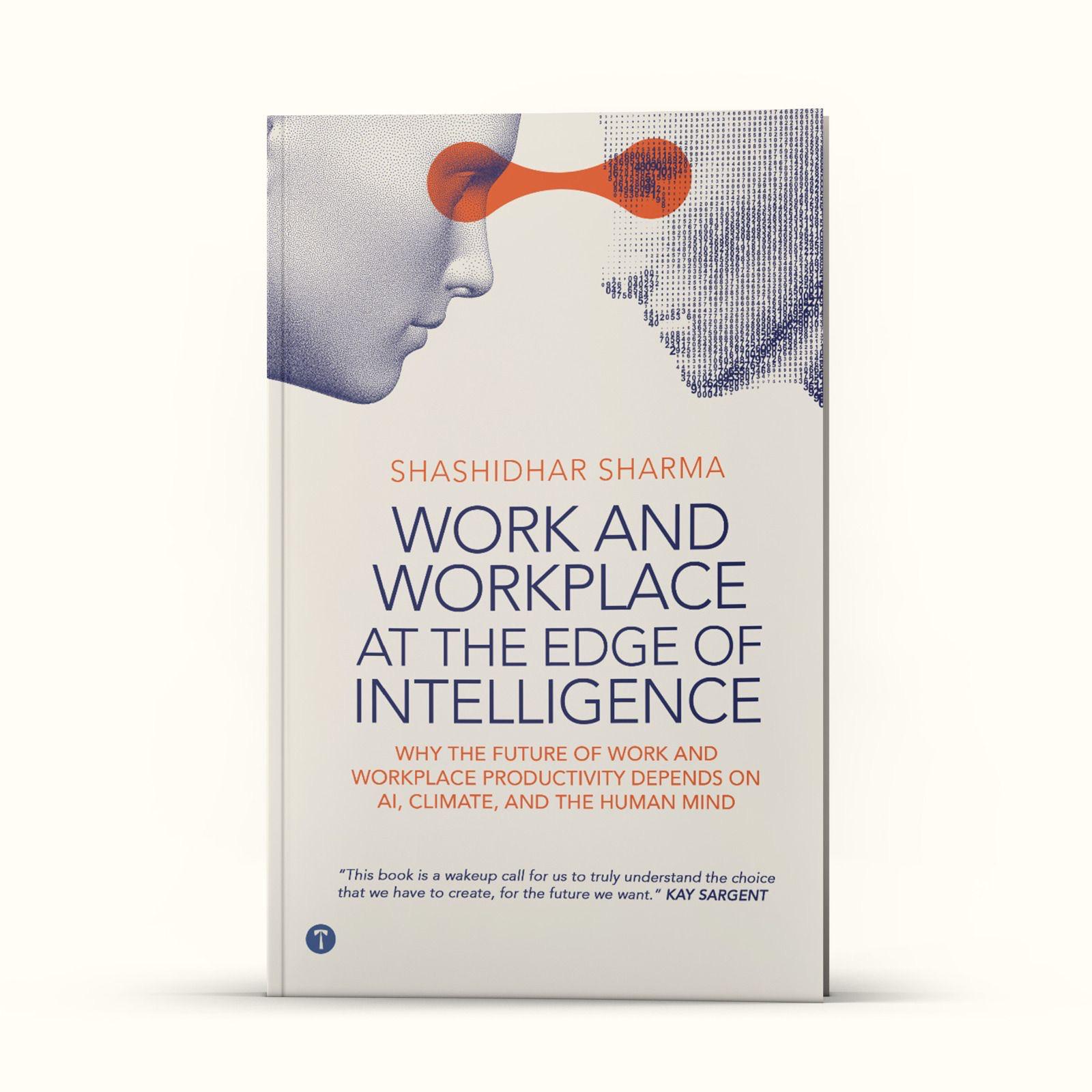
In today’s world, where almost all of us interact with artificial intelligence in our daily lives, Shashidhar Sharma’s Work and Workplace at the Edge of Intelligence offers an eye-opening, multidisciplinary perspective on its growing influence. He does not examine artificial intelligence in isolation, but explores how it intersects with other forces, particularly climate change and the human mind, and how this convergence can affect our ability to concentrate.
Rather than treating advancing technology simply as a danger, Sharma shows how we can learn to coexist with it and use it to enhance our work. As AI tools become more sophisticated by the day, he argues, our challenge is not to become better than machines, but to protect the human mind’s ability to focus, reflect and think critically. Ultimately, it is the human mind that can guide computers and provide the greatest value.
Everyone talks about artificial intelligence as a handy tool that makes daily life easier, whether it is creating a workout plan or designing a flyer. But Sharma argues that we are missing the bigger picture: the profound shift taking place in the way human minds interact with technology.
He identifies the primary danger not as artificial intelligence taking away everyone’s jobs, but as what he calls “Artificial Limitation”: the possibility that AI could gradually take away our ability to think independently and weaken our mental faculties.
How many times have you wanted to write an Instagram caption and, instead of writing it yourself, decided to use ChatGPT or Gemini? This is precisely what Sharma wants us to pay attention to.
One of the author’s most inspiring mottos, and one worth remembering, is “Refuse to Be Harvested”. The phrase reminds us to protect our attention, be conscious of where it goes and resist the pull of dopamine-driven distractions. In a world increasingly built around instant gratification, “Refuse to Be Harvested” is a reminder not to fall into that trap.
Another notable aspect of the book is that Sharma does not approach artificial intelligence purely through a technological lens. Instead, he examines it through the lens of human experience. He explores how productivity, workplaces, climate realities and human behaviour are interconnected in shaping the future of work.
Work & Workplace at the Edge of Intelligence offers a 70/30 Centaur Model, representing a partnership between humans and artificial intelligence. According to this model, 70 per cent of the work is performed by AI, handling data, matching patterns and similar tasks, while the remaining 30 per cent is performed by humans, involving critical thinking, empathy, final judgements and other distinctly human capabilities.
Sharma also looks beyond the relationship between artificial intelligence and humans to examine the architecture of the workplace, both physical and digital. He argues that workplaces should be designed in ways that help employees focus on important tasks while reducing mental fatigue.
The book also brings climate change into the conversation. At a time when one part of the world is embracing artificial intelligence without thinking twice, while another is increasingly concerned about the environmental damage caused by technology, Sharma draws attention to an often-overlooked dimension. The book points out that every prompt we use carries an energy cost. Data centres consume enormous amounts of electricity and contribute to global carbon emissions, while also requiring large quantities of water for cooling. Sharma argues that our desire to get work done more quickly is not only draining our minds but also placing an unsustainable strain on the Earth and on future generations.
What makes Work & Workplace at the Edge of Intelligence different is that it is an accessible read. It is free from heavy corporate and technological jargon. Through simple language and real-life stories, Sharma makes the subject engaging and accessible. The book also offers actionable frameworks to help readers move from conventional workflows towards approaches that are more resilient and cognitively inclusive.
The central idea of the book is a call to reclaim our humanity even as we become increasingly technology-driven. Skills such as empathy and critical thinking, along with other human competencies, are presented as some of the most important competitive advantages of this decade.
Sharma leaves readers with a critical question: How can we humans remain sharp, focused and truly human in a world of rapidly advancing technology?
Work & Workplace at the Edge of Intelligence is a worthwhile read for CEOs, HR practitioners, facility managers and professionals trying to remain creative, focused and productive in a rapidly changing world. It is a book about the future of work and the workplace that seeks to bridge the gap between high-end technology and everyday human life. Above all, it encourages us to think, remember and become better and smarter human beings.