

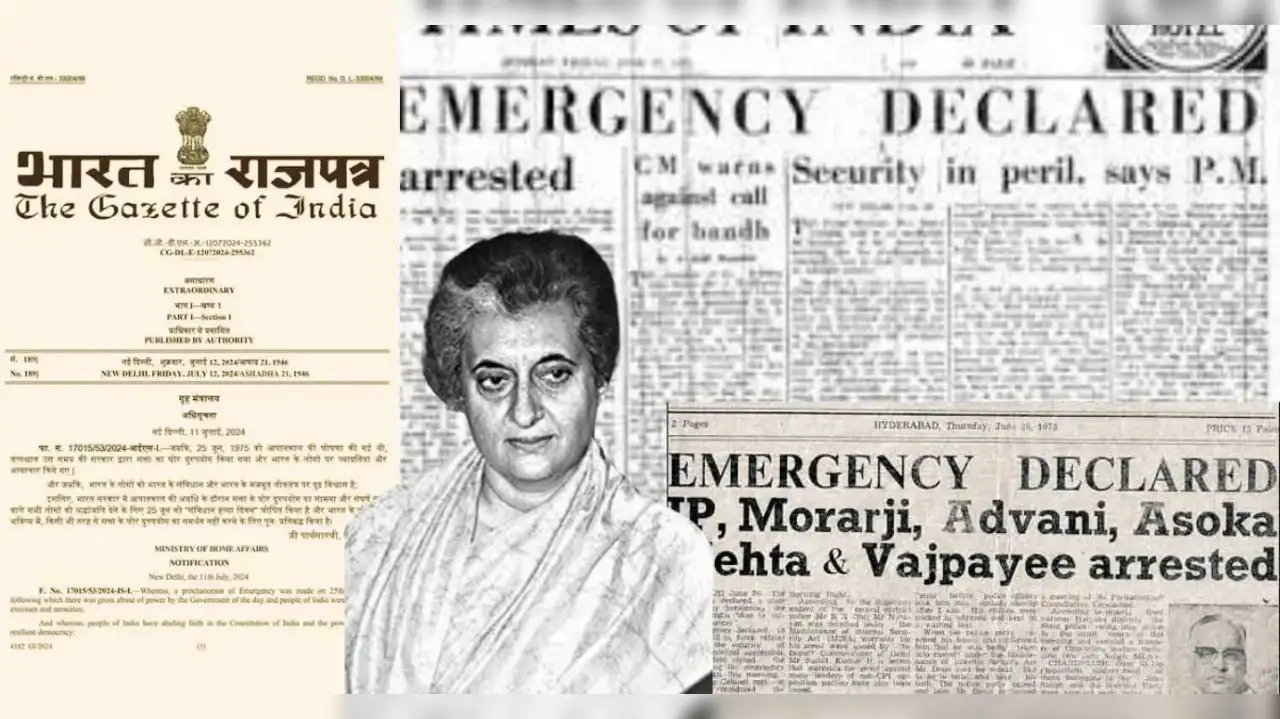
At midnight on 25 June 1975, Prime Minister Indira Gandhi proclaimed a national Emergency under Article 352 of the Constitution. The immediate trigger was the Allahabad High Court’s judgment invalidating her election to Parliament, threatening both her position and the stability of her government.
The Emergency not only enabled her to retain office but also fundamentally altered India’s democratic framework. Judicial oversight was curtailed, press censorship was imposed, civil liberties were suspended, and sweeping constitutional amendments were enacted. Hundreds of opposition leaders and thousands of political activists were imprisoned, while coercive policies, including forced sterilisation, became defining features of the period.
Defining Characteristics of the 1975 Emergency
The National Emergency declared on 25–26 June 1975 was characterised by an unprecedented concentration of executive power.
Suspension of Fundamental Rights: Civil liberties, including the right to life and personal liberty under Article 21, were effectively suspended. Citizens could be detained without trial under the Maintenance of Internal Security Act (MISA). Several organisations, including the RSS, were banned because they threatened public order. Historian Shamsul Islam has documented letters written by the then RSS chief, Balasaheb Deoras, to Prime Minister Indira Gandhi requesting the lifting of the ban on the organisation. No reply was forthcoming.
Mass Arrests: Nearly 100,000 political opponents, journalists, trade unionists and activists were detained without charge or access to legal counsel. Among those imprisoned were Jayaprakash Narayan, Morarji Desai and Atal Bihari Vajpayee.
Press Censorship: Newspapers and broadcasters were subjected to pre-publication censorship. Editors were required to obtain official clearance before publishing news reports, editorials and photographs.
Curtailment of Judicial Powers: Courts were prevented from reviewing Emergency proclamations or entertaining habeas corpus petitions. Constitutional amendments insulated the prime minister’s election from judicial scrutiny and sharply limited judicial oversight.
Restrictions on Labour: Trade unions were suppressed, strikes were prohibited, wages were frozen, and labour rights were substantially weakened.
Authoritarian Policies: Democratic processes were bypassed to implement controversial policies, most notably Sanjay Gandhi’s coercive family-planning programme, which resulted in widespread forced and pressured sterilisation.
Grounds for the Emergency: The Emergency was proclaimed under Article 352 on the broad ground of ‘internal disturbance’. Recognising the potential for abuse, the Constitution was amended in 1978 to replace this expression with the narrower term ‘armed rebellion’.
Indira Gandhi’s Defence of the Emergency
In an interview with the BBC in September 1975, Indira Gandhi defended the Emergency on two principal grounds.
First, she argued that the government had acted within the Constitution. ‘I have not taken any powers whatsoever,’ she maintained, adding that the government had merely detained several people and banned organisations that, in its view, promoted violence and anarchy. When challenged that denying detainees access to the courts amounted to extraordinary power, she acknowledged that it involved “a little bit of extra power” but insisted that the prevailing situation justified such measures.
Second, she defended the suspension of civil liberties as necessary to preserve national unity and integrity. Referring to Abraham Lincoln’s suspension of habeas corpus during the American Civil War, she argued that governments are sometimes compelled to choose between safeguarding constitutional liberties and preserving the nation itself. “Do you want India to continue as a united entity”, she asked, “or do you want anarchy”?
What Is an ‘Undeclared Emergency’?
Unlike the formally proclaimed Emergency of 1975, the expression ‘undeclared emergency’ has no constitutional status. It is a political and analytical term used by critics to describe a gradual erosion of democratic institutions, civil liberties and constitutional safeguards without the formal invocation of Article 352.
According to this view, democratic backsliding today is less visible but no less significant. Rather than suspending the Constitution outright, governments may rely on legal instruments, administrative pressure, institutional capture and economic leverage to achieve outcomes similar to those witnessed during a formally declared Emergency.
Whether this comparison is justified remains a matter of political debate, but it has become an increasingly prominent feature of discussions about the health of Indian democracy.
Signs of an ‘Undeclared Emergency’
Critics who draw parallels with the Emergency of 1975 argue that, although no formal proclamation has been made, several developments indicate a gradual weakening of constitutional safeguards and democratic institutions. Reports by civil liberties organisations, journalists and international watchdogs identify several recurring concerns.
The BJP government in West Bengal has removed even eggs from the Mid-day Meal diet of the poor children studying in schools and anganwadis. The civil liberties and the dietary needs of children are thereby infringed.
Media Freedom and Structural Control
During the Emergency of 1975, censorship was direct and legally enforced. Today, critics argue, media control is exercised not through formal censorship but through economic and institutional pressure.
India ranks 157th of 180 countries in the Reporters Without Borders (RSF) World Press Freedom Index, reflecting concerns about the deteriorating environment for independent journalism. While newspapers and television channels are not required to obtain prior government approval before publication, many observers point to the increasing prevalence of self-censorship.
They argue that this stems from a combination of factors. Governments at both the Centre and the States are among the country’s largest advertisers, giving them considerable influence over media revenues. Public advertising is often alleged to favour supportive media organisations while being reduced or withheld from critical publications, creating strong incentives for editorial restraint.
Media ownership has also become increasingly concentrated among a handful of large corporate groups with significant commercial interests and close links to political power. In the absence of robust anti-concentration and cross-media ownership laws, critics argue that independent journalism has steadily given way to corporate and political interests.
UAPA and Prolonged Detention
Another frequently cited concern is the extensive use of the Unlawful Activities (Prevention) Act (UAPA), India’s principal anti-terrorism law.
The legislation contains stringent bail provisions, making release before trial exceptionally difficult. Human rights organisations argue that, because investigations and trials often take years, prolonged incarceration effectively amounts to punishment before conviction. Official data also indicate relatively low conviction rates under the Act.
Among those detained under the UAPA in recent years are Umar Khalid, Sharjeel Imam, Father Stan Swamy, Sudha Bharadwaj, Shoma Sen, Varavara Rao, Prabir Purkayastha, Anand Teltumbde, Gautam Navlakha, Rupesh Kumar Singh and Surendra Gadling. Their cases have become central to the debate over whether anti-terror legislation is increasingly being used against journalists, academics, students and civil rights activists.
The Government rejects this criticism, maintaining that the UAPA is an essential instrument for combating terrorism and safeguarding national security.
Encounter Killings
Human rights organisations have also raised concerns about police ‘encounter’ killings, particularly in Uttar Pradesh.
Official figures indicate that more than 17,000 police operations over the past nine years resulted in the deaths of 289 suspected criminals. The State Government has defended these operations as necessary measures against organised crime and dangerous offenders.
Civil liberties groups, however, contend that many such encounters amount to extrajudicial killings that bypass due process and judicial scrutiny, raising important constitutional questions about the rule of law.
Civil Liberties and Minority Rights
Another area of concern relates to the treatment of religious minorities, particularly Muslims. Human rights organisations and several Muslim bodies have documented increasing restrictions on religious practices in some parts of the country, including interference with public prayers and local administrative actions affecting religious freedom.
Supporters of the Government reject allegations of discrimination, arguing that such measures are directed solely at maintaining law and order. Critics, however, regard them as indicative of a broader pattern of marginalisation.
SIR, Electoral and Constitutional Institutions
Questions have also been raised about the functioning and perceived independence of constitutional institutions.
Opposition parties and several commentators argue that the Election Commission has become less autonomous, while central investigative agencies, including the Enforcement Directorate (ED), the Central Bureau of Investigation (CBI) and the Income Tax Department, are alleged to disproportionately target opposition leaders. The Government has consistently denied these allegations, maintaining that all investigations are conducted strictly in accordance with the law and without political bias.
Recent controversies surrounding the Election Commission’s Special Intensive Revision (SIR) of electoral rolls have sparked protests. Civil society groups allege that these drives are being used to arbitrarily delete legitimate voters, thereby harking reference to the curtailment of civil rights and, hence, an “undeclared emergency”. In a recent interview with Teesta Setalvad on Sabrang India, veteran journalist and former The Telegraph editor R. Rajagopal detailed how he was abruptly disenfranchised and had his passport renewal stalled following West Bengal’s SIR of electoral rolls. His name was deleted, with authorities claiming they could not trace his or his late father’s name from 2002 records. Rajagopal missed his daughter’s wedding in the USA due to a lack of a passport. If this could happen to a well-known editor, like Rajagopal, the SIR could threaten fundamental civic rights and could render millions of ordinary citizens vulnerable to disenfranchisement.
Forced Sterilisation: Then and Afterwards
The Emergency cannot be understood without recalling the coercive sterilisation programme associated with Sanjay Gandhi.
During 1975–76, family-planning targets were aggressively pursued, particularly among poor men. Numerous reports described police rounding up villagers and compelling them to undergo sterilisation. Approximately 6.2 million sterilisation procedures were reportedly carried out in a single year, and thousands of deaths were attributed to botched operations. The programme remains one of the most controversial episodes of the Emergency.
However, sterilisation did not end with the Emergency. India has continued to operate one of the world’s largest family-planning programmes. During 2013–14, nearly four million sterilisations, predominantly of women, were performed. The deaths of 15 women following botched sterilisation procedures at government camps in Chhattisgarh highlighted continuing concerns about safety, informed consent and public health practices.
The origins of India’s large-scale sterilisation programme predated the Emergency itself. Beginning in the early 1970s, with financial support from international agencies, including the World Bank, the Swedish International Development Authority and the United Nations Population Fund, successive governments pursued ambitious population-control policies. The Emergency transformed these policies into a coercive campaign, but debates over reproductive rights and informed consent have continued long after its formal end.
Similarities and Differences
The comparison between the declared Emergency of 1975 and what critics describe as an “undeclared emergency” today should not obscure the important differences between the two periods.
There are, nevertheless, certain similarities. In both periods, critics allege that state institutions have been used to intimidate political opponents, journalists and civil society activists. Media freedom has come under pressure, albeit through very different means. Both periods have also witnessed concerns about the growing concentration of authority within the Prime Minister’s Office and the weakening of institutional checks and balances.
The differences, however, are substantial. The Emergency of 1975 was a constitutionally proclaimed suspension of democratic rights under Article 352. By contrast, today’s situation involves no formal suspension of the Constitution. Elections continue to be held regularly, opposition parties govern several States, courts remain open, and independent media organisations continue to function, albeit under what critics describe as increasing pressure.
Likewise, the scale of state action differs considerably. The Emergency witnessed mass arrests of opposition leaders, blanket press censorship and sweeping restrictions on civil liberties across the country. Contemporary critics, by contrast, point to selective prosecutions, digital surveillance, economic pressure and the increasing use of stringent criminal laws rather than to a nationwide suspension of democratic rights.
Finally, the ideological context is different. The Emergency of 1975 was primarily intended to preserve the political survival of the ruling government following a judicial setback. Critics argue that contemporary developments reflect a broader ideological project involving long-term changes in state institutions, governance structures and the relationship between the State and civil society.
Defending Exceptional Powers: Then and Now
Indira Gandhi defended the Emergency on two principal grounds. First, she maintained that her government had acted within the Constitution and had assumed only “a little bit of extra power” in response to an extraordinary situation. Second, invoking Abraham Lincoln’s suspension of habeas corpus during the American Civil War, she argued that preserving the unity and integrity of the nation sometimes required temporary curbs on civil liberties.
How does this compare with the present Government’s defence of stringent laws such as the Unlawful Activities (Prevention) Act (UAPA)?
There is no public statement by the present Prime Minister suggesting that the Government has assumed ‘extra powers’ comparable to those acknowledged by Indira Gandhi during the Emergency. On the contrary, the Government has consistently maintained that it is acting fully within the constitutional framework.
The Government has defended the UAPA as an indispensable instrument in the fight against terrorism and threats to national security. Prime Minister Narendra Modi has repeatedly articulated a policy of ‘zero tolerance’ towards terrorism and has argued that law-enforcement agencies must be equipped to deal not only with those who resort to violence but also with those who, in his words, “mislead the youth” through ideology and propaganda.
The Union Government has also defended the stringent bail provisions of the UAPA before the Supreme Court, arguing that the ordinary principle that “bail is the rule” cannot be uniformly applied in terrorism-related cases because of the grave implications for national security and the complexity of such investigations.
Civil liberties organisations, constitutional scholars and opposition parties contest this position. They argue that prolonged pre-trial detention, low conviction rates and the application of anti-terror legislation to journalists, students and human rights activists undermine the presumption of innocence and erode fundamental constitutional freedoms.
The debate, therefore, differs from that of 1975. Rather than openly defending the suspension of civil liberties in the name of national unity, the present Government presents its actions as necessary measures to combat terrorism and protect national security. Whether this distinction is substantive or merely one of method remains the central point of disagreement between the Government and its critics.
Role of the RSS
One significant difference between the Emergency of 1975 and the present political environment concerns the Rashtriya Swayamsevak Sangh (RSS).
During the Emergency, the RSS was banned and its leaders were imprisoned. Historical records show that the then RSS chief, Balasaheb Deoras, wrote several letters to Prime Minister Indira Gandhi seeking the withdrawal of the ban and expressing support for some of the Government’s stated objectives during the Emergency.
Today, by contrast, critics argue that the RSS exercises considerable influence across a wide range of public institutions and social organisations. They point to its expanding role in educational initiatives, cultural organisations, social mobilisation and electoral campaigns. Supporters of the RSS reject this characterisation, maintaining that it is a voluntary cultural organisation engaged in nation-building and civic service.
Critics, however, argue that the organisation’s expanding influence raises broader questions about the relationship between political power and ideological mobilisation. They contend that this institutional presence enables the Government to exercise influence beyond formal constitutional structures and may become even more significant should future political circumstances require extraordinary measures.
Conclusion
The Emergency of 1975 remains one of the defining moments in the history of the Indian Republic. It demonstrated how constitutional democracy can be weakened through the concentration of executive power, the suspension of civil liberties and the erosion of institutional checks and balances.
The contemporary debate over an “undeclared emergency” is necessarily more complex. Unlike in 1975, there has been no formal proclamation under Article 352, no blanket suspension of fundamental rights, no nationwide press censorship and no mass imprisonment of opposition leaders on the scale witnessed during the Emergency. Democratic institutions continue to function, elections are held regularly, and constitutional remedies remain available.
At the same time, critics argue that democracy may be weakened not only through dramatic constitutional measures but also through gradual institutional change. They point to the growing use of stringent security laws, increasing pressure on independent media, concerns about the autonomy of constitutional institutions, prolonged pre-trial detention and the shrinking space for dissent as evidence of a more subtle form of democratic backsliding.
Whether these developments amount to an “undeclared emergency” is ultimately a matter of political and constitutional judgment.
The enduring lesson of the Emergency is not confined to a single period of India’s history. Rather, it is that constitutional democracy depends not only on elections and formal legal procedures but also on an independent judiciary, a free press, accountable institutions and the protection of civil liberties. Preserving these values remains the responsibility of every generation.
(Aurobindo Ghose is a human rights activist and former lecturer in Economics at the University of Delhi. His doctoral research examined monopoly in the Indian economy. After retiring from academia, he practised law and has written extensively on constitutional, economic and human rights issues)