


By S. Krishnan and Aman Chandel
Temples in India are more than places of worship. They are enduring centres of faith, culture and community life, drawing millions of devotees every year in search of spiritual solace, blessings and a connection with the divine. For centuries, they have symbolised not only religious devotion but also the idea that every individual stands equal before God, irrespective of wealth, caste, social status or occupation.
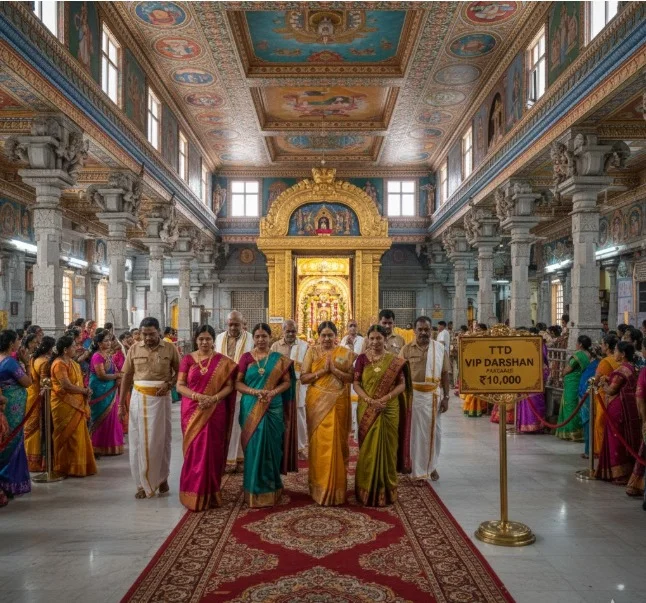
In recent decades, however, many of India’s most prominent temples have adopted a system of paid VIP darshan, allowing devotees to purchase quicker access to the deity while others wait in long queues. Temple administrations defend the practice as a practical response to ever-growing crowds and an important source of revenue. Critics, however, see it as the commercialisation of faith and a departure from the principle of spiritual equality.
The debate is not merely about queue management or convenience. It raises larger questions about the relationship between faith, money and constitutional values in a modern democracy. Can access to the divine legitimately be differentiated by one’s ability to pay? Or does such a system undermine the very ideals that religious institutions are expected to uphold?
Equality Before God
One of the most fundamental principles shared by almost every religious tradition is that all believers are equal before the divine. While social hierarchies may exist in everyday life, places of worship are expected to transcend those divisions. A temple is not merely a physical structure; it is a sacred space where humility, devotion and surrender take precedence over worldly distinctions.
Paid VIP darshan challenges this ideal by creating two categories of worshippers. Those who can afford premium tickets receive quicker and more comfortable access to the deity, while ordinary devotees often spend several hours in crowded queues. Although both groups ultimately receive darshan, the experience itself becomes unequal.
This distinction is particularly striking because the privilege is not based on age, disability or medical necessity but, in many instances, on financial capacity. The resulting perception is that money can purchase a superior religious experience. Even if this is not the intention of temple administrations, it is an impression that cannot easily be ignored.
Faith has traditionally been regarded as one of the few domains where material wealth carries little significance. When economic privilege begins to influence access to sacred spaces, questions naturally arise about whether religious institutions are drifting away from their foundational values.
Burden on Ordinary Devotees
The practical consequences of paid VIP darshan are experienced most acutely by ordinary pilgrims. Whenever VIP devotees are accommodated, general queues are often halted, extending waiting times for thousands of others. During festivals and peak pilgrimage seasons, these interruptions can add several hours to an already demanding wait. What should be a spiritually fulfilling journey sometimes becomes an exhausting test of patience.
The hardship is particularly severe for elderly people, women accompanied by young children and devotees with health concerns. Many travel hundreds of kilometres after saving for months to undertake what may be a once-in-a-lifetime pilgrimage. Watching others move ahead simply because they have paid for priority access can leave a lasting sense of disappointment.
The issue extends beyond physical inconvenience. Worship is deeply personal and emotionally significant. When devotees perceive that wealth can secure a more meaningful or dignified encounter with the deity, it risks diminishing the sanctity of the experience itself. The spiritual satisfaction derived from darshan should never appear to depend upon one’s purchasing power.
Frequent interruptions to regular queues also complicate crowd movement. Instead of improving efficiency, repeated diversions for VIP access can create confusion, congestion and frustration among waiting pilgrims.
Commercialisation of the Sacred
The growth of paid VIP darshan reflects a broader trend towards the commercialisation of religious institutions. There is little dispute that temples require substantial financial resources. Maintaining large premises, preserving heritage structures, ensuring sanitation, providing security, operating accommodation facilities and conducting charitable activities all involve considerable expenditure. Revenue is therefore essential. The question is not whether temples should generate income but how that income should be generated. When premium access becomes an important revenue stream, worship begins to resemble a service that can be upgraded through payment. The danger lies not merely in the collection of fees but in the gradual transformation of religious institutions into organisations driven by commercial considerations.
For many devotees, the symbolism matters as much as the practice itself. If access to the deity appears to have different price categories, it can weaken public confidence in the impartiality and spiritual character of religious institutions.
Religion occupies a unique place in Indian society because it has historically served as a source of moral guidance, social cohesion and cultural continuity. Excessive commercialisation risks undermining that moral authority.
Social Justice and Religious Access
India continues to grapple with significant economic inequality. Religious institutions have traditionally offered spaces where such disparities become less visible, fostering a sense of shared identity and collective belonging.
Paid VIP darshan risks reinforcing precisely those inequalities.
Affluent devotees enjoy greater convenience, while economically disadvantaged worshippers bear the burden of longer waiting times. Such distinctions become particularly uncomfortable because they occur within institutions that are sustained by contributions from devotees across all sections of society.
Most temples receive donations from people irrespective of income levels. Small offerings from ordinary devotees collectively contribute significantly to temple finances. It is therefore understandable that many question whether differential access based on financial capacity is compatible with the principle of equal participation in religious life.
The issue is not one of resentment towards those who purchase special tickets. Rather, it concerns whether religious institutions should institutionalise economic distinctions in spaces intended to promote spiritual equality.
Constitutional and Legal Dimensions
The debate also has constitutional implications. Articles 25 and 26 of the Constitution guarantee freedom of religion while recognising the rights of religious denominations to manage their own affairs. At the same time, Article 14 guarantees equality before the law and equal protection of the laws.
Temple administrations undoubtedly possess legitimate authority to regulate pilgrim movement, ensure public safety and maintain orderly worship. Large pilgrimage centres cannot function without effective administrative mechanisms.
The legal question is therefore one of reasonable classification. If priority access is provided to senior citizens, persons with disabilities, pregnant women or individuals with genuine medical needs, such differentiation is clearly linked to legitimate administrative objectives. Similarly, temporary restrictions for security reasons may also be justified.
However, when preferential treatment is extended primarily based on payment, constitutional concerns become more complex. Although courts have generally recognised the administrative autonomy of temple authorities, they have also emphasised that public religious institutions must function in a manner consistent with constitutional principles. The challenge lies in balancing administrative efficiency with the constitutional commitment to fairness and equality.
Case for VIP Darshan
Despite the criticism, the arguments supporting paid VIP darshan cannot simply be dismissed. Many of India’s major temples receive tens of thousands of visitors every day, with numbers rising dramatically during festivals and auspicious occasions. Managing such enormous crowds requires sophisticated infrastructure, substantial manpower and continuous investment.
Revenue generated through premium entry tickets often helps finance temple maintenance, sanitation, security, accommodation facilities and charitable programmes. Several temple trusts operate hospitals, educational institutions, free meal schemes and other welfare initiatives that benefit society at large.
Separate queues may also improve crowd distribution by reducing pressure on general waiting areas. For devotees travelling on tight schedules because of professional commitments, premium entry can offer practical convenience without necessarily preventing others from receiving darshan.
Viewed from this perspective, paid VIP darshan is not merely a commercial exercise but an administrative tool that supports the functioning of complex religious institutions. The issue, therefore, is not entirely one-sided. It requires a nuanced assessment rather than absolute acceptance or outright rejection.
Towards a Fairer System
The real challenge is to reconcile administrative necessity with spiritual values. Rather than abolishing paid VIP darshan altogether or expanding it without restraint, temple administrations should adopt reforms that preserve fairness while improving efficiency.
Priority access should primarily be reserved for senior citizens, persons with disabilities, pregnant women and individuals with genuine medical needs. Such need-based prioritisation reflects compassion rather than privilege.
Technology offers several practical alternatives. Online booking systems, digital queue management, time-slot reservations and real-time crowd monitoring can significantly reduce waiting times without creating visible disparities among devotees.
Investment in infrastructure is equally important. Larger waiting halls, better seating arrangements, clean drinking water, improved sanitation and more efficient queue management can substantially enhance the experience of ordinary pilgrims.
If paid special-entry tickets continue to exist, their numbers should be carefully regulated so that they do not cause repeated disruptions to general queues. Transparency is equally essential. Temple authorities should publicly disclose how revenue generated through premium darshan is utilised. Clear financial accountability would strengthen public confidence and reassure devotees that the funds are being used for maintenance, heritage conservation and charitable purposes rather than commercial gain.
Preserving the Spirit of Worship
The debate over paid VIP darshan ultimately reflects a broader tension between tradition and modern administration. Temples today must accommodate unprecedented numbers of visitors while maintaining safety, order and financial sustainability. Administrative innovation is therefore unavoidable. Yet efficiency should never come at the cost of the ethical principles that make religious institutions worthy of public trust.
Places of worship derive their moral authority from the belief that every devotee approaches the divine with equal dignity. That belief should not be weakened by systems that create the impression that spiritual access can be purchased.
Technology, transparent governance and compassionate, need-based prioritisation offer practical ways to manage crowds without compromising the principle of equality. The objective should not simply be to move pilgrims through queues more efficiently but to ensure that every devotee, regardless of economic status, feels equally respected.
Ultimately, the strength of a temple is measured not by the speed with which a privileged few receive darshan, but by the fairness, dignity and inclusiveness with which it welcomes everyone who comes in faith.
(Dr S. Krishnan is a seasoned academician and experienced journalist based in Jaipur. Aman Chandel is a law student at the Seedling School of Law and Governance, Jaipur National University, Jaipur)
