

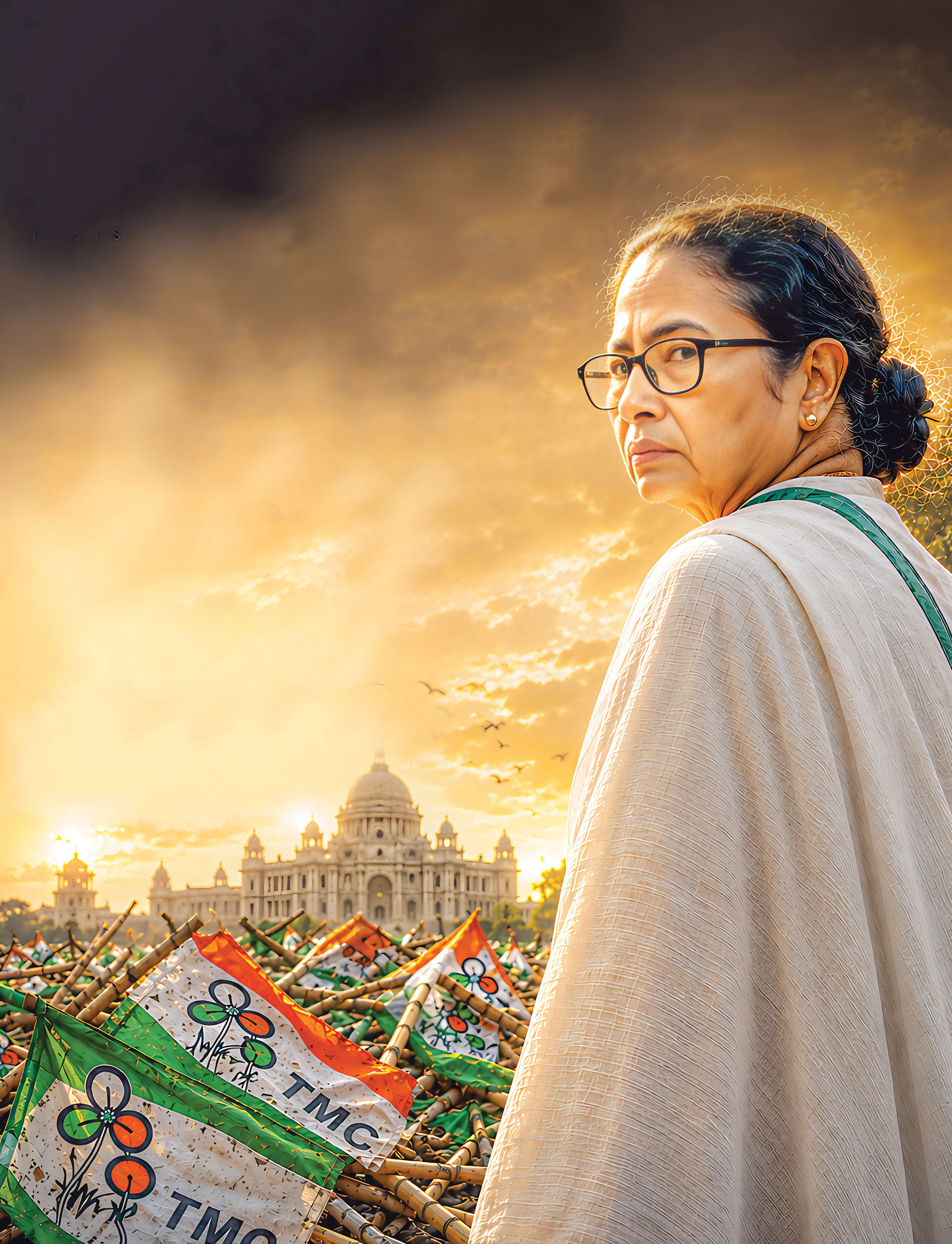
For years, West Bengal’s former Chief Minister Mamata Banerjee represented one of the most extraordinary political transformations in modern India. She emerged from the streets of Kolkata as a relentless anti-establishment agitator, challenged the seemingly immovable 34-year Left Front regime and ultimately dismantled one of the longest-serving Communist governments in democratic history. To millions across Bengal, she became far more than a chief minister. “Didi” was not merely a political identity. It was a moral construction. That moral authority became the foundation upon which her party, All India Trinamool Congress, built its political empire.
But over the years, as scandals multiplied, arrests intensified, corruption allegations widened, and financial investigations burrowed deeper into Bengal’s power structure, another narrative slowly began to emerge — one shaped not merely by opposition attacks, but by voices from within the very system that had once fuelled her rise. Former police officers, bureaucrats, journalists, ministers, political insiders and former associates–one after another, they began describing what they allege was not isolated corruption but a deeply embedded ecosystem of patronage and protection operating beneath Bengal’s political machinery, much of it allegedly under the nose of the all-powerful leader, Mamata Banerjee.
A New Delhi Post investigation, based on recorded testimonies, paints a politically devastating portrait. A portrait of a government, critics allege gradually transformed corruption from episodic misconduct into an administrative culture.
- Fortress Around Power
Perhaps the most damaging testimony before New Delhi Post comes from Dr Upen Biswas, former additional director of the CBI and later adviser under the Trinamool dispensation. Biswas was not an outsider peering into the administration from the opposition benches. He was part of the ecosystem itself. Mamata Banerjee personally brought him into the government after coming to power. That proximity, hence, gives his allegations unusual political weight.
According to Biswas, what he encountered inside the administration was not scattered corruption but an entrenched structure where wrongdoing allegedly survived because decisive intervention never came from the top.
“She closed her eyes,” he alleges while speaking about Mamata’s response to corruption inside the government.
That allegation lies at the heart of the wider political narrative now surrounding the Trinamool Congress. Not merely that corruption existed. But it allegedly flourished because political protection enabled it.
When asked by New Delhi Post why he had not stopped the corruption despite being an insider, Biswas further claims that ministers could not interfere in departments controlled by others and that meaningful intervention could come only from the chief minister herself.
The implication is profound. If corruption spread across recruitment systems, financial networks, contracts and administrative structures, critics argue that such expansion could not continue without political shelter at the highest level.
The testimony also revisits the school recruitment scandal, one of the most explosive controversies to hit Bengal in recent memory. The SSC recruitment scandal did not merely expose allegations of bribery. It shattered faith. Thousands of educated young Bengalis who believed government jobs would reward merit suddenly found themselves confronting allegations that jobs themselves had become commodities. Raids, luxury apartments, mountains of seized cash and arrests transformed the scandal into a political nightmare for the Trinamool Congress.
But critics insist the scandal was never about one minister alone. They argue it reflected a deeper collapse in institutional accountability. A political culture where corruption allegedly evolved into a functioning ecosystem.
Biswas attempts to connect those dots. He also makes one especially controversial claim: that a high court judge privately told him Mamata Banerjee herself had allegedly accepted money in certain matters.
No documentary evidence supporting the claim has been publicly presented. Yet the allegation illustrates how deeply suspicion had allegedly travelled even within sections of the administrative establishment.
- Corruption Before Becoming CM
Former IPS officer Dr Nazrul Islam pushes the allegations further back to Mamata’s tenure as Union railways minister. Islam alleges that while examining railway ministry files, he encountered a corruption-linked matter allegedly connected directly to Mamata.
More dramatically, he claims attempts were made to involve him in questionable financial dealings. Islam further alleges that he possesses recorded material linked to the episode. “I can release the video,” he says.
The available material, however, does not establish whether such recordings were ever placed before any court or investigative agency. Yet politically, the testimony performs a critical function. It attempts to dismantle the long-standing defence that corruption allegations emerged only after Mamata consolidated power in Bengal. Instead, critics use such accounts to suggest that the roots of the alleged ecosystem predated her chief ministership itself.
- Parallel State Machinery
No scandal scarred Bengal’s political consciousness more deeply than the Saradha chit fund scandal collapse. For thousands of ordinary Bengalis, Saradha was not an abstract financial crime. Small investors lost life savings. Families collapsed under debt. Retired workers saw decades of earnings disappear overnight.
But as investigators began probing the financial empire behind the network, the scandal rapidly evolved into something larger. And this is where noted journalist Suman Chattopadhyay delivers some of the most explosive allegations in the testimonies. Once regarded as close to Mamata, Chattopadhyay directly alleges that the former CM and the Trinamool Congress benefited from the Saradha network. “Everybody knows that she is personally a beneficiary of Saradha. Her party is a beneficiary of Saradha,” he claims.
Among the most controversial allegations repeatedly revisited over the years is the claim that a painting by Mamata was allegedly purchased for more than Rs 1 crore by entities linked to the chit fund network. Critics argue that the transaction became symbolic of the alleged nexus between political authority and financial operators. Chattopadhyay further alleges that Mamata held secret meetings with Saradha and Rose Valley figures in the Darjeeling Hills. Still, politically, the allegations remain explosive because they attempt to establish not merely an indirect association, but personal proximity.
The testimony also revisits statements made by Trinamool Congress leader Kunal Ghosh during the Saradha investigation. Ghosh repeatedly alleged in court that Mamata was the “biggest beneficiary” of the scam. “Let CBI have a sitting organised between Mamata Banerjee and me,” Chattopadhyay recalls Ghosh as saying.
No court has convicted Mamata in connection with the Saradha case. That distinction remains legally important. But politically, Saradha fundamentally altered public perception. Because the scandal fused financial fraud with allegations of political patronage.
If Saradha symbolised the alleged overlap between political power and financial networks, the allegations surrounding political consultancy firm Indian Political Action Committee raised another disturbing question: Who was really running Bengal’s governance structure after 2021? According to Chattopadhyay, Bengal allegedly began functioning under what he describes as a “parallel state”. “Every inch of Bengal is under their control,” he claims.
The allegation is extraordinary. Not because political consultants are unusual in modern elections. But because the testimonies suggest something far beyond campaign management. According to the allegations, government contracts above Rs 3 crore allegedly required vetting through political strategists. Files from government departments allegedly travelled to the offices or residences of consultants.
Bureaucrats who resisted allegedly found themselves sidelined. “What sports and youth welfare files of a government are doing in a political strategist’s office or house?” Chattopadhyay asks.
Across India, political consultancy firms have become increasingly influential in electoral strategy. But the testimonies here allege something far more serious, that governance itself became intertwined with electoral management and political control. The allegations also intersect with broader concerns inside the Trinamool Congress over the concentration of influence around a shrinking inner circle and the growing prominence of Abhishek Banerjee, her nephew and an MP.
A political structure allegedly controlled not merely through party organisation, but through bureaucracy, contracts, strategy networks and administrative influence.
- The Insider Revolt
Former minister and current MLA Humayun Kabir makes another deeply damaging allegation. According to the testimonies, Kabir claims that money allegedly influenced the distribution of election tickets within the Trinamool Congress.
The testimonies collectively seek to construct precisely that argument: that corruption under the Trinamool regime allegedly evolved beyond isolated scandals and became woven into the functioning of political power.
Among all the testimonies, few carry the symbolic significance of Jawhar Sircar. A retired IAS officer, former CEO of Prasar Bharati and former Rajya Sabha MP nominated by the Trinamool Congress, Sircar was once considered part of Mamata’s intellectual and administrative inner circle. His allegations are sharp enough: Mamata was aware of many crimes and instances of corruption. She protected her party leaders despite huge public resentment.
What gives these allegations unusual political force is the profile of those making them: former insiders, bureaucrats and associates who once operated close to the centre of power. Their testimonies seek to challenge Mamata’s carefully cultivated image as a leader untouched by corruption, portraying instead an allegedly centralised system where corruption was not incidental but protected and institutionalised.
None of the allegations establishes legal guilt, and many remain without a judicial conclusion. Yet in politics, perception often shapes reality as powerfully as court verdicts. The allegations seek to portray Mamata not as a distant leader allegedly surrounded by corrupt subordinates, but as the central authority presiding over an intensely centralised political system.
To supporters, the claims may appear politically motivated or unproven. To critics, they reinforce a deeper suspicion: that under the Trinamool Congress, corruption allegedly evolved from isolated scandal into a governance culture. At the core of the allegations lies one recurring charge that corruption survived because political authority allowed it to survive. And that accusation strikes directly at the moral foundation upon which Mamata built her political rise.
GFX
UPENDRA BISWAS
Former minister and former additional director, Central Bureau of Investigation
‘Mamata Knew Everything’
- I personally advised Mamata Banerjee to act against corruption
- I also spoke to several leaders whose names were surfacing in multiple corruption cases. “One or two fellows” listened to me, but most continued operating in the same manner
- Mamata knew everything that was happening, but chose to “close her eyes” to corruption
- In several cases, individuals accused of corruption were allegedly shielded from legal action
- A high court judge once told me that Mamata Banerjee had “even taken money”
- Although I was a minister in her cabinet, my hands were institutionally tied. One minister cannot directly interfere in another minister’s department; only the chief minister can intervene decisively. Despite being aware of wrongdoing, I felt constrained by the system
NAZRUL ISLAM
Former IPS officer who worked closely with Mamata
‘She Wanted Me to Collect Money’
- When Mamata Banerjee was Union railways minister, she sent several corruption-related files to me for examination. During the process, I found numerous loopholes and irregularities
- When I raised those concerns, I realised that the objective was not to expose corruption, but to secure something favourable
- “She tried to use me to collect more money. I can release the video.” The video remains in my possession as evidence
- I warned Mamata Banerjee that if the footage were released, she would have to answer publicly
- I possess concrete evidence and eyewitness testimony, which. according to me, establish her links to criminal conduct
HUMAYUN KABIR
Former minister in the All India Trinamool Congress government
‘Ticket for money common in Trinamool’
- There have long been serious allegations surrounding the distribution of party tickets within the Trinamool Congress. Money, clearly, played a major role in the process
- I possess documentary material relating to corruption allegations which, if made public, could “send shock waves through West Bengal politics”
SUMAN CHATTOPADHYAY
Veteran journalist and author
- Mamata Banerjee was, according to me, among the biggest political beneficiaries of the chit fund scandal. Her party, too, benefited enormously
- Mamata allegedly held secret meetings with the promoters of tainted chit fund companies such as Rose Valley Group and Saradha Group
- Key evidence had allegedly already been “hushed up” before the CBI formally took over the probe
- Trinamool Congress, in my assessment, is ideologically weak and deeply opportunistic; many entered politics primarily to make money
- In West Bengal, I-PAC operated like a “parallel state”, exercising extraordinary influence over governance after 2021
- Government contracts worth more than ₹3 crore allegedly required I-PAC’s approval
- Bureaucrats who resisted this parallel structure were sidelined or removed
- Sensitive government files were allegedly routed to a private political consultancy office
- Mamata’s relationship with Abhishek has, in my view, remained unstable and transactional — a continuing “roller-coaster ride”
(K. Ashish is an investigative journalist and editor-in-chief of ‘New Delhi Post’)