


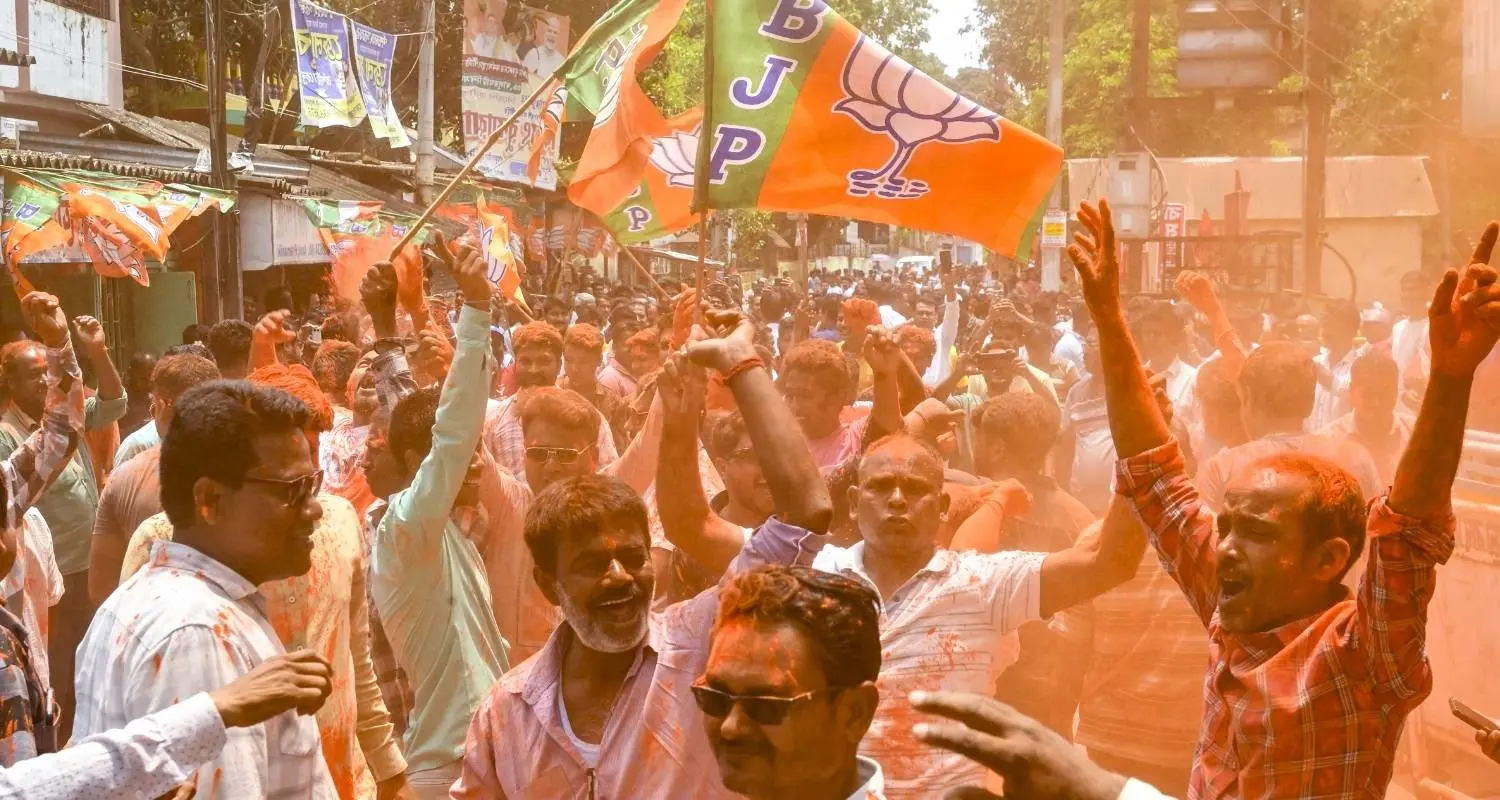
What ended the long, formidable run of Mamata Banerjee was not a single wave, but a convergence of pressures: administrative, economic, organisational and psychological. The defeat of the Trinamool Congress, hence, reflects a layered voter verdict. Stripped of rhetoric, here are the nine clearest faultlines that cumulatively brought her down:
GOVERNANCE FATIGUE SET IN: After over 15 years in power, the distinction between agitation politics and governance blurred. Mamata continued to rely on confrontation and symbolism, but voters increasingly demanded administrative delivery: roads, jobs, investment, law-and-order consistency. The “permanent protest” model of Mamata lost credibility as her establishment failed to deliver quality.
CORRUPTION BECAME PERSONAL & VISIBLE: Allegations, particularly around teacher recruitment and municipal contracts, were no longer abstract. Arrests, investigations, and daily headlines created a perception of entrenched corruption. The moral edge Mamata once held against the Left eroded sharply, and the damage was reputational as much as electoral.
WELFARE HIT ITS CEILING: Schemes like “Kanyashree” and “Lakshmir Bhandar” built a loyal base, especially among women. But over time, cash transfers without economic expansion began to feel like maintenance, not progress. Voters started asking a harder question: where are the jobs and upward mobility?
ECONOMIC STAGNATION BECAME UNAVOIDABLE: Industrial investment remained non-existent; private sector confidence was uneven; youth migration continued. Bengal’s growth narrative struggled against the lived reality of job scarcity. For first-time voters, aspiration replaced gratitude and aspiration was unmet.
ORGANISATIONAL DECAY INSIDE TMC: The party’s grassroots machinery weakened as local units became associated with patronage networks. Decision-making centralised around a tight inner circle. This reduced internal feedback loops and made course correction difficult. In contrast, the BJP expanded aggressively at the booth level. Mamata’s highly personalised style meant that successes were hers, but so were failures. With institutions weakened or bypassed, there was no buffer between governance lapses and public anger.
HINDU CONSOLIDATION & SHIFTING IDENTIRY POLITICS: Bengal’s political culture, once dominated by class and ideology, saw a rise in identity-driven mobilisation. The BJP capitalised on sections of Hindu consolidation, especially in border and semi-urban districts. Mamata’s balancing act, minority outreach plus secular messaging, began to look reactive and less convincing.
CAMPAIGN STRATEGY LOOKED DATED: The TMC leaned heavily on Mamata’s charisma, emotional appeals, and cultural symbolism–methods that had worked before. The BJP, however, ran a sharper, data-driven, multi-platform campaign that fused national narratives with local grievances. The mismatch in campaign intensity and technique was visible.
SILENT VOTERS TURNED DECISIVE: Public rallies and visible enthusiasm masked a quiet shift. Women voters, first-time voters and sections of rural Bengal voted for change without signalling it openly. Bengal’s tradition of “silent voting” reasserted itself, and this time, it worked against Mamata.
THE LONGEVITY TRAP: Every long regime faces diminishing legitimacy. Mamata rose in 2011 on a promise of change against 34 years of Left rule. After more than a decade, her government began to resemble the inertia it once opposed. Voters completed the cycle—they voted for change again.
The Bottom Line
This defeat is not just about a leader losing power; it is about an electorate recalibrating its expectations. Bengal’s voters have signalled that welfare without growth, charisma without credibility, and control without accountability have limits.
(Bikash C Paul is a Delhi-based senior journalist and executive editor of ‘New Delhi Post’)
