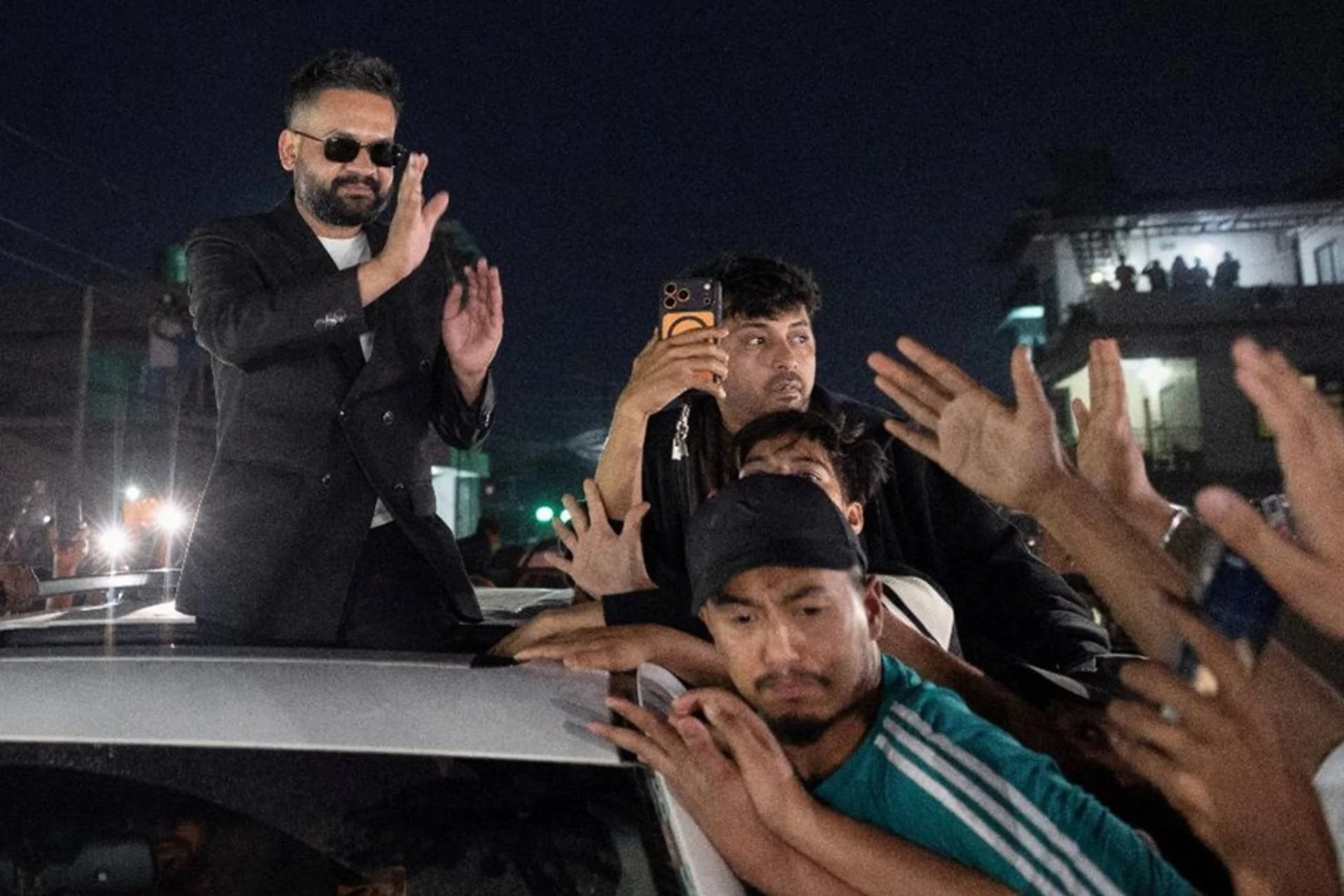
Nepal has entered a new political phase following the unexpected outcome of the March 5 parliamentary election. The landslide victory of the Rastriya Swatantra Party (RSP), led by former television host Rabi Lamichhane and boosted by rapper-turned-politician Balen Shah, has significantly altered the country’s political landscape.
For the first time in more than three decades, traditional political parties that dominated Nepal’s politics since the restoration of democracy in 1990 have been pushed to the margins. Major parties such as the Nepali Congress, the Communist Party of Nepal (Unified Marxist–Leninist) (CPN-UML) and the Maoists, even in combination, are not in a position to form a government, as the RSP has secured almost two-thirds of the votes. No political party has secured such a huge mandate since the first parliamentary election held in 1959, when the Nepali Congress (NC) secured two-thirds of the seats in parliament.
The election results are widely interpreted as a political reset for the Himalayan nation. With a two-thirds majority in the 275-member House of Representatives (HoR), the lower house, the RSP now has the numbers to form a single-party government, a situation not seen since 1999, when the NC secured a single-party majority.
The outcome has paved the way for the 35-year-old Balen Shah to be sworn in as one of the youngest prime ministers in the world. The mandate reflects deep public frustration with the political establishment and strong expectations for reform, accountability, and economic revival. One of the most symbolic victories of the election occurred in Nepal’s eastern Jhapa district. There, Balen Shah defeated three-time prime minister Khadga Prasad Sharma Oli by more than 68,000 votes.
Jhapa holds strategic significance due to its proximity to India’s narrow “chicken’s neck” corridor connecting mainland India to its northeastern states. The region has also been politically important for Oli, who has long maintained a strong base there through development initiatives.
The contest also carried geopolitical undertones. Oli had strongly advocated the construction of the proposed Nepal-China Friendship Industrial Park, a project linked to China’s global infrastructure programme, the Belt and Road Initiative (BRI), promoted by Chinese President Xi Jinping. Oli even included the industrial park in his election manifesto.
Balen Shah, however, avoided mentioning the project during his campaign. The proposal has drawn opposition from India and several Western countries, which remain wary of China’s growing influence in Nepal through the BRI framework. The electoral defeat of Oli, therefore, carries implications not only for domestic politics but also for Nepal’s geopolitical positioning between its two powerful neighbours. As a former Prime Minister, Oli signed several strategic agreements with China, including the transit and transport treaty and the BRI framework agreement.
The success of the RSP reflects a broader generational shift in Nepal’s politics. For years, younger voters expressed dissatisfaction with traditional parties such as the Nepali Congress and the CPN-UML. That frustration erupted during the mass youth demonstrations of September 8-9, often described as a “Gen Z protest movement”. The demonstrations targeted corruption, political patronage, and chronic governance failures. Many analysts believe the protests helped create the momentum that ultimately unseated the long-standing political elite.
The election outcome has intensified what many observers describe as an “old versus new” debate in Nepali politics. Voters, particularly younger ones, appear to have consciously rejected familiar political figures in favour of new faces and alternative political platforms. The ‘new versus old’ debate has also affected the traditional political parties, as senior leaders of the major parties lost the election, while new forces emerged victorious. It clearly shows that people are seeking either a new political force or new faces from the traditional political parties.
According to political analyst Chandra Dev Bhatta, expectations from the new government are extraordinarily high. “A lot of expectations are pinned on Balen,” Bhatta said, “particularly regarding good governance, reducing corruption and depolarising state institutions.” For many voters, the RSP victory is not merely a change of government but an opportunity to redefine the country’s political culture.
Balancing geopolitical interests while safeguarding national autonomy will be one of the defining challenges of the new administration. The new government inherits a difficult economic situation. Despite significant political transformation over the past two decades, including the transition from monarchy to a federal republican system, Nepal’s economic growth has remained modest.
Over the past decade, the economy expanded at an average rate of roughly 3.2 per cent annually, a pace insufficient to generate adequate employment opportunities. Several other shocks have further slowed economic progress. The devastating 2015 Nepal earthquake, the trade disruptions caused by the 2015 India–Nepal blockade, and the global Covid-19 pandemic severely affected the country’s economy.
Nepal today remains one of the world’s lower-income countries, with a per capita income of roughly $1,517. Structural challenges persist, including limited industrialisation, dependence on remittances, and vulnerability to external economic shocks. A large portion of Nepal’s workforce continues to migrate abroad, particularly to Gulf countries and Malaysia, in search of employment.
During the election campaign, many migrant workers reportedly urged their families back home to vote for a new political alternative that might create jobs domestically.
People want decisive action against corruption. Public perception of corruption has grown steadily over the past three decades, and voters expect the government to introduce visible and credible anti-corruption measures.
Citizens hope for better service delivery. Many believe that excessive bureaucracy and inefficiency have slowed development. Improving the accessibility and responsiveness of public services is, therefore, a priority. Job creation remains a central demand. Young voters, in particular, expect policies that generate employment and reduce the need for labour migration.
Voters want careful management of foreign relations. Geopolitical debates played a much larger role in this election than in previous ones, reflecting growing public awareness of Nepal’s strategic position. Improvements in healthcare and education are widely expected. Concerns remain about the effectiveness and sustainability of the country’s health insurance system, as well as disparities in access to quality education.
Meeting these expectations quickly may prove challenging, but failure to do so could erode the public trust that brought the RSP to power.
Several factors explain the scale of the RSP’s electoral victory.
The most significant was the public’s desire for change. After decades of alternating governments led by the same parties, many voters concluded that the established political leadership could not deliver meaningful reform. Bidur Khatiwada, who travelled across more than two districts for election coverage, says: “This time, people wanted to see a regime change in Kathmandu, with a view that the new government could resolve all the problems.”
Corruption scandals also played a major role. Allegations involving high-ranking political figures contributed to widespread public anger and shaped voting behaviour. During my visit, ordinary people pointed to several major corruption scandals, accusing political parties of covering them up. This is the first time that voters have raised the corruption issue so prominently.
Many voters were also motivated by the belief that giving a new political force an opportunity, even if it did not immediately solve all problems, was worthwhile.
Internal dynamics within traditional parties further weakened their electoral performance. Critics argue that major parties increasingly operate in an authoritarian manner, with limited internal democracy. Leadership positions were often controlled by small groups of senior figures, frustrating younger party members and grassroots activists. Both the Nepali Congress and the CPN-UML suffered from intra-party rifts, affecting their performance in the elections.
Organisational divisions and internal disputes also left these parties poorly prepared for the campaign. Finally, the so-called “Balen factor” proved decisive. As a young public figure who gained popularity through music and social activism before entering politics, Balen Shah symbolised generational change. His entry into national politics energised voters who had previously been disengaged from the political process.
Nepal’s new political moment presents both opportunity and risk. The RSP’s majority in parliament gives it a rare chance to implement reforms and potentially even amend the constitution with sufficient support. Yet governing a country facing economic fragility, institutional challenges, and complex geopolitics will test the capacity of the new leadership. For many Nepalis, the election represents more than a political victory; it is an expression of hope after years of instability and stagnation.
The RSP’s foreign policy vision has also drawn considerable attention. The party advocates what it calls a “balanced and dynamic diplomacy”, to transform Nepal from a geopolitical buffer between India and China into a “vibrant bridge” connecting the two Asian powers. In practical terms, this approach emphasises strategic partnerships, regional connectivity, and development cooperation.
In a telephone conversation with Shah and party president Rabi Lamichhane, Indian Prime Minister Narendra Modi expressed India’s commitment to work with the new government for mutual prosperity, progress, and the well-being of both countries. In reply, Lamichhane said the RSP government will remain dedicated to fostering a relationship built on mutual respect and shared prosperity and will prioritise development diplomacy.
“We look forward to a partnership with India that scales new heights through cooperation in connectivity, cultural tourism, energy, and trade, ensuring a prosperous future for the people of both countries,” Lamichhane told Modi.
Yet uncertainty remains about how the new leadership will manage Nepal’s complex external relationships. Balen Shah’s previous actions as mayor of Kathmandu raised eyebrows in India. During his tenure, he displayed a map of “Greater Nepal” in his office and temporarily banned several Indian films in the capital. Such moves fuelled perceptions that he could adopt a confrontational stance towards New Delhi. However, analysts note that managing Nepal’s ties with both India and China requires careful diplomacy. This time, common voters expressed concerns about whether Balen would handle foreign policy carefully. Prem Bhattarai (45), a local from Jhapa-5, said: “After the Gen Z movement, I am hearing many things about geopolitics, and I am worried about the missteps that the new government may take.”
As analyst Chandra Dev Bhatta notes, Nepal’s citizens have endured repeated political crises and slow economic progress. The current mandate offers a chance to change that trajectory. Whether the new government can deliver on its promises of clean governance, economic opportunity, and balanced diplomacy will determine whether this moment truly becomes the reset that many Nepalis are hoping for.
(Kamal Dev Bhattarai is a senior Kathmandu-based journalist and political analyst)