






More than half a century after its birth, Bangladesh stands at a defining moment in its national journey. Political uncertainty, growing ideological polarisation, competing narratives of history, and shifting geopolitical interests have combined to create one of the most challenging periods since independence. Governments may change and political alliances may rise and fall, but the more fundamental question confronting Bangladesh concerns the identity of the Republic itself. The debate is no longer confined to who should govern the country. It increasingly concerns the principles upon which the nation was founded and whether those principles will continue to shape its future.
Every nation possesses a defining moment that determines its political character. For Bangladesh, that moment was not merely the military victory of December 1971. The Liberation War represented the triumph of an idea over repression. It was a struggle for democracy against authoritarianism, for cultural identity against forced assimilation, for political representation against exclusion, and for human dignity against systematic violence. The emergence of Bangladesh transformed the aspirations of millions of Bengalis into the constitutional foundations of a sovereign republic.
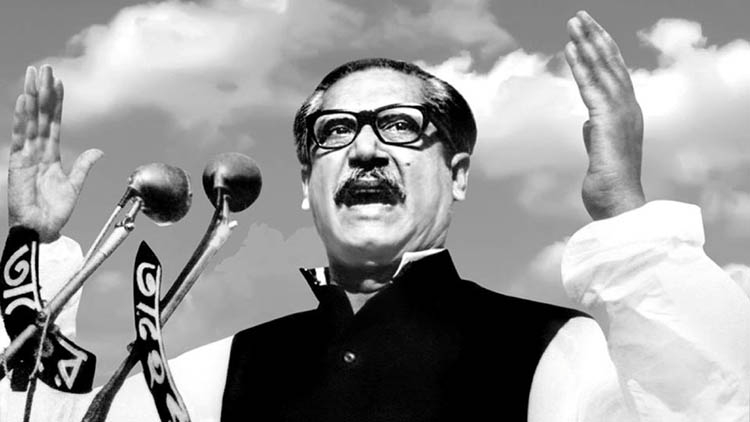
No individual embodied those aspirations more completely than Bangabandhu Sheikh Mujibur Rahman. His political leadership did not emerge suddenly during the Liberation War. It evolved over decades through the Language Movement, the Six-Point Programme, the mass uprising of 1969, the overwhelming electoral mandate of 1970, and finally the historic call for resistance that united an entire nation. His greatest achievement was not simply leading Bangladesh to independence. He transformed a linguistic and cultural identity into a modern political nation with a shared democratic purpose.
The Constitution of Bangladesh, adopted in 1972, reflected that vision. Nationalism, socialism, democracy and secularism were not inserted as abstract political ideals. They represented the collective experience of a people who had endured discrimination, economic exploitation and political denial. Those principles sought to ensure that the injustices that gave birth to Bangladesh would never be repeated.
Many countries celebrate their founding ideals while allowing them to fade from public life. Bangladesh cannot afford such complacency. The country’s independence was won through immense sacrifice, and its constitutional philosophy remains closely connected to the circumstances that produced the nation itself. Any attempt to dilute the ideals that inspired the Liberation War raises profound questions about the future character and direction of the Republic.
The present political climate, therefore, demands a deeper reflection on Bangabandhu’s legacy. His relevance cannot be measured simply by commemorations, monuments or official ceremonies. It must be judged by the continuing relevance of the principles he championed and by their capacity to guide Bangladesh through one of the most complex periods in its contemporary history.
Bangladesh’s contemporary challenges cannot be understood solely through the lens of electoral politics. They reflect a deeper contest over national identity, constitutional values and historical memory. The questions confronting the country today are strikingly similar to those that shaped the Liberation War more than five decades ago. What should define the Bangladeshi state? Should it derive its legitimacy from the inclusive ideals proclaimed in 1971, or should those ideals give way to alternative political and ideological narratives?
History shows that nations rarely remain stable when there is persistent disagreement over their founding principles. The experience of many post-colonial states demonstrates that constitutional institutions alone cannot guarantee national cohesion. A shared understanding of history, collective sacrifice and common purpose is equally essential. Bangladesh’s greatest strength after independence was that the Liberation War provided precisely such an unifying narrative.
That consensus has gradually weakened. Successive political confrontations have transformed the history of 1971 into an arena of partisan conflict rather than a shared national inheritance. Instead of serving as common ground, the Liberation War has increasingly become the subject of competing interpretations. Such developments inevitably influence younger generations, many of whom know the events of 1971 through fragmented narratives on social media rather than through rigorous historical scholarship. Nations do not lose their history overnight. They lose it gradually, when memory gives way to misinformation and evidence yields to political convenience.
An equally significant challenge comes from the growing appeal of religion-based politics and ideological extremism. Bangladesh was founded after a struggle that rejected discrimination in all its forms and sought to establish equal citizenship regardless of religion, language or ethnicity. The constitutional commitment to secularism was intended to protect religious freedom while preventing the state from privileging one community over another. This distinction remains crucial. Secular governance does not diminish faith; it safeguards the equal rights of every citizen. Any departure from that principle risks weakening the inclusive character upon which the Republic was established.
The challenge is not confined to domestic politics. Bangladesh today occupies an increasingly important strategic position in the Indo-Pacific. Its geography, expanding economy and access to the Bay of Bengal have drawn the attention of major regional and global powers. India, China, the United States, Japan and several other countries all recognise Bangladesh’s growing geopolitical significance. Such attention creates opportunities for investment, trade and development, but it also demands greater national cohesion. A country uncertain of its own ideological direction becomes more vulnerable to external influence and strategic competition.
For this reason, the enduring relevance of Bangabandhu lies not merely in his role as the Father of the Nation but in the coherence of the political philosophy he articulated. His vision offered Bangladesh an identity that reconciled patriotism with pluralism, national sovereignty with international friendship, and economic progress with social justice. Those principles continue to provide a framework capable of strengthening democratic resilience in an increasingly uncertain regional and global environment.
The distinction between a government and a nation is particularly relevant to Bangladesh’s present circumstances. Governments derive their authority from elections and constitutions; nations derive their strength from shared values, historical memory and collective purpose. Political transitions are an inevitable feature of democracy. The more enduring challenge is to preserve the principles that bind society together despite changes in political leadership.
For Bangladesh, those principles were forged during the Liberation War and given constitutional expression in 1972. They created a framework within which people of different faiths, linguistic traditions and social backgrounds could participate as equal citizens of a sovereign republic. The durability of that framework has contributed significantly to Bangladesh’s resilience through periods of political upheaval, military rule, economic hardship and natural disasters.
The preservation of that legacy is not the responsibility of governments alone. Universities, schools, civil society, historians, journalists and cultural institutions all have a role in ensuring that the history of the Liberation War is presented with intellectual honesty and historical rigour. Every generation has the right to question the past, but no generation benefits when historical inquiry is replaced by selective memory or political expediency. A confident nation does not fear history. It learns from it.
Bangabandhu also understood that peace could not rest solely upon political freedom. Independence would remain incomplete unless accompanied by social justice, economic opportunity and equal citizenship. His speeches repeatedly emphasised the responsibilities of the state towards ordinary people, particularly those who had long remained on the margins of development. That message retains its relevance in an age when inequality, unemployment and social exclusion continue to test the stability of societies across the world. Peace cannot flourish where large sections of the population feel excluded from national progress.
His foreign policy reflected the same balance. The principle of “Friendship to all, malice towards none” was neither an idealistic slogan nor a diplomatic convenience. It reflected the strategic judgment that a newly independent Bangladesh should avoid becoming an instrument of great-power rivalry while engaging constructively with the international community. In today’s increasingly polarised geopolitical environment, that philosophy continues to offer valuable guidance. A confident Bangladesh maintains productive relations with all partners while preserving its strategic autonomy and national interest.
More than fifty years after independence, the Republic once again finds itself confronting difficult choices. Those choices extend beyond electoral politics or changes in government. They concern the values that will define Bangladesh in the decades ahead. A nation that forgets the ideas which shaped its birth risks losing the moral direction that sustains its future.
Bangabandhu’s greatest contribution was not simply leading a successful struggle for independence. He offered Bangladesh a constitutional and moral vision capable of transforming the suffering of 1971 into the foundation of a democratic and inclusive state. That vision remains unfinished because nation-building is never completed within a single generation. Every generation inherits both the freedoms won by its predecessors and the responsibility to preserve them.
The future of Bangladesh will therefore depend not only upon economic growth, political stability or diplomatic success. It will depend upon whether the Republic continues to uphold the ideals that inspired its birth: democracy, secularism, social justice, pluralism and respect for human dignity. These are not relics of history. They remain the strongest safeguards of Bangladesh’s unity, sovereignty and long-term peace. That is why Sheikh Mujibur Rahman continues to matter, not merely as the Father of the Nation, but as the principal architect of the values that still define Bangladesh’s highest aspirations.
(Dr Dipankar Roy is a global advisor on peace and is active in boosting India-Bangladesh friendship)