



Delhi’s Yamuna Riverfront Revival Pits Tourism Against Traditional Communities
Delhi’s ambitious plan to transform the historic Yamuna riverfront into a major heritage and tourism destination has sparked a debate that goes far beyond encroachments or flood safety. At its heart lies a more fundamental question: Who gets to define heritage? Is it the state that seeks to restore historic ghats and curate a riverfront for public recreation and tourism? Or is it the communities that have lived, worked on and sustained these spaces for generations?
>> The Demolition Drive
The Delhi Government maintains that its demolition drive along the Yamuna floodplains, including Yamuna Bazaar, is intended to protect the river’s fragile ecology and safeguard residents from monsoon flooding. Acting on directions issued by the Delhi Disaster Management Authority (DDMA) on May 7, 2026, the Delhi Development Authority (DDA) launched an extensive eviction and demolition exercise across the floodplain. 1100 residents (310 families) of Yamuna Bazaar received a series of notices directing them to vacate the area, and on June 25, the Municipal Corporation of Delhi deployed earthmovers to demolish houses and other structures.
The official reasoning appears straightforward: reclaim the ecologically sensitive floodplain and minimise the risk to human life during the monsoon. Yet many residents question why such urgency has emerged only now. Flooding is hardly a new phenomenon in Delhi, nor did these settlements appear overnight. Many families claim that their presence predates the colonial period and that they have lived and worked along the river for generations.
For them, the Yamuna is far more than a river. It is the centre of their social, cultural and economic life. Families earn their livelihood by selling flowers and worship materials, assisting pilgrims, performing cremation rites at Nigambodh Ghat, or working as lifeguards and boatmen. Their relationship with the river is not simply one of occupation; it is one of continuity, shaped over generations.
The timing of the demolition drive has therefore invited a larger question. Is the exercise solely about protecting the floodplain, or is it also linked to the government’s broader vision for redeveloping the Yamuna riverfront?
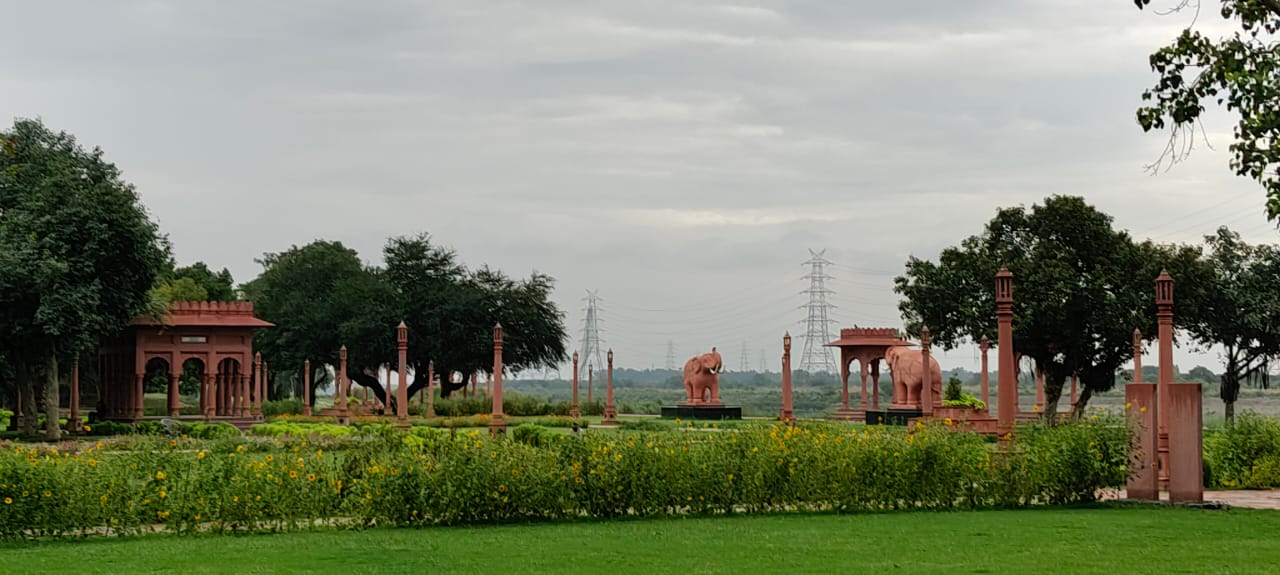
That vision began taking shape in March 2019 when, acting on the recommendations of the National Green Tribunal (NGT), the Delhi Development Authority commissioned the Indian National Trust for Art and Cultural Heritage (INTACH) to prepare a restoration and rejuvenation plan for nearly seven kilometres of the Yamuna floodplain between the Wazirabad Barrage and the Old Iron Bridge. This vision started materialising with the inauguration of Vasudev Ghat in March 2024. Originally called the historic Qudasia Ghat, adjoining Qudsia Gardens, built by Queen Qudasia during the reign of Mughal emperor Muhammad Shah, Qudasia Ghat was restored by INTACH and later renamed Vasudev Ghat by the DDA. Built predominantly in rich red sandstone, the restored ghat recreates the elegance of Mughal architecture through a traditional charbagh, stone bathing ghats, ornamental chhatris, an elegant baradari and intricately carved elephant sculptures. Modern visitor facilities, cycle tracks, parking spaces and other public amenities have been carefully integrated into the design, creating a heritage space that blends history with contemporary public use.
The government has further enhanced Vasudev Ghat’s appeal by organising the Yamuna Aarti every Tuesday and Sunday evening. While the ritual itself is not new, its elaborate presentation on the lines of the famous Ganga Aarti in Varanasi has transformed the restored ghat into a major public attraction. Visitors above the age of 13 are charged an entry fee of ₹50, although entry remains free during the evening Aarti. In 2025, the initiative was expanded with the unveiling of a statue dedicated to the River Yamuna by the then Delhi Lieutenant Governor V K Saxena near Nigambodh Ghat. The surrounding area, once marked by garbage and encroachments, was cleaned, landscaped and developed into an attractive public space.
There is little doubt that these initiatives have revived public interest in Delhi’s riverfront. “The restored ghats offer citizens much-needed public spaces while celebrating the city’s rich riverine heritage,” say Delhi government officials. The government now envisions redeveloping all 32 Yamuna ghats, creating a continuous heritage and tourism corridor along the river.
>> Living Heritage of Yamuna Bazaar
“The vision itself deserves appreciation,” say heritage enthusiasts. “The question, however, is whether creating this new heritage landscape required the demolition of Yamuna Bazaar, itself a historic riverfront settlement that has evolved alongside these ghats for centuries.” In fact, the history of Delhi’s riverfront suggests that the Yamuna ghats were shaped not only by emperors and governments but also by the communities that lived and worked along them. While Mughal rulers developed formal spaces such as the Meena Bazaar, historians point out that the Yamuna bazaars evolved largely through local initiative.
Historian Rana Safvi notes that “seasonal fairs and markets regularly lined the stretch between the Red Fort and the Yamuna during the Mughal period”, making the riverfront one of the city’s busiest centres of trade and social life. The Provincial Gazetteer: Delhi District (1883–84) traces the history of Nigambodh Ghat to ancient times, associating it with Indraprastha, the legendary capital mentioned in the Mahabharata. These references suggest that the riverfront has long been a living cultural landscape rather than merely a collection of historic monuments.
That living heritage survives even today. For generations, families have depended on the Yamuna for their livelihood. Some sell flowers, diyas and offerings to devotees visiting the ghats. Others assist in cremation ceremonies at Nigambodh Ghat, one of Delhi’s oldest cremation grounds. Boatmen, priests and workers associated with the ghats have continued occupations passed down through successive generations. Their presence is not incidental to the riverfront; it forms part of its continuing social and cultural history.
It is this history that many residents believe is being overlooked. While the ghats have been restored and public spaces beautified, the communities that have sustained the river’s traditions are being treated as unauthorised encroachers. For them, Yamuna Bazaar is not simply a cluster of settlements but an extension of the ghats themselves, a place where worship, trade, livelihood and community have coexisted for centuries.
The demolition drive has therefore become more than an administrative exercise. It has raised a larger question about what constitutes heritage. Is heritage confined to restored architecture and curated public spaces, or does it also include the people whose lives have remained intertwined with the river across generations?
The voices of the residents reflect this dilemma. Ganesh, a resident near Ghat No. 24, says his family cannot imagine life away from the Yamuna. “We have lived here for generations. We pay electricity bills, have Aadhaar cards, and this river has always been our home,” he says. Another resident, Raju Pandit of Yamuna Bazaar, whose family has performed religious rituals at Ghat No. 24 for generations, fears that relocation would not only deprive them of their livelihood but also sever a tradition that has survived for decades. For them, displacement is not merely the loss of a house; it is the loss of a way of life built around the river.
>> The Legal Battle
The residents challenged the demolition before the Delhi High Court through Writ Petition (Civil) No. 6965 of 2026. On May 19, 2026, Justice Purushaindra Kumar Kaurav, sitting as a single-judge Bench, dismissed the petition, not on the merits of the dispute, but because the Residents Welfare Association had failed to obtain authorisation from the affected families, leaving it without the legal standing to maintain the case. The court, however, left it open for individual residents to pursue their claims separately.
The legal proceedings have done little to settle the larger debate. The issue has moved well beyond whether the structures are authorised or the floodplain should be protected. Few would disagree that the Yamuna needs ecological restoration or that its ghats deserve conservation. The redevelopment of the riverfront, the restoration of historic ghats and the creation of better public spaces are all welcome initiatives. Equally, no one can dispute the need to protect the floodplain from unauthorised construction.
The controversy lies elsewhere. Can a heritage corridor be created by removing its living heritage? Yamuna Bazaar has evolved alongside the ghats for centuries. Its residents have not merely occupied the riverfront; they have shaped its everyday life through commerce, religious practices and occupations that remain inseparable from the Yamuna. If the restored ghats represent the architectural heritage of the river, these communities represent its social and cultural heritage and must be accommodated in this restoration plan.
The redevelopment also raises another question that extends beyond Yamuna Bazaar. If the government can mobilise substantial financial resources to recreate the riverfront as a heritage and tourism destination, why has the Yamuna itself not witnessed an equally determined effort at ecological restoration? The river flowing past the newly restored ghats continues to struggle with untreated sewage, pollution and poor water quality. A revitalised riverfront undoubtedly enhances the city’s image, but the health of the river remains the true measure of its revival.