


In a blistering statement issued on polling day, former Bangladesh Prime Minister Sheikh Hasina rejected the country’s general election as a “carefully planned farce” and called for its immediate cancellation, sharply escalating the political confrontation surrounding the vote.
Thanking “the masses at all levels, including mothers, sisters, and minority communities” for what she described as their rejection of the process, Hasina alleged that the election had been “staged” by “the killer-fascist Yunus,” referring to interim authority figure Muhammad Yunus, whom she accused of seizing power “illegally and unconstitutionally.”
Her statement forms the most forceful denunciation yet of the poll by the leadership of the Awami League, which did not participate in the election.
‘Deceptive Election Without Voters’
Hasina asserted that the vote was conducted in violation of “the people’s voting rights, democratic values, and the spirit of the constitution.” She described the exercise as a “so-called election” arranged without her party and, crucially, without meaningful voter participation.
Citing figures released by the Election Commission, she pointed to an 11 am turnout of 14.96 per cent, roughly three and a half hours after polling began, as evidence of what she characterised as a public boycott. According to her, such low participation during peak voting hours demonstrated that citizens had “rejected this election without the Awami League.”
Hasina further said that from the evening of February 11, polling centres had been “captured,” alleging incidents of gunfire, vote-buying, pre-stamping of ballot papers and coercion of polling agents to sign result sheets. By the morning of 12 February, she said, many polling stations in the capital, Dhaka, and elsewhere were “empty of voters.”
Allegations of Intimidation and Voter Roll Irregularities
The former prime minister also alleged a climate of sustained intimidation in the run-up to the vote. She cited “continuous attacks, arrests, and an atmosphere of fear” targeting Awami League supporters and minority communities. According to her statement, there were attempts to forcibly compel voters to attend polling stations.
Despite these pressures, Hasina claimed that supporters “ignored all fear and intimidation” and instead boycotted the election, resulting in what she described as “voterless” polling centres across much of the country.
She additionally raised questions over the integrity of voter rolls, particularly in Dhaka, alleging an “abnormal” and “highly questionable” increase in registered voters. No documentary evidence accompanied the claim, but it forms part of a broader challenge to the legitimacy of the electoral process.
Demands for Cancellation and Caretaker Government
Framing the vote as “illegal and unconstitutional,” Hasina laid out a series of demands: the cancellation of the election; the resignation of Yunus; the withdrawal of what she termed “false cases”; and the release of political prisoners, including teachers, journalists, intellectuals and professionals.
She also called for the lifting of the suspension on Awami League activities and for the restoration of voting rights through a “free, fair, and inclusive election under a neutral caretaker government.”
The statement signals that the Awami League intends to contest not merely the outcome of the election, but its constitutional validity. With turnout figures and opposition participation now central to the dispute, Bangladesh faces the prospect of prolonged political uncertainty as rival narratives of legitimacy collide.
For Hasina, the core argument is unequivocal: the election, she contends, was not rejected by her party alone — but by the people themselves.
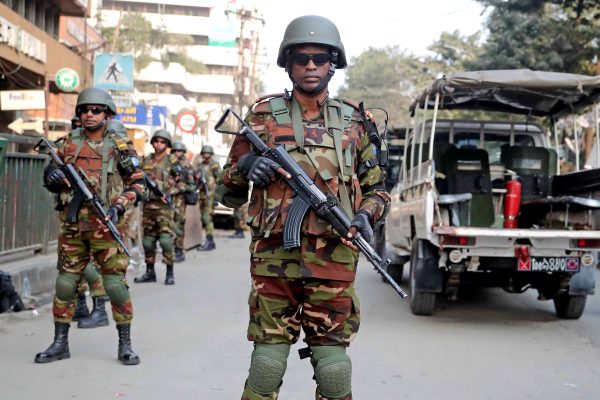
Meanwhile, Reuters reported isolated incidents of violence and allegations of intimidation in certain constituencies, but described the overall security situation as largely controlled. The agency noted that opposition participation was fragmented, with the absence of the Awami League significantly altering the electoral landscape.
Foreign news agencies highlighted that the credibility of the election would ultimately hinge on turnout figures, transparency in counting, and the acceptance, or rejection, of results by major political stakeholders. As ballot counting continues, Bangladesh now confronts not merely a contest over seats, but a contest over legitimacy itself.
