

Washington, September 22: Confusion and chaos gripped Indian tech workers and travellers over the weekend, with flights disrupted and rumours spreading, after President Donald Trump ordered a $100,000 surcharge on new H-1B visa petitions. US agencies scrambled to reassure workers and companies that the fee will apply only to future applications, not to current visa holders.
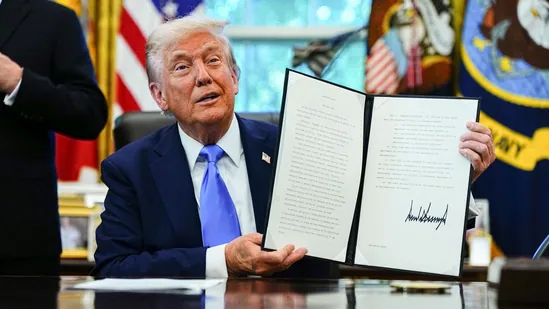
Trump on Friday signed an executive order restricting the entry of certain non-immigrant workers, citing “systemic abuse” of the H-1B visa program. The order directs that new employment-based petitions must be denied unless accompanied by an additional payment of $100,000.
According to guidance from US Citizenship and Immigration Services (USCIS), “this guidance applies to H-1B employment-based petitions filed after 12:01 a.m. ET on September 21, 2025.”
The memo stressed that the measure does not affect beneficiaries of petitions filed before the deadline, current visa holders, or those with approved petitions.
US Customs and Border Protection (CBP) issued parallel instructions to field offices, underscoring that “the Proclamation only applies prospectively to petitions that have not yet been filed” and “does not impact the ability of any current visa holder to travel to or from the United States.”
Still, confusion was immediate. On Saturday, an Emirates flight departing San Francisco for Dubai and Mumbai was delayed for hours after multiple Indian passengers disembarked. “Chaos on an Emirates flight at San Francisco International Airport (SFO). Delayed by 3 hours after many Indian H-1B holders bound for India disembarked from the plane after hearing the news,” one account circulated on social media said.
A WhatsApp message from a passenger described 10–15 travellers leaving the aircraft amid fears about re-entry, comparing the scene to “an Indian train”.
The White House and federal agencies tried to tamp down rumours. “This is NOT an annual fee. It’s a one-time fee that applies only to the petition,” White House press secretary Karoline Leavitt said. “Those who already hold H-1B visas and are currently outside the country will NOT be charged $100,000 to re-enter.”
CBP added in its own statement: “Petitions submitted before September 21, 2025, are not affected. Any reports claiming otherwise are flat-out wrong and should be ignored.”
Despite the clarifications, business leaders voiced alarm. The U.S. Chamber of Commerce said it was “concerned about the impact on employees, their families, and employers,” and vowed to work with members and the administration “to understand the full implications and the best path forward.”
In New Delhi, India’s Ministry of External Affairs issued a carefully worded statement acknowledging the uncertainty.
“The full implications of the measure are being studied by all concerned, including by Indian industry, which has already put out an initial analysis clarifying some perceptions,” it said.
The ministry emphasized that both Indian and US industries “have a stake in innovation and creativity” and warned of “humanitarian consequences arising from the disruption caused for families,” the Indian government said.
The stakes are high. H-1B visas have long been a pipeline for skilled Indian engineers and managers into American firms. Companies such as Amazon, Cognizant, Tata Consultancy Services, Google, and Microsoft are among the top sponsors, collectively accounting for tens of thousands of visa applications each year. Salaries for such positions often run well above $100,000 annually, according to Labour Department filings.
The programme has also been a springboard for some of the world’s most prominent executives. Sundar Pichai of Google, Satya Nadella of Microsoft, Shantanu Narayen of Adobe, and former PepsiCo chief Indra Nooyi all began their US careers on H-1B visas.
For critics, however, the new fee answers long-standing concerns. Congressman Brandon Gill, a Republican, said, “America is a nation, not a jobs program for foreign workers. Our H-1B visa program has been abused for far too long.”
The measure’s immediate future remains uncertain. Policy lawyers expect lawsuits from companies and trade groups, while administration officials maintain that the proclamation rests on the president’s broad authority under the Immigration and Nationality Act.
For now, the guidance is clear: only future applicants filing new petitions will face the six-figure surcharge. Yet for many Indian workers and their families, the sudden turn of events has already disrupted lives, fueled uncertainty about travel, and injected new strain into an immigration system long caught between political rhetoric and economic demand. (5WH)