



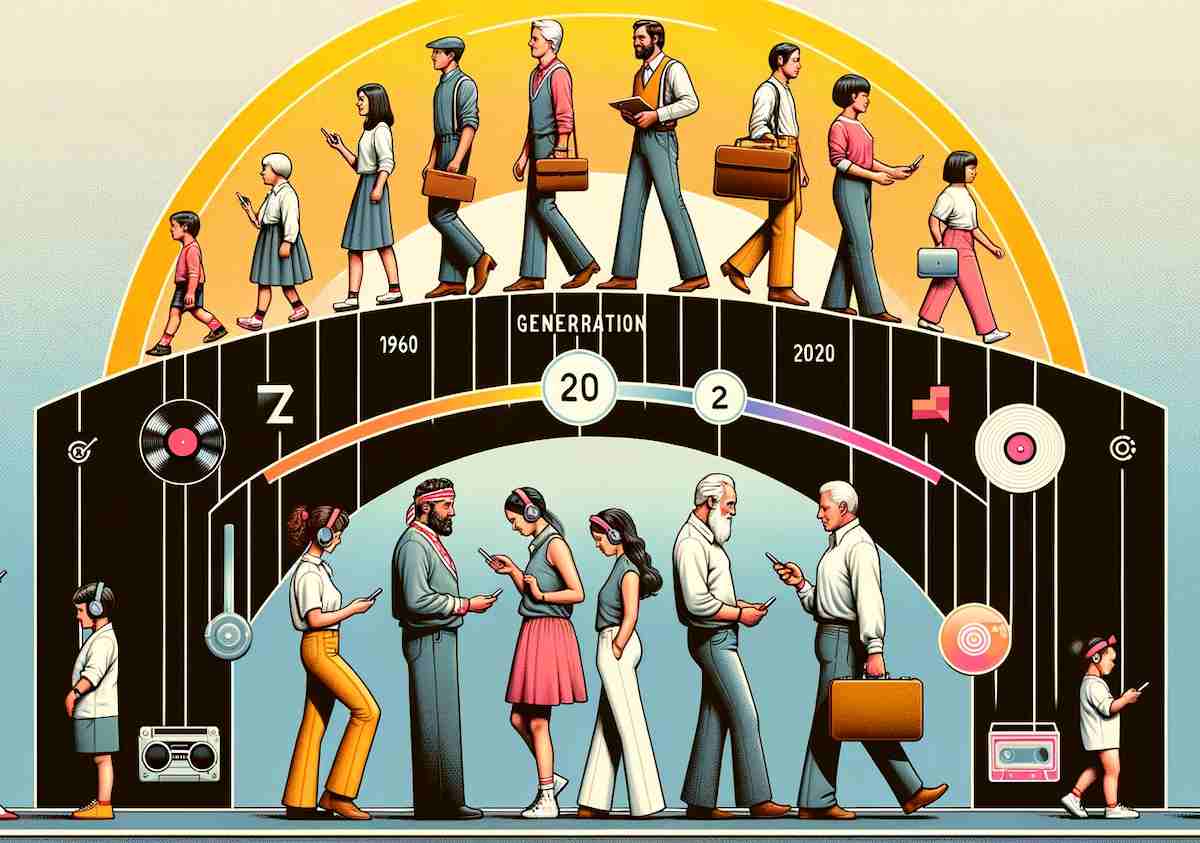
The Cambridge Dictionary defines the generation gap as a situation in which older and younger people fail to understand one another because of differences in their experiences, opinions, habits and behaviour. The term became especially prominent during the 1960s, when the political and cultural rebellion of the baby-boomer generation appeared to challenge the values of its parents. Since then, Baby Boomers have been followed by Generation X, Millennials, Generation Z and, most recently, Generation Alpha. Each has been assigned its own attitudes, anxieties and cultural characteristics.
Generational labels can easily become caricatures. Baby Boomers are portrayed as conservative and resistant to change; Millennials as entitled; and Generation Z as impatient, anxious and permanently attached to screens. Such descriptions may contain fragments of truth, but they often conceal more than they reveal. No generation is culturally or politically uniform. Differences of class, caste, gender, geography and education can be as consequential as differences of age.
Nevertheless, the generation gap is real. Different economic conditions, technologies and historical events shape people born at different moments. Those who grew up before the internet encountered a world profoundly different from that experienced by people for whom social media, instant communication and algorithmic entertainment have always existed. A generation raised during economic expansion may understand employment, home ownership and financial security differently from one entering adulthood amid insecure work, unaffordable housing and climate anxiety.
The World Shapes the Generation
The gap, therefore, is not simply the result of young people rejecting tradition or older people refusing to change. It develops because different generations learn to navigate different worlds. Generational conflict is hardly a modern invention. Literature repeatedly depicts children resisting the expectations of their parents and established authority confronting new ideas. Ivan Turgenev’s Fathers and Sons, published in 1862, placed this conflict at the centre of its story. Its young protagonist rejects the beliefs and conventions of the older generation, revealing how political and philosophical change can enter the home and turn family relationships into ideological struggles.
Similar tensions remain familiar today. Parents may expect their children to follow secure and respected professions, while young people may place greater importance on personal fulfilment, flexibility or creative independence. Older family members may see marriage, family duty and social stability as essential markers of adulthood. Younger people may question those expectations or wish to fulfil them on their own terms.
Such disagreements become especially painful when parental concern turns into control. Parents naturally draw upon their own experience when advising their children. The problem arises when experience is treated as a universal rule rather than as knowledge acquired under particular circumstances. A career that provided security three decades ago may no longer offer the same opportunities. Social conventions that once appeared unquestionable may now seem restrictive or unjust. What worked for one generation cannot simply be imposed upon the next.
Neither Generation Has All the Answers
The young, however, are not automatically wiser because they are closer to the future. Rapid social change brings new freedoms, but it also produces new vulnerabilities. Digital technology has expanded access to information and enabled relationships across enormous distances. At the same time, it has intensified misinformation, surveillance, social comparison and political polarisation. Younger people may understand new platforms more intuitively, but technical familiarity does not necessarily produce sound judgement.
Older generations possess knowledge that cannot be downloaded or acquired instantly. They have experienced failure, uncertainty, political change and personal loss. Their advice may help younger people recognise dangers that initially appear new but are, in fact, variations of older human problems. Yet experience becomes useful only when it is offered with humility. Wisdom cannot be forced upon someone; it must be communicated in a way that leaves room for the other person’s circumstances and autonomy.
This is why overcoming the generation gap does not require eliminating differences. That would be neither possible nor desirable. A society without generational disagreement would be one in which values and institutions were never questioned. Many forms of social progress have depended upon younger generations challenging inherited assumptions. At the same time, a society that dismisses everything inherited from the past condemns itself to historical amnesia. The real challenge is to prevent difference from hardening into contempt.
When Labels Replace Understanding
Contemporary communication makes this harder. Social media rewards certainty, outrage and ridicule. Complex differences are reduced to jokes about “Boomers”, “Millennials” or “Gen Z”. These labels allow people to dismiss an argument without engaging with it. Instead of asking why another generation sees the world differently, we assume that its members are selfish, ignorant or hopelessly out of touch.
Meaningful dialogue begins with a more generous question: what conditions made this person’s outlook reasonable to them? Older people may place a high value on stability because they remember scarcity or upheaval. Younger people may distrust established institutions because they have watched those institutions fail to respond adequately to inequality, war or climate change. Understanding the source of a belief does not require agreeing with it. It simply makes disagreement more intelligent.
Both sides must also resist the temptation to speak for entire generations. The old should not treat every departure from tradition as evidence of moral decline. The young should not confuse novelty with progress or assume that age makes a person irrelevant. Respect cannot mean unquestioning obedience, just as independence need not mean rejecting every lesson of the past.
The Gap Can Be Source of Renewal
The generation gap will never disappear, and perhaps it should not. Every generation inherits a world it did not create and must decide what to preserve, what to repair and what to abandon. That process inevitably produces conflict. But conflict can become a source of renewal when generations listen to one another without demanding complete agreement.
The purpose of intergenerational communication is not to make the young think like the old or the old behave like the young. It is to allow experience and imagination to meet. The older generation can offer memory, perspective and caution; the younger can offer new possibilities and the courage to question familiar arrangements. Neither is sufficient by itself. The generation gap becomes dangerous only when conversation across it ends. The task should not be to close the gap completely, but to build bridges strong enough for knowledge, criticism and empathy to travel in both directions.