

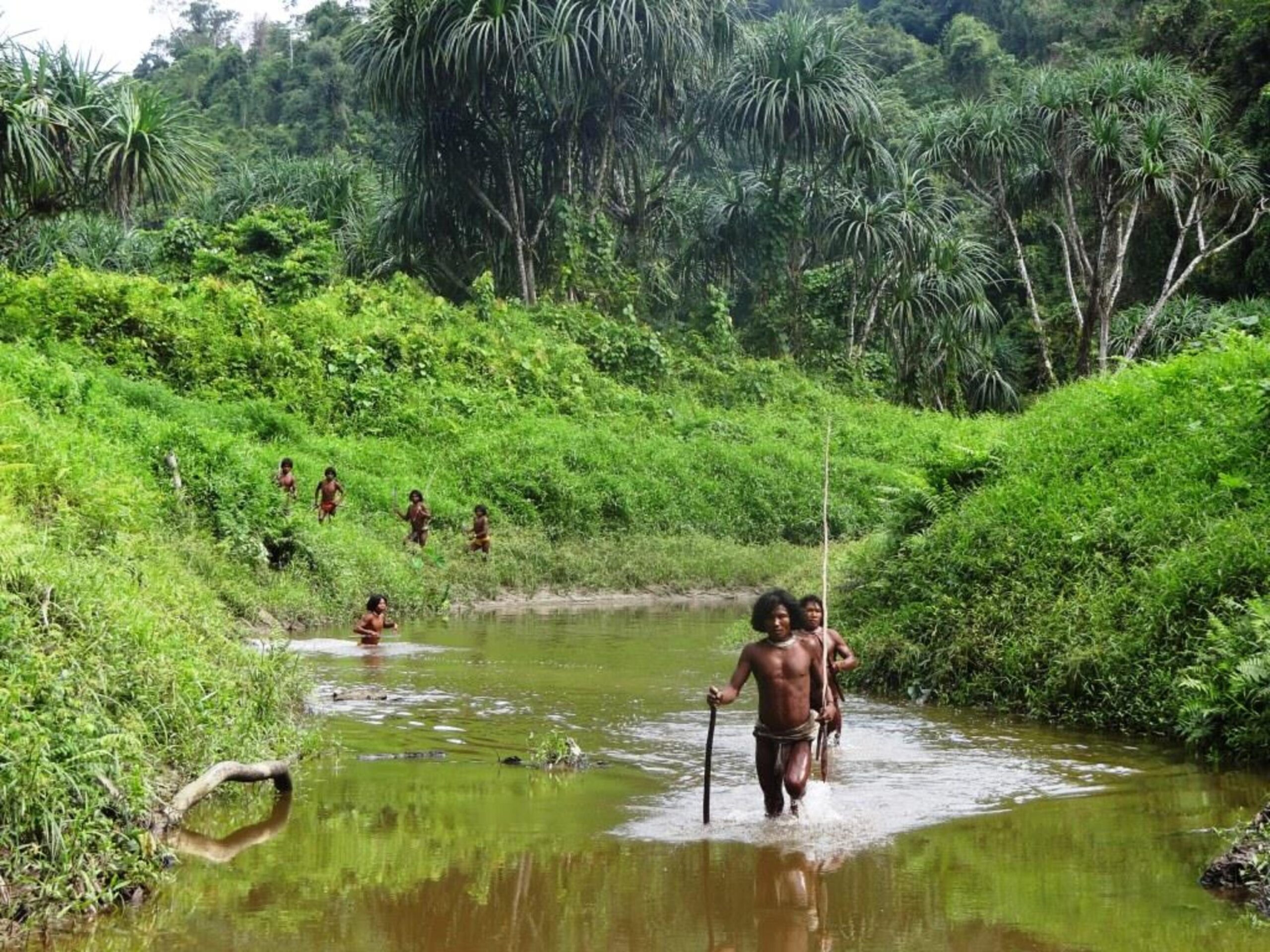
This is the story of people we barely know exist: they are the world’s uncontacted Indigenous groups. A stark warning, issued by Survival International, an NGO: these little-known and little-understood people may vanish within a decade. In its first global inventory of uncontacted people, possibly the most accurate count yet, identifies at least 196 groups in 10 countries across South America, Asia and the Pacific, including India. The report, Uncontacted Indigenous Peoples at the Edge of Survival, is unequivocal: more than 96 per cent of these groups face life-threatening danger from extractive industries. What is unfolding is not a natural decline but a slow-motion annihilation, driven by profit, state power and global indifference.
Uncontacted people, in the words of Survival International, “make an active and ongoing choice to reject contact,” asserting autonomy in the face of centuries of intrusion and dispossession. They are not “lost tribes”; they are communities that consciously and repeatedly reject contact with outsiders. Their continued isolation is not a symptom of backwardness but a conscious act of self-determination.
However, their survival worldwide is increasingly incompatible with the appetite of states and corporations for minerals, timber, land and geostrategic control. The report says logging threatens 65 per cent of uncontacted groups, and every new track cut through their forests becomes a corridor for miners, agribusiness and infrastructure projects.
Over 40 per cent face active risks from mining, including nickel extraction for electric-vehicle batteries. The race for “green minerals” is, ironically, endangering some of the planet’s most sustainable communities. Agribusiness expansion threatens over 20 per cent of these groups, while 38 per cent face direct risk of disappearance as government-backed roads, railways and ports carve through untouched habitats.
New-age threats, including mission groups using advanced tracking, influencers staging fabricated “first contact” videos, and criminal gangs controlling illegal mining and drug routes compound the danger.
The survival of India’s uncontacted tribes—the Sentinelese of North Sentinel Island in the Andaman, and the Shompen of Great Nicobar— also poses profound questions.
The Sentinelese, often described as the most isolated people on Earth, have lived for tens of thousands of years on North Sentinel Island in the Andaman, a stretch of land no larger than Manhattan. Their fierce resistance to contact—arrows fired at aircraft, hostility toward missionaries and complete rejection of external intrusion—is not a primitive impulse but a political statement of refusal.
The Shompen who inhabit the dense rainforests of Great Nicobar Island represent a more complex reality. While some groups have limited interactions with outsiders, the majority continue to avoid contact, living in small, mobile communities that depend on forest and riverine ecosystems. Their survival, however, now hangs in the balance.
Survival International warns that India’s proposed Great Nicobar Mega Project, a multi-billion-dollar industrial and infrastructural venture including a port, airstrip and township, poses an existential threat to their homeland. As the report notes, this project risks “annihilation of the mostly uncontacted Shompen.” For the Shompen, bulldozers may be as lethal as rifles.
Earlier, 124 genocide experts from all over the world urged the Indian government that the Shompen will face genocide if the plan to turn their island into the “Hong Kong of India” goes ahead. “The cumulative effect of these developments and the proposed demographic shift entailing 650,000 settlers, or an 8,000 per cent increase in population, will ensure the death knell of the Shompen”, they said.
Under conventions such as ILO 169 and the UN Declaration on the Rights of Indigenous Peoples, uncontacted groups hold collective rights over their land and the right to refuse contact. The principle of free, prior and informed consent dictates that no project should proceed without the explicit agreement of those affected. But how does one obtain consent from communities that have deliberately chosen isolation? As Survival International insists, no consent can ever be presumed from silence.
India, although not a signatory to ILO 169, has reaffirmed a “no-contact policy” that prohibits any approach to the island. This acknowledges that contact could wipe out the community through epidemics to which they have no immunity.
Yet implementation remains selective. The same administration that invokes humanitarian arguments to protect the Indigenous people is now advancing industrial expansion into the Shompen’s forests. Experts are of the view that the Sentinelese and Shompen do not merely occupy land but shape its ecological balance through millennia of intimate knowledge. Protecting their autonomy also safeguards a living repository of environmental wisdom. India’s “no-contact” policy, though commendable, must evolve into a broader framework of protection by respect, reinforcing Indigenous territorial rights, prohibiting industrial or military projects in their habitats.
EXPLAINER
What does ‘uncontacted’ really mean?
Uncontacted peoples may encounter outsiders rarely or not at all, yet they often know of neighbouring Indigenous groups. Indonesia’s Hongana Manyawa have relatives who left the forest under pressure. Brazil’s Pirititi sometimes meet their contacted Kinja neighbours, while the Massaco were long known only through forest traces, including rodent-toothed booby traps meant to deter intruders.
Where do uncontacted people live?
Nearly 95 per cent of uncontacted peoples live in the Amazon—mostly in Brazil, with 124 groups—alongside Peru, Colombia, Bolivia, Venezuela and Ecuador. Others survive in the Paraguayan and Bolivian Chaco, Indonesia’s West Papua, and India’s Andaman and Nicobar Islands.
How do uncontacted people live?
They live independently and self-sufficiently in environments most would find harsh. Mostly nomadic, they hunt, fish, gather and sometimes plant, build their own shelters, share food and rely on deep botanical knowledge for tools, materials and medicines. When not under attack, their communities are healthy, resilient and thriving, protecting biodiversity-rich territories and rejecting the outside world.
(Mamta Chitnis Sen is a Mumbai-based journalist and artist. She writes on art, culture and current affairs)