



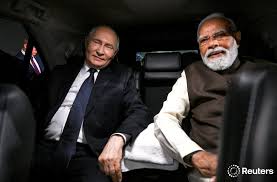
Prime Minister Narendra Modi has given Russian President Vladimir Putin a very warm welcome to India – as he should! India needs to maintain its historical friendship with Russia (the main survivor of the Soviet Union) because Russia is probably its most reliable major international partner. This is important because India is essentially alone in the world with two less than friendly countries with powerful militaries – Pakistan and China – on its borders.
This does not mean that Russia will assist India in any military conflict, but Russia will seek to calm things down if possible because it sees advantages in a strong India as a counterweight to its own increasing dependence on China. This was the reason that Russia pushed for India to become a member of the Shanghai Cooperation Organisation. China, not wanting to feel constrained, agreed to admit India if Pakistan was also admitted.
Until rather recently – before the era of the second Trump presidency – India was showing signs of moving closer to the USA. This was evident in its membership of the Quad, which also includes Australia, Japan and the US. India had excessively bought into the idea of an “Indo-Pacific” region as essential to its own security when the reality is that the other three Quad members just want to rope India into fighting for South China Sea lines and Taiwan, in which it has no vital interest. While about 20 per cent of India’s international trade flows through the South China Sea, most of this is actually with China itself!
It is just a coincidence that the United States has just released its latest National Security Strategy (NSS). This NSS document reads like it has been put together by a committee of people who have no coherent view except that of a need to please Donald Trump’s ego by emphasising USA military, political and economic dominance in the Western Hemisphere with a “Trump Corollary” of the historic Monroe Doctrine.
The National Security Strategy pays a lot of attention to the need for the US to compete and even contain China within an area encompassed by the “First Island Chain” and keep the South China Sea lanes open for international trade. The “Indo-Pacific” regional concept gets several mentions, with strong cooperation from India and Japan demanded. It is ironic that when Japanese Prime Minister Takaichi recently suggested that Japan was interested in the defence of Taiwan, which provoked a severe Chinese backlash, Japan was shocked to find little support from the USA because Trump has his eye on commerce and the pomp of an exchange of presidential visits with China.
There is a lesson for India and Australia here! Do not allow yourself to be dragged by the US into an uncomfortable situation and then find yourself abandoned!
India means little in the Trump world – as his actions and threats against India for importing Russian oil demonstrate. Indeed, Pakistan will rank equally with India in Trump’s eyes, while it promotes the idea that he should win the Nobel Peace Prize and his family can make money in some cryptocurrency scheme. This brings us back to the Russia-India relationship. Russia will also want to avoid getting tangled up in any India-Pakistan dispute.
The principal strategic benefit for India in its relationship with Russia—beyond long-standing goodwill and discounted oil—is continued access to Russian military equipment. Prior to the 2022 Russian invasion of Ukraine, India was mainly wedded to Russian military equipment for compatibility with its historical purchases. However, after a poor start, Russia has demonstrated an ability to learn and upgrade such equipment so that it is much more competitive with that available from other countries.
Russia, even more than India, is now obsessed with technological independence. I examined this issue over several years while living and working in Russia and concluded that—military equipment aside—its push for broad technological self-reliance is misguided, given the limited scale of its domestic market and the narrowness of its industrial base. So, there is little general technological advantage for India in being closely associated with Russia.
Finally, Trump has only been in power as US President for one year and has already been very disruptive, including in his continually changing views on tariffs and the war in Ukraine. The next three years of his four-year term are extremely unpredictable, irrespective of what the National Security Strategy document says. India is wise to keep its strong friendship with Russia while avoiding getting caught up in Trump’s schemes. With China rising and Trump wavering, India needs Russia more than ever.
(Jeff Schubert is a former chief economist of an Austrian Bank. He subsequently worked in business and academia in Russia and China)