


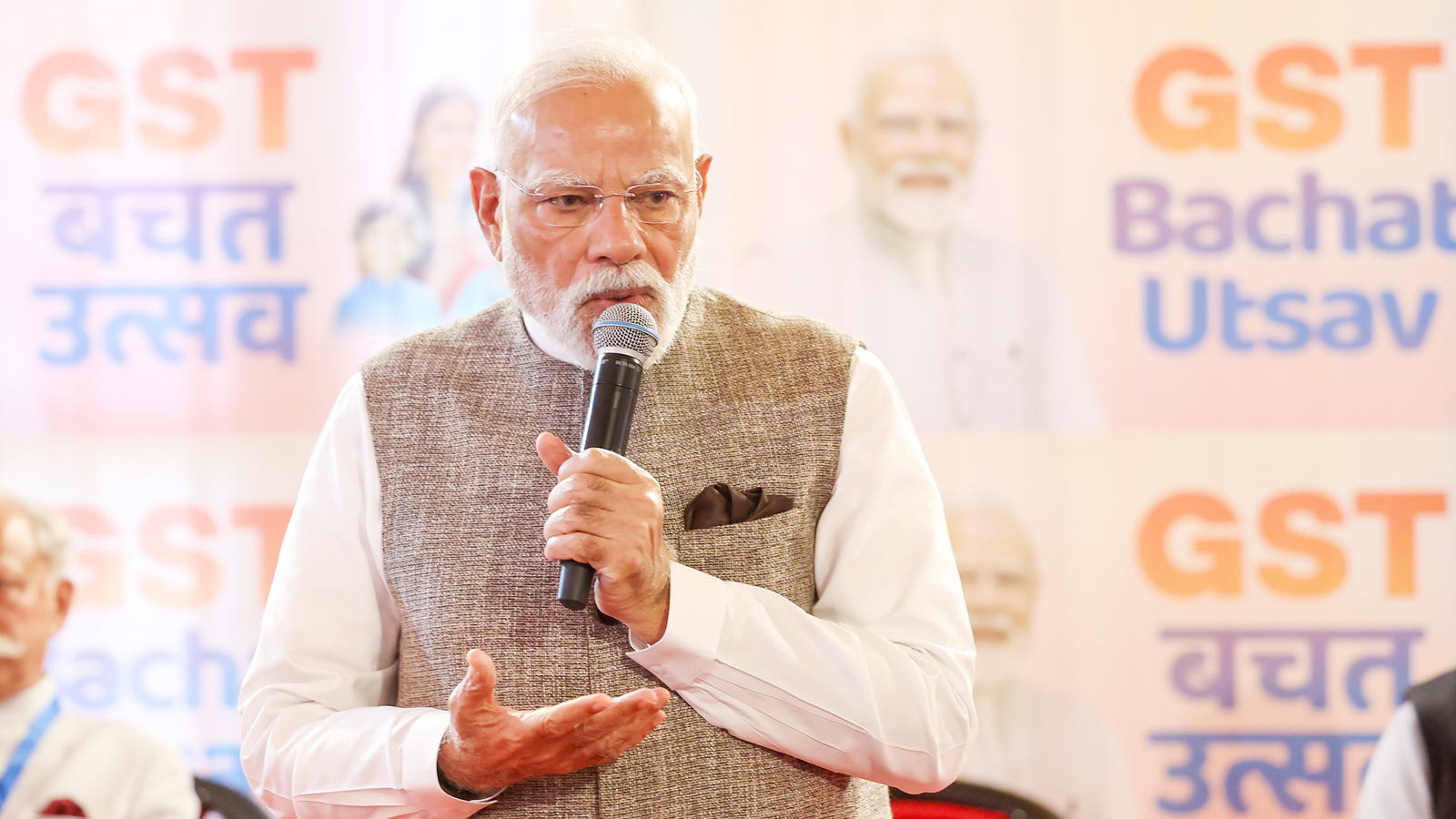
Prime Minister Narendra Modi’s recent proclamations hailing the reduction in Goods and Services Tax (GST) rates as a monumental success of his government are a masterclass in political manoeuvring. It is an attempt to sell a mirage to the public, hoping they have forgotten the scorching desert of compliance burdens and relentless tax extraction that citizens have endured for the better part of a decade. To celebrate a slight easing of the burden after years of applying a fiscal vice is not a sign of success; it is an admission of a prolonged failure that has crippled ordinary Indians.
For nearly ten years, the Goods and Services Tax, launched with the promise of “One Nation, One Tax”, functioned as “One Nation, One Trauma” for millions of small businesses, traders, and the average consumer. The complex, multi-slab structure, coupled with a glitch-ridden, punitive compliance mechanism, sucked the lifeblood out of the informal sector. The “Aam Aadmi” and “Aam Aurat” did not just pay the tax at the point of sale; they bore the brunt of a system that increased the cost of everything from a packet of biscuits to a basic household appliance.
The government conveniently forgets the years when essential items were taxed, when the compliance nightmare forced small shops to shut down, and when the input tax credit mechanism became a labyrinth from which few small players could emerge unscathed. The money extracted through this cumbersome GST regime amounted to a massive transfer of wealth from the pockets of citizens into the government’s coffers, contributing significantly to inflation and economic distress that have made life miserable for the common person.
This narrative of success, peddled now, is a calculated political stunt. It is an attempt to whitewash a history of economic repression and rebrand it as a story of benevolent governance, just as the nation inches closer to another electoral cycle. The government’s marketing machinery is in overdrive, hoping that short public memory will blur the years of hardship. The reduction in rates on certain items is not an act of generosity but a forced correction, a response to widespread anguish and the undeniable drag the complex GST structure imposed on the economy. To market this as a great achievement is like a doctor claiming credit for slowly reducing medication dosage after having prescribed a dangerously high dose for years, thereby poisoning the patient in the process.
However, the most glaring evidence of this government’s insincerity lies not in what is under GST, but in what remains defiantly outside it: petrol and petroleum products. This is the ultimate betrayal of the GST’s founding principle. While the prime minister celebrates minor rate rationalisations, the central government, with support from state administrations, continues to fleece the public through a brutal double taxation of excise duties and VAT. The price of petrol at the pump should logically be nearly half of what it is today if it were brought under the GST umbrella and taxed at the peak rate of 28%. Even that would provide significant relief.
The refusal to do so is not an oversight; it is a conscious policy of fiscal opportunism. Petroleum products have become the government’s golden goose, an easy source of revenue that it is unwilling to share with states transparently or to forgo for the benefit of the people. Every time a citizen fills their scooter or car, or sees a rise in transportation costs that inflates the price of every commodity, they are paying a stealth tax that this government has the power to eliminate but chooses not to.
Therefore, the demand is clear and urgent. The government must immediately bring petrol, diesel, and other petroleum products under the GST regime. Any celebration of GST’s success is hollow and hypocritical until this is done. The “Aam Aadmi” has endured a decade of repressive taxation. They can see through the political mirage. It is time for the government to offer real relief, not just repackaged narratives. The test of its commitment to the people lies not in a cleverly worded speech, but in bringing down the actual cost of living. The ball is in the government’s court. Will it act, or will it continue to manipulate?
When the GST was introduced in July 2017, it was billed as India’s largest tax reform since Independence: a “good and simple tax” that would unify the market, eliminate cascading levies, and broaden the tax base. In reality, for crores of small businesses and ordinary households, it became an albatross: a system of high rates, crushing compliance, and distorted incentives that hurt the very people it claimed to help.
Small and micro-enterprises were hit hardest. In a presentation, “MSMEs in the GST Regime: Insights from a Survey” (2022), the National Institute of Public Finance and Policy (NIPFP) found that across Delhi, Mumbai, and Surat, 53 per cent reported a 10-30 per cent fall in turnover after GST, while 36 per cent reported losses exceeding 30 per cent.
The stakes could not be higher. India’s MSMEs are not a side story; they are the story, as the 36 million units provide 80 million jobs across the country. For these firms, working-capital cycles are a matter of life and death. Yet GST created bottlenecks: delays in refunds and blocked input tax credits became chronic, choking cash flows and tilting the playing field in favour of large corporates with in-house compliance teams and deeper pockets.
For India’s vast informal economy — street vendors, small workshops, kirana stores — GST was a double shock layered upon demonetisation. Peer-reviewed studies document how these twin disruptions compressed wages, destroyed jobs, and accelerated distress across the informal sector. Informal units operate on daily liquidity, not quarterly refunds. The abrupt formalisation imposed by GST, coupled with its complexity, placed many under severe stress.
Consumers fared no better. Essential financial security products such as health and life insurance were long taxed at 18 per cent GST, inflating premiums and putting them beyond the reach of ordinary households. The consequence was visible in the annual report of the Insurance Regulatory and Development Authority of India (IRDAI): insurance penetration in India fell to 3.7 per cent of GDP in 2023-24, down from over 4 per cent earlier.
The government’s decision to finally exempt health and life insurance premiums from GST is an acknowledgement, tacit but undeniable, that the system was broken. For years, families struggled to pay inflated premiums, and millions went uninsured, only for policymakers to discover in 2025 what citizens knew back in 2017.
(The author is a veteran journalist and political analyst)

