


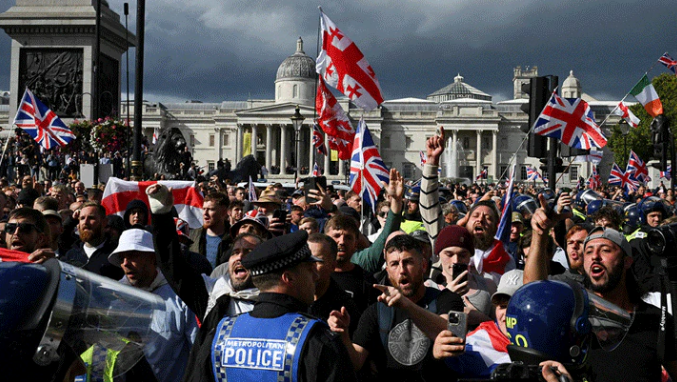
Immigration has become the defining political fault line of post-Brexit Britain. The debate is no longer confined to border control; it has evolved into a clash over Britain’s values, future direction and a fractured national identity.
The latest wave of government reforms on immigration has reignited fierce debate across the political spectrum, splitting the country into two sharply opposed camps. Measures such as tighter visa restrictions, limits on family dependants and the proposed rollout of the controversial Rwanda deportation scheme under the previous Conservative government signalled a decisive shift in Britain’s approach to migration.
Now, the Labour government under Prime Minister Keir Starmer has taken the issue further, signing a “one in, one out” migrant deal with France and announcing the introduction of digital ID cards for UK adults in an attempt to curb illegal immigration.
The new policies have breathed fresh life into the far-right Reform UK party, led by Nigel Farage. Polls now suggest that if elections were held today, Farage could emerge as the next UK prime minister. Though the party currently has just four MPs, it scored notable gains in the summer’s local elections and hit 31 per cent in some polling aggregates by September.
Immigration remains Reform UK’s flagship issue. The party claims it would deport up to 600,000 migrants during a single parliamentary term if it came to power.
Olivia O’Sullivan, Director of the UK in the World Programme, explained: “It is not clear if the focus would be on new arrivals or those already in the UK, but the numbers suggest this could cover bespoke humanitarian schemes responsible for a significant number of asylum seeker arrivals in the past five years, including for Ukraine, Hong Kong and Afghanistan.”
She further warned: “Deporting this many people would involve withdrawing from international treaties, including the European Convention on Human Rights (ECHR), and striking returns agreements with conflict-affected, hostile or authoritarian states. From 2002 to 2025, the top five asylum-seeking countries in the UK were Iran, Afghanistan, Pakistan, Iraq and Eritrea. Returns agreements are also difficult to conclude and often opaque.”
Reform UK’s chair, Zia Yusuf, has described such return deals as the party’s “almighty foreign policy push” as a clear appeal to Eurosceptic and anti-migration sentiment for political gain. Farage has also pledged to abolish Indefinite Leave to Remain (ILR) status for migrants. A close ally of US President Donald Trump, Farage appears intent on replicating Trump’s anti-immigration rhetoric on British soil.
Confronted by the surging populist tide, Starmer has chosen to respond head-on. After months of grappling with rising nationalist sentiment and Farage’s growing influence, he is now articulating a muscular, centre-left vision of what he calls “patriotic renewal”.
Addressing the Global Progress Action Summit of centre-left leaders in London on September 26, Starmer urged progressive politicians to confront “the lies of the populists” and challenge the “industrialised infrastructure of grievance”. “It is an open fight now between Labour and Reform,” he said, describing it as a “battle for the soul of the country”.
Starmer also sought to contrast his stance with that of Donald Trump. “I do accept that it is now time for social democrats to confront directly some of the challenges and some of the lies, frankly, that have taken root in our societies,” he said.
Trump had recently attacked London’s Muslim mayor, Sadiq Khan, claiming the city was on the verge of adopting Sharia law. Starmer pushed back: “This city isn’t the wasteland of anarchy that some would have you believe. It captures what we’re up against. There are versions in all of your countries where places, institutions and communities are portrayed in a way that is a million miles from reality.”
Starmer’s attempt to reclaim patriotism from nationalist forces has been shaped by events such as the recent “Unite the Kingdom” protest in London, attended by over 100,000 people — a demonstration he said “sent shivers down the spines of many of our communities.”
“You don’t have to be a great historian,” Starmer warned, “to know where that kind of poison ends up.”
While acknowledging that uncontrolled migration must be addressed, Starmer has refrained from branding far-right protestors as racists, instead advancing a more nuanced vision of “patriotic renewal” to prevent extremist forces from tearing the country apart.
Among those amplifying such forces is Elon Musk, who frequently targets Britain’s multicultural character and openly supports far-right agitators such as Tommy Robinson, organiser of the “Unite the Kingdom” rally.
Starmer’s path forward will not be easy. Tensions within Labour are rising, while both the imploding Conservative Party and Reform UK continue to pressure the government to withdraw from the ECHR — a move that would strip away legal protections for everyone in the UK, not just migrants, and could breach the Belfast Good Friday Agreement.
Yet in a nation where immigration consistently tops voters’ concerns, some may begin to wonder whether that is a price worth paying.
As Britain wrestles with these defining choices, the country remains deeply divided. Starmer himself has acknowledged what is at stake: “There’s a battle for the soul of this country now — a battle over what sort of nation we want to be.”
(Nabanita Sircar is a London-based journalist covering UK politics and governance for many years)
