

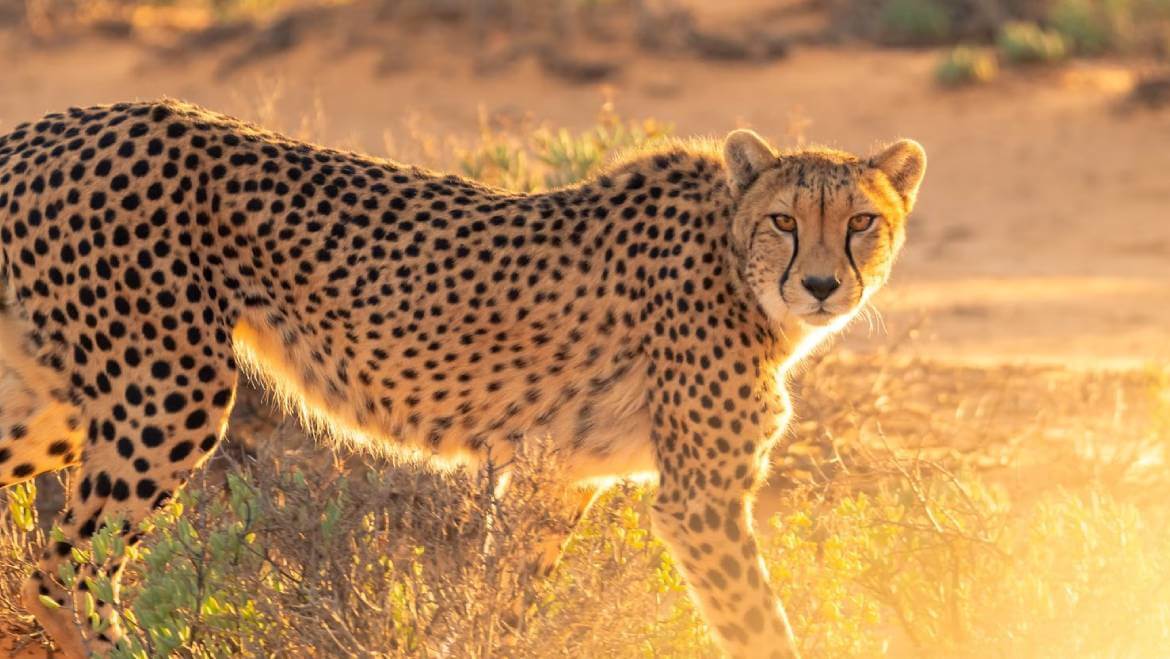
It was hailed as a landmark in conservation history—India reintroducing the cheetah, the world’s fastest land animal, to the subcontinent after more than 70 years. On September 17, 2022, amid much fanfare and spectacle, Prime Minister Narendra Modi released eight cheetahs from Namibia into specially constructed enclosures—or bomas—within Kuno National Park in Madhya Pradesh. Another 12 followed from South Africa in February 2023.
Since then, much water has flowed through the Kuno—the river that gave the park its name. The mood at the park is now markedly less celebratory. “Project Cheetah”, which was meant to showcase India’s conservation prowess, is under scrutiny for poor planning, mounting cheetah deaths, ecological unfitness, growing human–animal tension, and local resistance. Of the original cohort and subsequent arrivals, nine cheetahs have died. Others have wandered beyond park boundaries, preying on livestock and stoking fear and resentment in surrounding villages. Although some cubs have been born, a pertinent question remains: Is the much-touted “Project Cheetah” a success, or is it veering off track?
Death, Disease, and Detours: Of the 20 cheetahs imported from Africa, nine have died, including cubs born in captivity. Some perished from infections; others from stress, heat, or injuries. In July 2023, three adult cheetahs died of septicaemia caused by maggot-infested wounds hidden beneath dense winter coats—coats they would normally shed in Namibia’s winter but not in India’s blistering summer.
After much confusion among top officials of the Union Ministry of Environment, Forest and Climate Change (MoEFCC) and African cheetah experts, all the cheetahs were brought back from the open forest to the enclosures on August 13, 2023.
“This was a significant failure,” admitted one senior bureaucrat. “The project overlooked a basic biological fact: July is winter in Namibia but hot and humid in India. The cheetahs were not acclimatised. They weren’t prepared for Indian conditions,” he added. “They were placed in an unfamiliar ecosystem—thick forests, villages, and roads—instead of the open savannahs they evolved in.”
A Park Too Small: The relocation of African cheetahs into Kuno National Park has been a bone of contention from the very beginning. Kuno had long been prepared as a future home for Asiatic lions, not for African cheetahs. At just 748 sq km, it is simply too small for a predator that evolved to roam Africa’s open savannahs. The park was originally designated for Asiatic lions but was hastily repurposed for cheetahs—a move driven more by politics than science, ecologists say. “The creation of such an environment for African cheetahs is unscientific.”
Still, there has been some success. After the release of Gamini, a South African cheetah, and her four cubs in March 2025, there are now 17 cheetahs—including 11 Indian-born cubs—in Kuno’s open forest. All are reportedly healthy, according to Uttam Kumar Sharma, Additional Principal Chief Conservator of Forest and Director of Kuno National Park.
But ecologists have raised questions, as cubs born in captivity have grown up in semi-captive enclosures, shielded from predators and real-world survival challenges. True rewilding requires natural selection. Without exposure to danger and competition, can these cheetahs ever become truly wild?
A larger “Greater Cheetah Landscape”—spanning 17,000 sq km across parts of Madhya Pradesh, Rajasthan, and Uttar Pradesh—was proposed in 2024. However, it remains largely conceptual, with corridors fragmented by villages, highways, and agriculture. Worse still, this landscape planning came after the cheetahs had already landed in India—an example of “putting the cart before the horse”, as one expert puts it.
Man vs Cat—A Growing Conflict: The revival effort has not been without collateral damage. Coalitions of cheetahs have killed livestock in full public view, fuelling local anger. “We feel helpless,” said Birju, a villager in Vijaypur tehsil. “When a cheetah is nearby, we’re told to stay indoors. Even if compensation is promised, it hurts when an animal we rear and care for is killed.”
One major incident occurred in March this year, near Behardha village, when Jwala, a Namibian cheetah, and her cubs attempted to hunt a calf just outside the park. Villagers intervened—shouting, throwing stones, and waving sticks. The cheetahs fled, abandoning the prey. Such encounters have raised serious concerns about the future of the animals and the potential for human–wildlife conflict.
An advisory issued on December 23, 2024 attempted to address these tensions. It urged villagers not to panic: “Cheetahs are not dangerous to humans. Maintain distance, and keep children and cattle indoors if one is sighted.”
Still, villagers remain unconvinced. “Cheetahs move through forest and revenue areas, including grazing land,” noted Sharma. “Yet Sheopur, the district where Kuno National Park is situated, has one of the highest cattle densities in the country—and villagers don’t seem too concerned.” But data on the exact number of cattle killed remains elusive. “We’re compiling the figures,” said Sharma adding, “it should be around 50 to 60 cattle since their release.”
The Grassland Gap: Beyond reintroducing the cheetahs, “Project Cheetah” aimed to restore India’s neglected grasslands—long misclassified as mere “wastelands”. “These habitats are home to the Indian wolf, blackbuck, and the critically endangered Great Indian Bustard. But in practice, grassland restoration has been slow, scattered, and secondary to the cheetah spectacle. India still lacks a National Grassland Policy, and most grasslands are classified under outdated forest regimes.
Meanwhile, conservationists argue that funding for cheetahs has been diverted from more urgent priorities such as saving the Great Indian Bustard, whose numbers have fallen to fewer than 150, or strengthening tiger conservation efforts. “Every rupee for cheetahs is a rupee less for species already here and in crisis,” said a senior wildlife official.
Not Yet a Triumph: So, is “Project Cheetah” a failure? Not entirely. Some cheetahs have survived, cubs have been born, and India has sparked global interest in large-scale rewilding. But by any objective measure, the project is not yet a success either. However, the official version has a different take, as claimed by Sharma: “All is well. The project is moving in the right direction. Cheetahs released in Kuno are hunting and surviving with cubs in the presence of predators like leopards.”
In reality, the project suffers from inadequate planning, reactive management, lack of transparency, and ecological mismatch. What began as a high-octane conservation dream risks becoming a political vanity project, losing momentum. “Project Cheetah” must evolve from symbolism to substance. This is no longer just about saving one species—it is about whether India can walk the tightrope between ambition and ecology, and whether its conservation model can learn from missteps before it is too late. If not, the cheetah may return to extinction in India—not for lack of trying, but for lack of planning.