






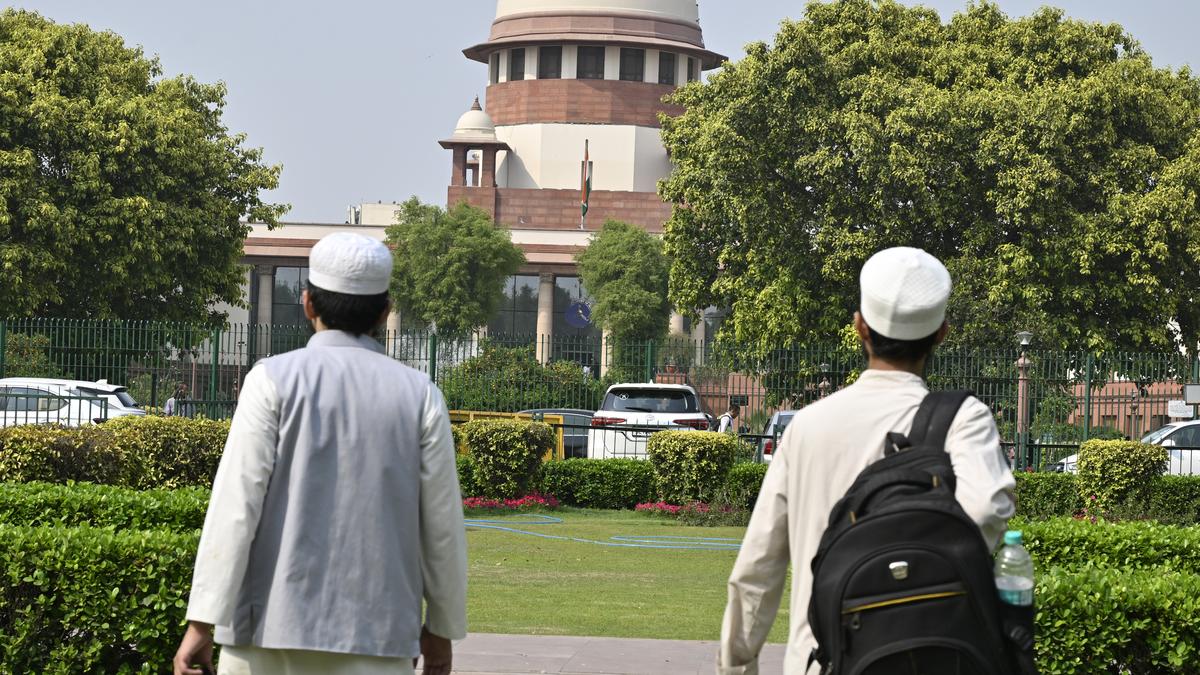
By [New Delhi Post]
New Delhi, [17 April, 2025]
In a significant interim order, the Supreme Court of India has directed the Centre to pause all non-Muslim appointments to Waqf Boards and assured that no Waqf properties—including those classified as “Waqf-by-user”—will be de-notified until further hearings. The decision comes amid a heated legal battle over the Waqf (Amendment) Act, 2025, with multiple petitions challenging its constitutional validity.
Key Interim Directions by Supreme Court
A three-judge bench, led by Chief Justice Sanjiv Khanna and comprising Justices Sanjay Kumar and KV Vishwanathan, recorded the Centre’s assurance that:
- No non-Muslim members will be appointed to Waqf Boards or the Central Waqf Council until further orders.
- No Waqf properties, including those recognised through long-standing usage (“Waqf-by-user”), will be de-notified or altered by district collectors.
- The next hearing is scheduled for May 5, with the Centre given a week to submit its preliminary response.
Why the Controversy?
The Waqf (Amendment) Act, 2025, has sparked widespread opposition, with critics alleging it undermines Muslim religious autonomy and threatens centuries-old Waqf properties. The Supreme Court had earlier expressed “serious reservations” about key provisions, hinting at possible interim stays if constitutional concerns persist.
Three Major Legal Concerns Raised by SC
- Threat to “Waqf-by-User” Properties
- The amendment risks invalidating properties historically recognised as Waqf through court decrees or public usage, even if they lack formal documentation.
- CJI Khanna warned this could lead to large-scale dispossession of religious trusts.
- Non-Muslim Majority in Waqf Council
- The bench questioned whether allowing a non-Muslim majority in Waqf governance aligns with Islamic principles, comparing it to non-Hindus managing Hindu temples.
- Collector’s Power Over Disputed Properties
- Under the new law, disputed Waqf properties would be treated as non-Waqf until a collector’s inquiry—a move the court called “premature de-notification.”
Who is Challenging the Waqf Act?
Over 70 petitions have been filed, including by:
- AIMIM chief Asaduddin Owaisi
- AAP’s Amanatullah Khan
- All India Muslim Personal Law Board
- DMK’s A. Raja & RJD’s Manoj Jha
- Hindu right-wing lawyer Hari Shankar Jain (also involved in Gyanvapi & Mathura cases)
Opposition’s Argument
Petitioners argue the amendments:
❌ Violate Articles 25 & 26 (right to manage religious affairs).
❌ Target Muslim institutions while similar rules don’t apply to Hindu trusts.
❌ Enable illegal land grabs by Waqf Boards, as alleged in cases involving temple lands and gram samaj properties.
What’s Next?
- May 5 Hearing: SC will examine Centre’s response.
- Possible Interim Stay: If constitutional flaws are proven, key provisions may be suspended.
- Political Fallout: The issue has become a communal flashpoint, with Opposition accusing the government of interfering in Muslim religious matters.
Tags:
SupremeCourt #WaqfAct #WaqfBoard #ReligiousRights #Article25 #MuslimRights #LegalNews #India
Key Takeaways:
✔ SC halts non-Muslim appointments to Waqf bodies.
✔ No de-notification of Waqf properties till next hearing.
✔ Next hearing on May 5—Centre must file reply in a week.
✔ Over 70 petitions challenge the amendments.
The Supreme Court’s interim order provides temporary relief to Muslim groups, but the final verdict could reshape India’s Waqf governance framework.


