



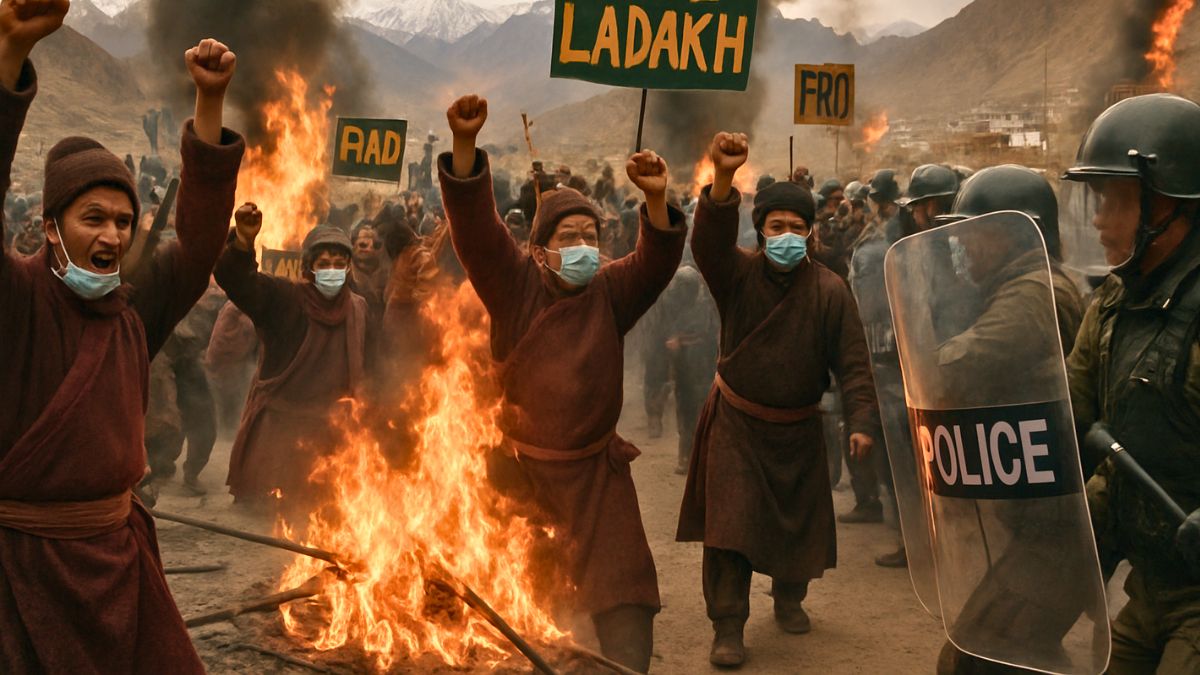
Three questions now define Ladakh’s turmoil. Is it a foreign-backed agitation, a Gen Z-led outburst or the inevitable result of political alienation? A New Delhi Post on-spot investigation finds the last explanation closest to the truth, and ignoring it could backfire on New Delhi.
Five years after the abrogation of Article 370, Ladakh stands at the brink of political burnout. Once hailed as a model of direct governance and stability, the Union Territory now simmers with discontent. What began as jubilation in 2019 has soured into resentment, as Ladakhis feel betrayed by the system that promised empowerment but actually delivered control.
The curfew has been lifted and the internet restored, yet the peace feels deceptive. Beneath the calm lies anger and fatigue. The unrest is rooted in the political vacuum created after the 2019 reorganisation that stripped Ladakh of its legislature. Residents had initially welcomed Union Territory status, expecting efficient administration. Instead, bureaucratic centralisation tightened and local representation evaporated.
Since 2020, the call for inclusion under the Sixth Schedule of the Constitution which provides tribal safeguards, protects land and guarantees local autonomy, has united Buddhist-majority Leh and Muslim-majority Kargil. This rare unity reflects a shared anxiety over the erosion of local identity. Ladakh’s demands, leaders insist are constitutional, not separatist, aimed at safeguarding culture and ecology in a frontier region where Delhi’s grip has grown heavy.
Two platforms spearhead the movement: the Leh Apex Body (LAB) and the Kargil Democratic Alliance (KDA). “We are on the same page as Leh,” says Sajjad Kargili, a founding member of KDA. “The bureaucratisation of Ladakh over the past five years has left people voiceless.”
Before 2019, Ladakh had four members in the Jammu & Kashmir Legislative Assembly and one in the Legislative Council. “Now, hand-picked bureaucrats call the shots,” Kargili says. Their key demands include restoration of statehood, Sixth Schedule inclusion, separate Lok Sabha seats for Leh and Kargil and filling long-pending government vacancies.
That unity was tested when a 35-day hunger strike led by educationist Sonam Wangchuk turned violent on September 24. Protests escalated after police clashed with demonstrators angered by the hospitalisation of two fasting activists. Four people, including Kargil war veteran Tsewang Tharchin, were killed and nearly 80 injured.
The authorities swiftly blamed Wangchuk. He was arrested under the National Security Act (NSA) while heading to a press briefing. Police Chief S.D. Singh Jamwal alleged he had links with a “Pakistan PIO” and incited unrest by referencing the “Arab Spring” and “Nepal’s Gen Z movements.”
The Centre subsequently revoked the FCRA licence of Wangchuk’s NGO SECMOL and put his university, HIAL, under scrutiny. His wife Gitanjali Angmo, called the action hypocritical. “HIAL received awards from two Union ministries,” she said. “If Sonam was anti-national, why honour him? Why did he become one overnight?”
The bloodshed marked Ladakh’s third major protest since Independence—after the tribal status agitation of 1981 and the UT demand of 1989. Following the killings, both LAB and KDA suspended talks with the Ministry of Home Affairs (MHA), stalling dialogue with the High-Powered Committee (HPC) headed by Minister of State Nityanand Rai. The committee had met local leaders thrice since 2023, including a session with Amit Shah, but talks collapsed in March 2024 over unmet demands.
In response, Delhi announced three Presidential Regulations this year:
- Increasing tribal reservation from 45% to 85%;
- Recognising English, Hindi, Urdu, Bhoti and Purgi as official languages;
- Reserving one-third of Hill Council seats for women.
The MHA hailed these as “phenomenal results”. But Ladakh’s leaders dismissed them as token gestures. “None of these addresses our core issue,” says Cherring Dorjay Lakruk, president of the Ladakh Buddhist Association and LAB co-convenor. “Ninety-seven per cent of Ladakh’s population is tribal—why deny us Sixth Schedule protections?”
He also demanded accountability for the September 24 firing. “Who ordered it? Was there a magistrate’s sanction?” he asks. “The government calls it national interest, but their crackdown endangers the very nation they claim to protect.”
In Leh, the aftermath is grim. Internet restrictions lingered till early October, businesses are struggling, and over 50 protesters have been arrested. “Those calling us violent should ask what pushed us here,” says a 24-year-old local. “Jobs are scarce, everything is contractual, and our future feels uncertain. How long can we stay silent?”
Experts say the unrest reflects systemic neglect, not foreign manipulation. Siddiq Wahid, a Ladakh-born scholar at Shiv Nadar University, attributes the turmoil to Delhi’s delays and opacity. “The demand for UT was spontaneous,” he notes. “But after studying models in the Northeast, Ladakhis realised statehood under the Sixth Schedule was a better fit. Five years of procrastination have made them impatient. Ladakhis can’t be taken for granted anymore.”
The movement’s character, locals stress, is deeply indigenous. “Today, Delhi is repeating the same mistake. Branding us as foreign-backed agents will only deepen alienation,” says a lawyer in Leh.
Opposition voices are now amplifying the issue. Congress leader Jairam Ramesh invoked the legacy of Kushok Bakula Rinpoche, Ladakh’s revered monk-diplomat who once strengthened India’s ties with Mongolia, reminding Delhi of Ladakh’s deep-rooted Indian identity. The INDIA bloc is also planning a fact-finding visit to Leh and Kargil.
By relying on coercive tactics and security rhetoric, Delhi risks alienating one of India’s most strategic and patriotic borderlands. Ladakh’s message remains clear:
This is not an insurgency, it is a constitutional plea for dignity, autonomy and inclusion.
(Shakir Mir is a journalist based in Jammu and Kashmir and Ladakh)