


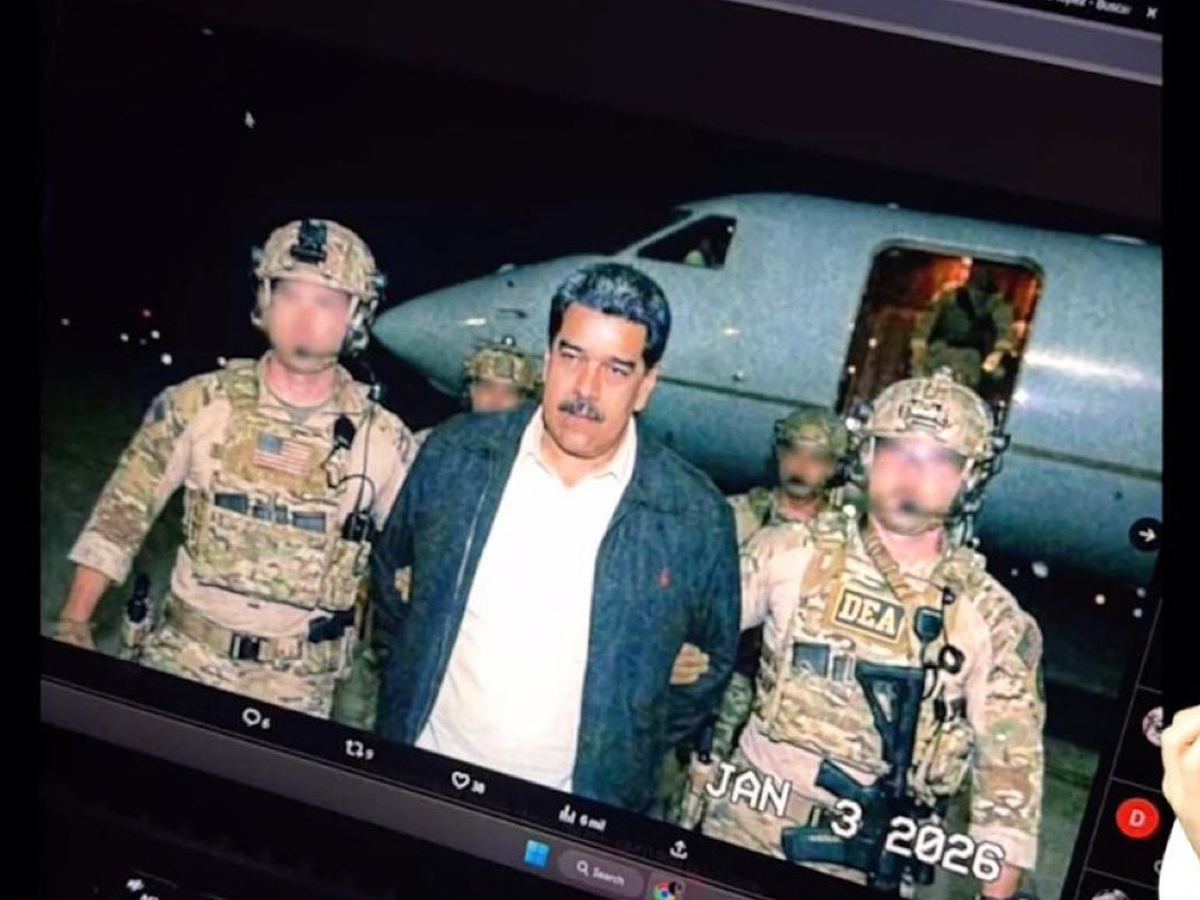
In the early hours of January 4, the United States announced what it described as a precision military operation that removed Venezuelan President Nicolás Maduro from power and transferred him to US custody. According to official statements issued by the US President Donald Trump’s administration, the operation was framed as a law-enforcement action aimed at apprehending an “indicted criminal”. Yet the scale of military deployment, the explicit assertion of US authority over Venezuelan territory, and repeated references to oil extraction and administration of the country have placed the episode among the most consequential and controversial uses of American force in Latin America since the Cold War.
The account of the operation, described in detail in a commentary circulated by journalist Laurie Garrett, reportedly named Operation Absolute Resolve, was ordered directly by Trump and involved extensive air and naval assets converging on Caracas. The White House has claimed there were no American casualties and that the mission achieved its objectives swiftly. Maduro and his wife, Cilia Flores, were said to have been taken into custody and transferred to the United States to face charges linked to narcotics trafficking. These claims, while repeated by US officials, remain disputed by Venezuelan authorities and have not been independently verified by international bodies.
What is not disputed is the language used by Washington after the operation. President Trump publicly declared that the United States would “run the country” until a suitable transition could be arranged, while American oil companies would be brought in to rehabilitate Venezuela’s collapsed energy infrastructure. He also stated openly that the US would be “reimbursed” through oil revenues for the costs of intervention. Such statements have shifted the episode from a narrow law-enforcement narrative into a broader assertion of coercive power over a sovereign state.
International reaction was immediate. Media outlets across Latin America, Europe, Africa and Asia drew comparisons to the 1989 US invasion of Panama, when President George H W Bush ordered the capture of Panamanian strongman Manuel Noriega. That operation, justified at the time on drug-trafficking and security grounds, resulted in significant civilian casualties and long-term destabilisation. Noriega was eventually tried and imprisoned in the US and Europe, but the invasion left a lasting scar on Panama and reinforced regional perceptions of US overreach.
The historical echo is not incidental. Noriega, like Maduro, was indicted in US courts while still in office. In Panama, the US ultimately chose military invasion over diplomacy or extradition negotiations. The human cost of that decision remains contested decades later. Critics argue that the Venezuela operation risks repeating this pattern, particularly given the absence of United Nations authorisation or a clear claim of immediate self-defence under international law.
To understand why Venezuela has once again become the site of such confrontation, it is necessary to examine the country’s political and economic trajectory over the past quarter-century. Modern US–Venezuela tensions date back to the rise of Hugo Chávez in 1999. Chávez dismantled the old oil-backed elite, nationalised key industries and aligned Venezuela with Cuba, positioning his government as an anti-imperialist counterweight to Washington. While his social programmes reduced poverty in the short term, his administration also concentrated power, weakened institutions and fostered a new, politically connected elite that later entrenched itself under Maduro.
After Chavez died in 2013, Maduro inherited both the machinery of control and an economy that was dangerously dependent on oil revenues. When global oil prices collapsed after 2014, Venezuela’s finances imploded. Combined with widespread corruption and sweeping international sanctions, the country entered one of the worst peacetime economic collapses in modern history. Hyperinflation wiped out savings, public services disintegrated and millions of Venezuelans fled abroad. By 2024, nearly a quarter of the population had left the country.
The US, under successive administrations, responded primarily through sanctions and diplomatic isolation. Both Democratic and Republican governments refused to recognise Maduro’s legitimacy after disputed elections, but stopped short of direct military action. That restraint appears to have ended with Trump’s return to office in 2025. From the outset, his administration linked Venezuela not only to authoritarianism but also to narcotics trafficking and regional insecurity. The Justice Department has long accused senior Venezuelan officials of participating in cocaine smuggling networks, though these allegations have been contested and complicated by the overlap of criminal, political and intelligence claims.
What distinguishes the current episode is the explicit centrality of oil in the administration’s rhetoric. Venezuela possesses the largest proven oil reserves in the world, primarily in the Orinoco Belt. While production has collapsed due to mismanagement and sanctions, the strategic value of those reserves remains immense. Trump’s public statements, including remarks that the US had been “robbed” of oil assets and intended to “get them back”, have reinforced accusations that the intervention reflects resource imperialism rather than law enforcement or humanitarian concern.
Legal scholars have raised serious objections. Under the United Nations Charter, the use of force against another state is permitted only in self-defence or with Security Council approval. Neither condition appears to have been met. Even if Maduro is indicted in US courts, international law does not recognise unilateral military abduction of a sitting head of state as lawful. The precedent, critics warn, is destabilising: if powerful states claim the right to seize foreign leaders by force, the entire architecture of the post-1945 international order is weakened.
Inside Venezuela, the immediate aftermath has been marked by uncertainty rather than celebration. Reports describe citizens stockpiling food and bracing for instability. While opposition figures such as María Corina Machado have welcomed Maduro’s removal and called for a democratic transition, the Trump administration has conspicuously avoided recognising an alternative Venezuelan leadership. Instead, it has asserted that there is “nobody to take over,” reinforcing fears of prolonged external control rather than rapid restoration of sovereignty.
The shadow of Iraq looms heavily over these events. In 2003, US leaders insisted that regime change would bring stability, democracy and prosperity. Instead, Iraq endured years of violence, institutional collapse and mass civilian casualties. Trump himself once denounced that war as a “big, fat mistake”. Yet the logic now invoked in Venezuela, that forceful intervention will create order and pay for itself through resource extraction, echoes the same flawed assumptions.
As the situation unfolds, one principle articulated years ago by former US Secretary of State Colin Powell has resurfaced with renewed relevance: if you break it, you own it. Whether the United States is prepared to own the political, economic and human consequences of its actions in Venezuela remains unclear. What is already evident is that the seizure of Maduro marks a decisive break from the norms Washington once claimed to defend. The long-term costs, for Venezuela, for the region and for the credibility of international law, may only become visible with time.