

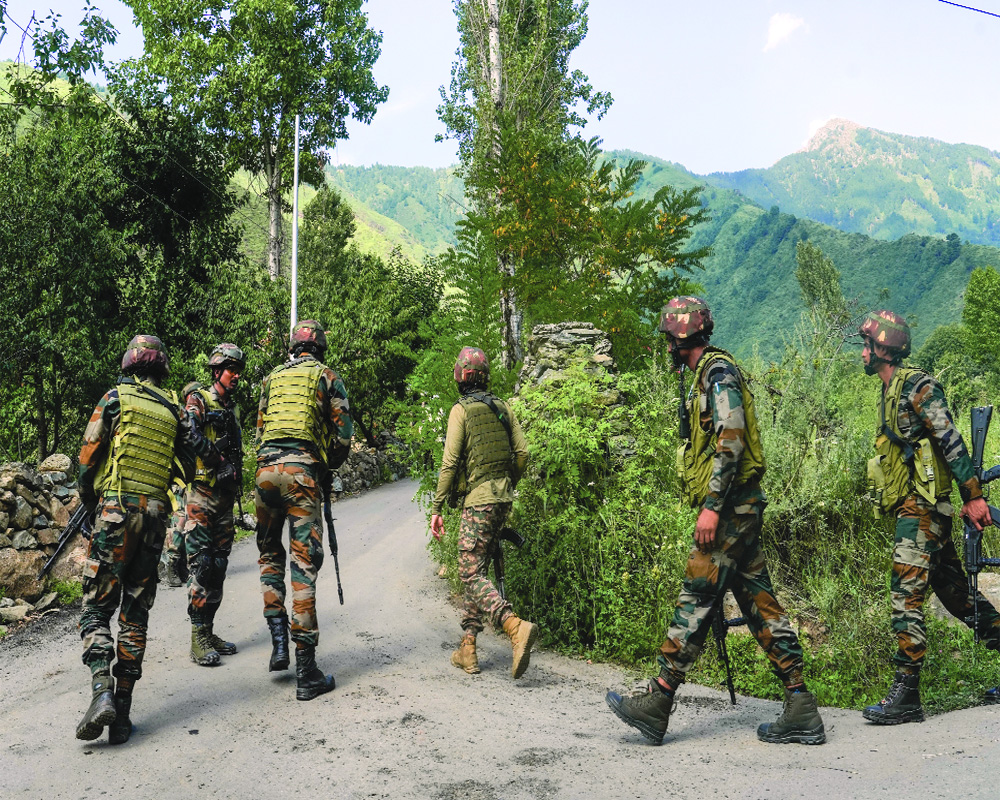
Following Operation Sindoor, India’s security landscape is undergoing a paradigm shift. With Pakistan-based terror groups regrouping and internal sleeper cells reactivating, anti-India forces are once again gaining momentum. In response, India has begun re-moulding its internal security policy with the highest degree of caution.
In July, Jammu and Kashmir recorded its lowest monthly tally of incidents this year, with eight attacks and the neutralisation of six terrorists. The month also saw Operation Mahadev, which eliminated three terrorists, including the perpetrator of the Pahalgam killings. This marks a relative improvement compared to the heightened tensions earlier, when the Union Territory witnessed 98 terror incidents.
Yet senior intelligence officials warn against complacency. They note that terror groups are repositioning—shifting from traditional border infiltrations to urban-centric operations, lone-wolf strikes, grenade attacks, and intensified online radicalisation campaigns. While India has not yet experienced a full-fledged lone-wolf attack, the Islamic State’s digital propaganda remains aggressive and persistent, targeting impressionable youth with a steady stream of radical content.
Although Op Sindoor dealt a severe blow to Pakistan’s terror infrastructure, intelligence reports suggest that reconstruction began almost immediately. In Pakistan-occupied Kashmir, training is now being conducted in smaller, decentralised camps accommodating no more than 20–30 cadres each. These facilities are deliberately hidden in dense forest belts such as Jankote, Chamankot, Lipa, Kotli, Athmuqam, and Kahuta to evade detection. They are equipped with advanced radar camouflage, thermal masking, and satellite signature-reduction technologies. Officials are also monitoring China’s suspected role in supplying surveillance tools and providing logistical expertise for these sites.
Meanwhile, old outfits have undergone cosmetic rebranding. Lashkar-e-Taiba now operates as “The Resistance Front”, while Jaish-e-Mohammad uses aliases such as “PAFF” or “Kashmir Tigers”. Indian agencies believe these changes are intended to create international deniability and mislead oversight bodies such as the Financial Action Task Force (FATF). More such rebrandings are expected as Pakistan seeks to avoid sanctions and maintain plausible deniability over its continued sponsorship of terrorism.
One lesser-publicised outcome of Op Sindoor has been a noticeable rise in ISI-led espionage activity in Punjab. Between March and June 2025, security agencies arrested multiple operatives linked to Pakistan’s Inter-Services Intelligence (ISI). Their assignments included tracking Army units, monitoring ammunition convoys, and co-opting digital influencers to spread “soft propaganda”. In Panipat, a man named Naumen Elahi, from Kairana, was caught filming sensitive military installations and sending the footage to handlers in Pakistan. Investigations uncovered an encrypted, multi-layered network operating via WhatsApp, Telegram, and Signal, with digital payments disguised as freelance journalism fees. Earlier, two YouTubers, Jyoti Malhotra and Jasbir Singh, were also arrested for espionage. Security experts see this as a strategic shift, with the ISI cultivating urban sleeper cells and digital foot soldiers well beyond border zones.
Border forces are also reporting a resurgence in narcotics smuggling by drones into Punjab’s hinterlands. After a temporary lull post-Op Sindoor, drug-laden drones are again breaching Indian airspace, flying two to two-and-a-half kilometres inside—some capable of penetrating seven to eight kilometres. To evade radar, operators launch drones at high altitudes before descending to low levels once inside Indian territory, using zigzag flight paths to confuse detection systems. Officials warn that this is not purely a criminal enterprise, but part of a broader hybrid warfare strategy aimed at destabilising the youth, funding insurgency, and overstretching law enforcement agencies.
While Punjab and Kashmir remain high-profile theatres, India’s eastern flank is emerging as a new frontier for infiltration. Since the ouster of Sheikh Hasina in Bangladesh, radical elements have tightened their grip, triggering political unrest and weakening border control. Indian intelligence agencies are increasingly concerned about infiltration routes through Bangladesh, Nepal, and Myanmar. The porous terrain, limited militarisation, and complex political dynamics make these corridors attractive for illegal immigration, counterfeit currency operations, cattle smuggling, and insurgent movement. A senior Research and Analysis Wing (R&AW) officer described the eastern frontier as a “multi-actor security puzzle” where vulnerabilities are as much political and economic as they are geographic.
Although banned in 2022 under the Unlawful Activities (Prevention) Act (UAPA), the Popular Front of India (PFI) continues to operate underground, particularly in Kerala, Karnataka, and Tamil Nadu. The group uses encrypted communications, community influence, and overseas funding channelled through fake charitable trusts. In the South, security agencies are tracking a wider threat spectrum. Al-Qaeda, through Pakistan-based Farhatullah Ghori, has announced the revival of Al-Ummah—the organisation behind the Coimbatore blasts targeting L K Advani. Intercepts point to plans for new attacks in southern India, according to informed sources. Meanwhile, the Islamic State continues to circulate radical content online, aiming to recruit and motivate young Indians toward lone-wolf strikes.
Op Sindoor’s primary battlefield success underscored a deeper strategic lesson: adversaries adapt quickly. India’s approach is now shifting from reaction to anticipation, focusing on intelligence-led prevention, cyber vigilance, psychological operations to counter ideological subversion, and hybrid warfare countermeasures that integrate border defence with digital monitoring. The operational emphasis has moved from intercepting rifles to intercepting narcotics, from blocking infiltration to blocking radicalisation pipelines. National Security Advisor Ajit Doval summed up the doctrine: “You don’t win wars just on borders. You win them in the minds of the people.”
The post-Op Sindoor security environment reveals a stark reality—India’s adversaries are recalibrating. Key threat vectors include Pakistan’s miniaturised terror camps, ISI-driven recruitment of digital influencers, drone-borne narcotics operations in Punjab, jihadist infiltration via eastern borders, and underground radical networks in the South. Internal security experts cautioned that countering them will require agility—not just retaliatory strikes, but pre-emptive disruption.
This means securing forests in PoK, alleys in Dhaka, drone flight paths over Punjab, and encrypted chat rooms in southern India. Op Sindoor was the first overt demonstration of domination through impact. The challenge now is to sustain that impact—across battlefields, information spaces, and ideological arenas.