





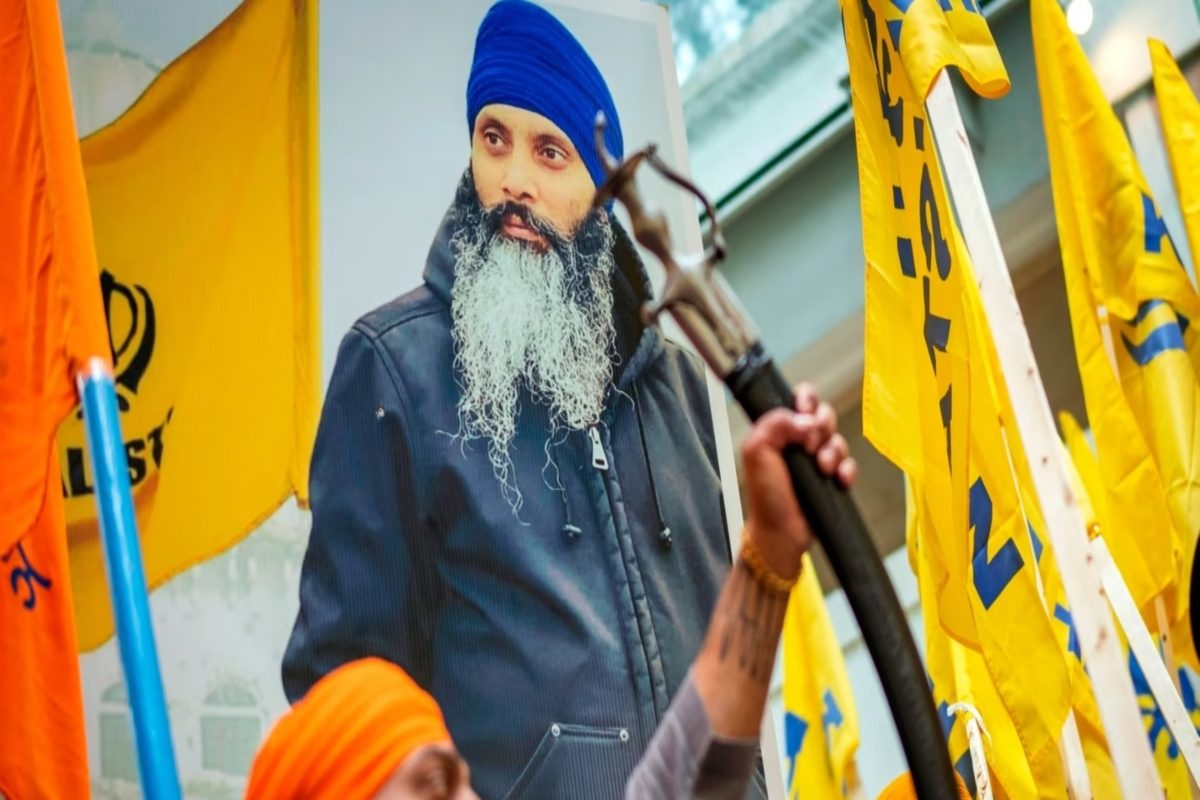
The Goldy Brar recording puts an organised-crime trail on the table in a Nijjar murder case once dominated by allegations of New Delhi’s involvement
A reported audio recording of gangster Goldy Brar has introduced the most significant new twist in the three-year-old murder case of Khalistani activist Hardeep Singh Nijjar, pointing to a possible criminal motive behind the killing. Coming after a US indictment naming the Bishnoi network and a Royal Canadian Mounted Police (RCMP) statement finding no evidence of Indian government involvement in its organised-crime investigation, the recording is shifting the centre of gravity of a case that once threatened to rupture India-Canada ties.
Gang-War Theory Gains Ground
For almost three years, the Nijjar murder has been viewed through the most politically explosive possibility that the agents of the Indian state killed a prominent Sikh separatist on Canadian soil. That proposition, raised publicly by then Canadian Prime Minister Justin Trudeau in September 2023, transformed a shooting outside a gurdwara in Surrey, British Columbia, into a confrontation between two governments. India rejected the allegation, while Canada maintained that its security agencies were investigating what Trudeau called “credible allegations” of a potential link between Indian government agents and the killing. The underlying intelligence was never fully released to the public.
The latest audio incident points towards a very different possibility. The recording that surfaced in August this year purportedly captures Canada-based gangster Satinderjit Singh, alias Goldy Brar, claiming responsibility for Nijjar’s murder. More important than the alleged admission is the motive attributed to him: Brar purportedly says that Nijjar was targeted because of his alleged association with people involved in using young people in drug activity. If the recording is genuine, it introduces a distinctly criminal explanation for the killing — one involving drugs, rival interests and a possible dispute within organised-crime networks.
There is, however, a large evidentiary qualification. The recording has not been independently authenticated, and the RCMP has said it cannot confirm or deny its origin, content, authenticity or evidentiary value. It would therefore be wrong to describe it as a “confession”. Its significance lies elsewhere: it offers a potentially testable explanation of the killing at precisely the moment when a separate US criminal prosecution has begun pointing in the same direction.
That convergence is what makes the recording important. On its own, an unverified audio clip would tell investigators very little. But it has surfaced after US prosecutors formally alleged that Brar and imprisoned gangster Lawrence Bishnoi ordered Nijjar’s assassination as part of a transnational organised-crime operation. The audio therefore potentially connects an alleged first-person account to a criminal theory that is already part of a formal prosecution. It does not prove that theory; it gives investigators another strand of evidence against which the theory can be tested.
The July Turn
The real shift in the case came in July, before the audio surfaced. Under “Operation Hard Ball”, the US Department of Justice announced a major crackdown on India-based international organised-crime networks accused of murder, shootings, extortion, kidnapping and drug trafficking. One of the indictments targeted Lawrence Bishnoi’s organisation, which US prosecutors alleged continued to operate while Bishnoi was imprisoned, with Brar serving as its principal figure in North America.
Nijjar appeared inside that indictment under the initials “H.S.N.” Prosecutors alleged that Bishnoi and Brar ordered his killing and described the June 18, 2023 shooting outside a Sikh temple in Surrey. For the first time in a major foreign criminal prosecution, the murder was formally located within an alleged organised-crime hierarchy rather than presented primarily as a politically motivated assassination.
That distinction is crucial. The indictment is not a judicial finding of guilt; its allegations still have to be proved in court. But it nevertheless changes the public evidentiary record because it names alleged organisers, places them within a defined criminal structure and attributes the Nijjar killing to that structure. The case consequently acquired something it had previously lacked in the public domain: a coherent criminal chain of responsibility.
The alleged Brar recording arrived into that new landscape. If authenticated, it would not merely repeat the US allegation; it could potentially corroborate it from another direction, while supplying the missing element of motive. That is why the timing of the recording matters more than the mere existence of the recording.
The Canadian police position makes the shift even harder to dismiss. On July 7, the RCMP announced action against international organised-crime networks linked to Bishnoi and others and included Nijjar’s killing among the incidents associated with the criminal activity under investigation. That placed the murder within the same organised-crime framework that had emerged from the US prosecution.
But the RCMP made another statement that is arguably more consequential for the political narrative surrounding the case: it said that no evidence had emerged from that organised-crime investigation, or from the charges arising from it, connecting Indian government officials to Nijjar’s killing.
This does not invalidate Canada’s earlier intelligence assessment. Nor does it establish that the Indian state played no role. What it does show is that the most recent publicly described criminal investigation has not produced the state connection that became the defining feature of the case in 2023.
That creates an important asymmetry in the public record. Canada’s original allegation rests on intelligence whose full evidentiary basis remains undisclosed, while the newer criminal theory has begun to acquire a visible trail: a US indictment naming Bishnoi and Brar, an RCMP organised-crime investigation that includes Nijjar’s killing, and an alleged recording that purports to contain Brar’s own account.
The evidence remains incomplete, but its direction has changed.
From State to Syndicate
The shift cannot be understood without considering who Nijjar was. He was a prominent pro-Khalistan activist in Canada and president of the Guru Nanak Sikh Gurdwara in Surrey. India had designated him a terrorist in 2020 and linked him to the Khalistan Tiger Force, accusing him of involvement in terrorist activities, recruitment, training and financial support. In Canada, he was regarded as a Canadian citizen and Sikh separatist activist.
That sharply different official assessment made political motivation an obvious line of inquiry when he was murdered in 2023. Amid the India and Canadian governments’ point-counterpoint, Nijjar’s death rapidly became the dominant international topic. The criminal record now developing is of a different character: the gang-war theory now has multiple points of entry into the investigation.
The alleged motive in the Brar recording deserves particular scrutiny because it could determine whether the gang theory develops into a credible explanation or remains another competing narrative.
Brar is purportedly heard accusing Nijjar of supporting people who used teenagers in drug activity and allegedly drawing young people into such activity through pressure and blackmail. The claim, if genuine, suggests that Nijjar’s killing may have been connected to a dispute over criminal interests.
That proposition can be tested. Investigators can examine whether the people and activities referred to in the recording existed, whether Nijjar had any demonstrable connection to them, whether Brar or the Bishnoi organisation had a documented dispute with those individuals, and whether communications, financial transactions, travel records or other evidence corroborate the alleged motive.
This is where the recording could become far more significant than a sensational audio clip. A genuine voice recording containing a claim of responsibility is still only one piece of evidence. But if its contents correspond with independent evidence already gathered by investigators, it could help turn an alleged motive into an evidentiary trail.
Conversely, if the alleged motive cannot be corroborated, the recording’s value would diminish sharply even if the voice were eventually authenticated.
A second reported recording surfaced towards the end of August, purportedly involving Paramjit Singh Pamma. In that recording, Pamma allegedly threatens Brar over Nijjar’s killing and says that Brar and his gang have created serious consequences for themselves following the murder. Like the first recording, it has not been independently authenticated.
If both recordings were eventually authenticated, their value would extend beyond the question of whether Brar was boasting about the murder. They could potentially reveal relationships, tensions and rivalries among actors in the wider criminal and pro-Khalistan ecosystem. In investigative terms, that would be considerably more useful than a single isolated admission because it could provide context around the killing and its aftermath. For now, however, the recordings remain leads rather than established evidence.
What Must Be Proven
The question that dominated the case in 2023 was whether an Indian state operation had reached into Canada to eliminate Nijjar. The question emerging in 2026 is more specific and, in some ways, more revealing: was Nijjar caught in a conflict involving organised-crime networks, and did the men allegedly responsible act entirely on their own?
The next stage of the case should therefore be judged not by the number of allegations circulating about it, but by whether those allegations can be connected to independently verifiable evidence.
- Is the Brar recording authentic? Its provenance, integrity, timing and voice identification will have to be established.
- Is the alleged motive real? The claims about drugs, young people and criminal rivalry need corroboration beyond the recording itself.
- Did Brar and Bishnoi actually order the killing? The US allegation must ultimately be tested against the evidence in court.
- How do the Canadian suspects fit into the alleged chain? Investigators will need to establish the links between the alleged organisers and the men charged with carrying out the murder.
- Was there a state connection? This remains the most consequential unresolved question: whether any Indian government official or agency instructed, assisted or facilitated the operation.
These are not merely questions for the next news cycle. They are the evidentiary tests that will determine which of the competing narratives survives scrutiny. The Nijjar case began as a question about a state. The latest evidence is forcing investigators to look first at a gang, and then to ask whether anyone stood behind it.
THE SHIFTING GROUND
ORIGINAL THEORY
Indian government agents
→ alleged state direction
→ operatives
→ Nijjar killing
EMERGING THEORY
Bishnoi
→ Brar
→ organised-crime network
→ shooters
→ Nijjar killing
THE QUESTION
What is right?
WHY THE AUDIO MATTERS NOW
JUNE 18, 2023
Nijjar killed in Surrey
↓
SEPTEMBER 2023
Trudeau raises alleged Indian-government link
↓
JULY 2026
US indictment alleges Bishnoi–Brar role
↓
JULY 2026
RCMP places killing within organised-crime investigation
↓
AUGUST 2026
Reported Brar audio surfaces
THE SIGNIFICANCE:
The audio arrives after the criminal theory has already entered the formal investigative records
FIVE ANGLES MUST BE PROBED
1. What is the authenticity of the Brar audio Recording?
2. Can the drug-related claims be independently corroborated?
3. Did Bishnoi and Brar order the killing?
4. Who recruited, directed and paid the alleged shooters?
5. Did any Indian government official or agency instruct, assist or facilitate the operation?


