



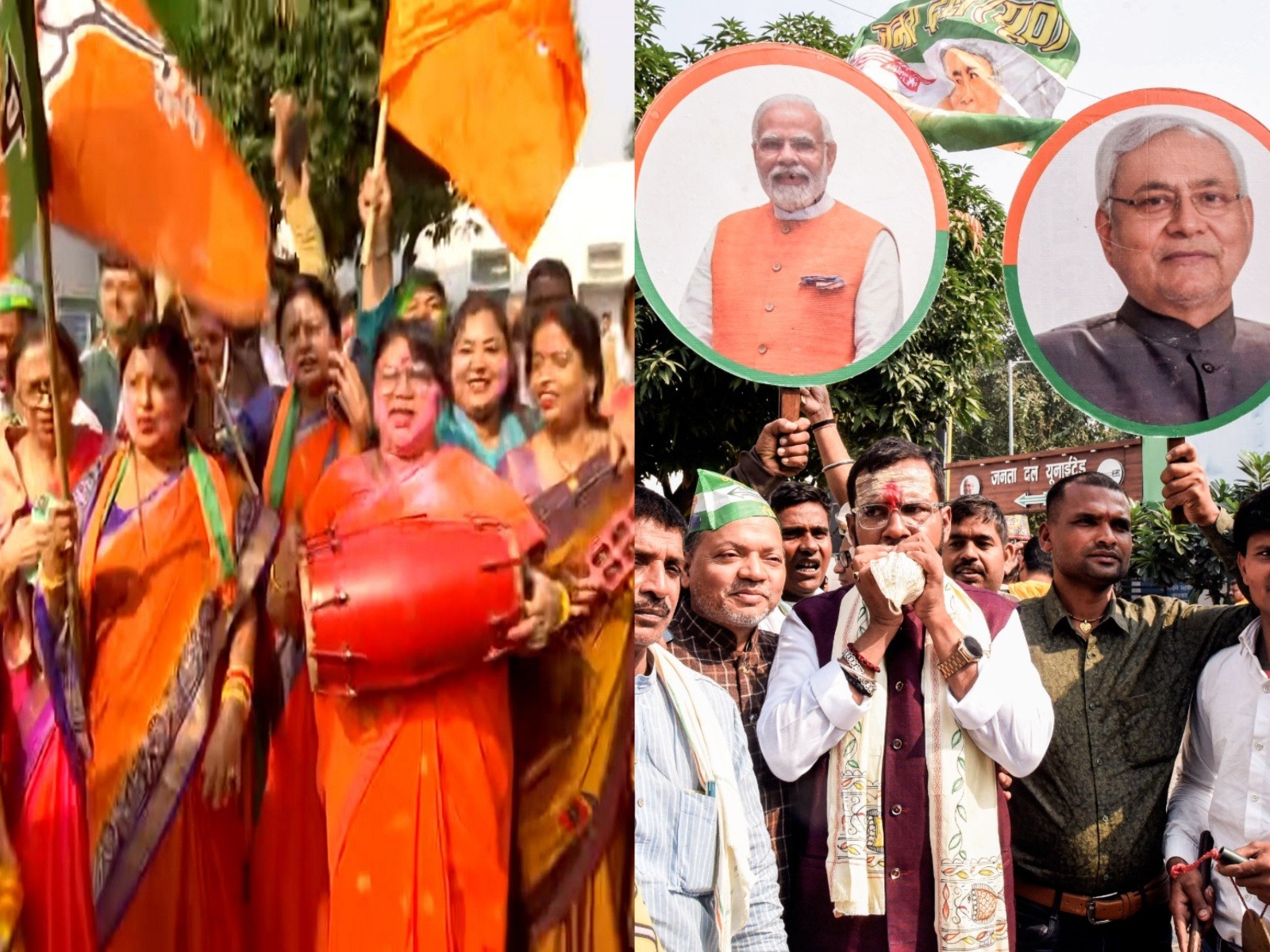
Some elections change governments, and some political physics. Bihar’s 2025 mandate falls firmly into the latter category. A staggering 202 out of 243 seats for the NDA is not just a win; it is a political restructuring, the kind that forces every party to redraw its maps, recalibrate its calculations and rethink its assumptions about what drives the Bihari voter.
The easy conclusion would be to call it Modi’s victory. The equally tempting narrative would be to attribute it to Nitish Kumar’s durability, his uncanny ability to reinvent alliances and political identities every few years. But neither explanation captures the whole truth. The 2025 verdict is the outcome of something more complex, more structural and far more revealing: a new caste coalition engineered with mathematical precision, powered by a perfect synchronisation between the BJP and the JD(U), and fuelled by the demographic truths laid bare in Bihar’s caste survey.
The numbers tell their own story. The caste study, published in 2023, confirmed what political workers on the ground had always known instinctively: Bihar is, first and foremost, an EBC-OBC state. The data are stark. EBCs constitute 36.01 per cent of the population. OBCs add another 27 per cent or so. Taken together, these two blocs represent over 63 per cent of Bihar’s people. Scheduled Castes contribute another nearly 20 per cent, Scheduled Tribes about 1.7 per cent, while “upper castes” stand at around 15.5 per cent of the population.
Bihar has always voted through caste; this isn’t new. What is new is how meticulously those castes were politically organised this time. Nitish Kumar’s political career rests on a simple truth: he understood the political potential of EBCs before anyone else did. He built schemes for them, created sub-quotas, made them visible in administration, and ensured their political ascent. The JD(U)’s dominance over EBC votes is not accidental; it is the result of two decades of labour.
But in 2025, that traditional Nitish advantage was plugged into something bigger: Modi’s national appeal, the BJP’s organisational muscle and a seat-sharing architecture that gave every caste group a sense of direct representation. The BJP’s decision to contest around the same number of seats as the JD(U) and yet give roughly the same number of tickets to OBC and EBC communities was a turning point. It allowed the NDA to run a caste strategy that looked less like an alliance between two parties and more like a synchronised, statewide social coalition.
This was the real NDA secret: complete caste coverage. JD(U) anchored the EBCs. BJP secured the upper castes and aggressively chipped into non-Yadav OBCs. LJP (Ram Vilas) held significant pockets of Dalit support. HAM contributed to the Mahadalit belts. Rashtriya Lok Morcha filled sub-regional gaps. Every caste group could look at the NDA slate and see someone who resembled them, spoke like them, lived like them. Elections are won by seats, but seats are secured through relationships, and the NDA’s candidate list built those bonds with almost forensic precision.
Contrast this with the RJD-led opposition. Tejashwi Yadav commands one of Bihar’s most consolidated caste groups: the Yadavs, roughly 14 per cent of the population. The Muslim–Yadav arithmetic has served the RJD well in the past. But 2025 was a different battlefield. When the NDA captured EBCs, the largest single bloc in the state, the opposition’s ability to compete collapsed. The RJD’s vote share looked respectable on paper, hovering around the low twenties, but the seats evaporated: just 25 in a 243-member Assembly. This wasn’t merely a defeat; it was a brutal demonstration of how poor vote-to-seat conversion can annihilate a party’s presence.
Some of this failure is organisational. Some of it is strategic. Some of it is simply the consequence of an NDA that left no caste relation unattended. But a large part of it is narrative. For years, backwards-class politics in Bihar was dominated by a single storyline: the RJD represented Yadavs and Muslims; the JD(U) represented multiple backwards groupings; the BJP catered to upper castes. That pyramid shattered in 2025. Voters no longer thought about caste blocs as monolithic. They saw them as competing for representation, benefits and power.
That is the human side of this story: the anxiety of political invisibility. After generations of marginalisation, EBC communities looked at the caste survey numbers and finally saw themselves quantified, recognised and acknowledged by the state. Nitish Kumar read that emotion correctly. So did the BJP. The Mahagathbandhan did not.
But even within the NDA victory, a subtler story is unfolding: the recalibration of power between Modi and Nitish. For the first time in Bihar’s history, the BJP emerged as the single largest party in an assembly election. The JD(U) wasn’t far behind, but the message was unmistakable: the BJP has grown from a partner into a co-equal force. Nitish still has his loyal social base, his unmatched experience, and the aura of the man, ‘Sushasan Babu’, who transformed Bihar’s governance in the 2000s. But the BJP’s rise has changed the internal arithmetic of the alliance.
Does this reduce Nitish’s centrality? Not immediately. Because no matter how many seats the BJP wins, it still lacks the one thing Nitish has in abundance: deep roots among backward communities. The BJP knows it. Nitish knows it. Bihar’s voters know it. That is why 2025 is neither solely Modi’s victory nor solely Nitish’s. It is a shared triumph built on complementary strengths, the kind that requires delicate maintenance.
The risks are real. When two partners become roughly equal, their differences can sharpen. Nitish’s politics is caste-first, delivery-first, local-first. Modi’s politics is national-first, ideological-first, charisma-first. There will be friction. There will be negotiations. There will be days when the alliance looks stretched.
But for now, the voter has delivered a clear message: Bihar rewards coalitions that understand its caste structure, speak to its aspirations, and offer both stability and representation.
In truth, the NDA victory does not belong to either one man or one party. It belongs to a carefully engineered coalition that read Bihar’s demographic map with precision, humanised its politics, and built something stronger than any individual claim: a new social alliance, running from Mahadalits to EBCs to upper castes, stitched together by political calculation but sustained by voter trust. That is the real story of Bihar 2025. And it is far bigger than any single leader.
(Bikash C Paul is a Delhi-based senior journalist. He is the executive editor, New Delhi Post)