


By Paranjoy Guha Thakurta and Aditi Roy Ghatak
A billionaire brawl has exposed how oligarchs seek to protect their monopolies through governments reliant on their political funding, dressing up commercial self-interest in the language of national security and sovereignty
1. A BILLIONAIRE’S BROADSIDE
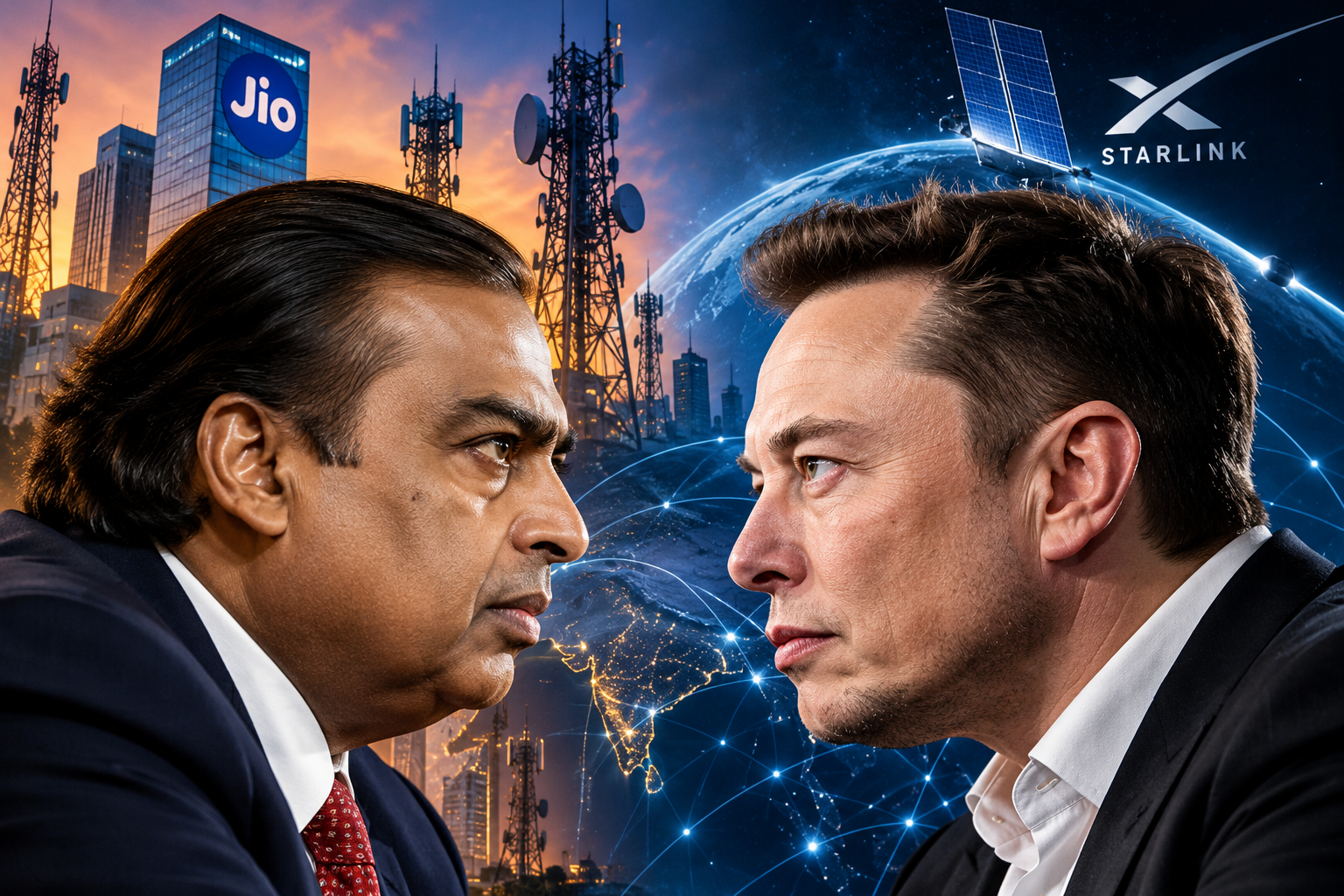
On October 9, the world’s richest man, Elon Musk, publicly took on one of India’s richest men, Mukesh Ambani. Musk heads several conglomerates, including Tesla, the electric vehicle maker; X (formerly Twitter), the microblogging platform; and SpaceX, which provides satellite services. Ambani heads Reliance Industries Limited (RIL), the country’s biggest privately owned corporate entity. RIL owns the world’s largest crude oil refinery and dominates several industrial sectors in India, including petrochemicals, synthetic yarn and fibres, and internet-based mobile communications.
On X, Musk sarcastically accused Mukesh Ambani of being the real “boss” and “prime minister” of India by keeping the satellite-based internet services provided by SpaceX in over 165 countries out of India ostensibly to favour Reliance Jio and maintain its monopolistic dominance. Interestingly, this unprecedented spat between the oligarchs took place just before Jio Platforms announced its initial public offering (IPO) of shares.
Musk highlighted Reliance’s funding of the ruling Bharatiya Janata Party and questioned whether the policies of the Indian government’s Ministry of Communications, led by Jyotiraditya Scindia, are fair. The American tycoon claimed that competition from Starlink would drive down prices and benefit Indian consumers. There was, of course, more than an element of hypocrisy in the allegations made by Musk, who has contributed generously to the coffers of US President Donald Trump and the Republican Party.
The Indian government has rejected Musk’s claims, calling them baseless and stating that the satellite communications and telecom authorisation framework is fair and non-discriminatory. It has also said that all applicants (including Starlink and Jio) must complete standard security and regulatory clearances.
For a week, the Ambanis remained silent in response to Musk. On October 16, however, Reliance issued a formal statement, which was circulated on X, Musk’s social media platform. It said: “In light of recent remarks about Reliance and the Indian market, we wish to place the facts on record. Like every Indian enterprise, Reliance has grown in an India that welcomes investment and innovation, homegrown or international, that improve the lives of the people.
That openness rests on the rule of law. As the Government of India has stated, it applies the same process to every applicant, Indian or foreign. Jio’s own satellite services await clearances.
At Reliance, we have never feared competition. We see it as the truest test of who serves the customer best. Jio itself entered India’s crowded telecom market in 2016 as the newest player, with not a single customer. In just ten years, Jio has earned the trust of over 530 million customers and given Indians some of the best digital infrastructure and most affordable data in the world.”
The statement concluded by saying: “We welcome competition in satellite communications, including Starlink. Every player, Jio included, must serve the people of India and abide by the laws and policies of the land.”
The public war of words acquired a different dimension when Rahul Gandhi, the Leader of the Opposition (LoP) in the Lok Sabha, jumped into the fray, telling Musk to “wait till you discover the other guy”. Gandhi did not mention Gautam Adani by name, but was obviously referring to him. After Musk thanked Rahul Gandhi for his apparent support, the BJP’s IT Cell got active and put out memes attacking the LoP.
Ironically, in March 2025, SpaceX had announced that it had tied up with both Jio and Bharti Airtel to offer Starlink’s broadband internet services to Indian customers after it obtained the relevant approvals from the government. That is yet to take place. Whether SpaceX’s agreement with Jio would continue remains to be seen.
In a paywalled article published in The Morning Context on March 10, 2025, we examined the key issues behind the hectic lobbying to persuade Sanchar Bhavan, the headquarters of the Union Ministry of Communications, not to assign satellite spectrum by issuing licences and instead allocate spectrum through an auction process.
2. THE LAW, THE LOBBYING AND THE STAKES
The lobby led by Starlink argues that auctioning satellite spectrum is unprecedented, impractical and impossible. The contending lobby led by Reliance Jio has raised the spectre of the second-generation (2G) spectrum scandal of the early 2010s, which contributed to the fall of the second Manmohan Singh government in 2014, to argue in favour of a “fair” and “equitable” allotment of spectrum that would provide a level playing field. This lobby points out that lakhs of crore rupees have been loaned by banks to Jio Platforms and Bharti Airtel to build telecom infrastructure over the years.
SpaceX’s Starlink, the world’s first and largest privately owned satellite constellation, rides advanced satellite technology and user hardware to deliver high-speed, low-latency internet across the planet. The “trick” lies in using low-Earth orbit to deliver broadband internet that can support streaming, online gaming, video calls and more.
What does Indian law state? The 2023 Act says that the “Central Government shall assign spectrum for telecommunication through auction, except for entries listed in the First Schedule for which assignment shall be done by administrative process”. The explanation for this sub-section is that “administrative process” means “assignment of spectrum without holding an auction”.
Herein lies the contention. Mukesh Ambani insists that administrative allocation will skew the playing field in favour of satellite services and against terrestrial services. Musk said in September 2024: “Starlink is the only high-bandwidth Internet system that covers all of Earth. It will probably deliver over 90 per cent of all space-based Internet traffic next year.”
Satellite-based communication systems provide internet coverage across remote areas, an important advantage in a country like India, which has many inaccessible regions. Sparsely populated areas, even if strategically important, and remote hamlets with poor populations have poor, if not zero, mobile terrestrial coverage. Communication satellites are the answer to this problem. They have the ability to provide connectivity everywhere. Where Ambani has a problem is that such services may give his business a run for its money.
Before introducing satellite spectrum in the First Schedule of the Telecommunications Act, the Telecom Regulatory Authority of India (TRAI) circulated a consultation paper on April 6, 2023, examining spectrum that does not respect geographical borders and therefore requires global monitoring to prevent users from interfering with one another’s transmissions. It underscored that: “Satellite communication services do not stop at country borders. Therefore, a global agreement is needed to regulate the use of radio spectrum.”
The ITU protects geostationary-satellite systems from harmful interference from non-geostationary orbit (NGSO) satellite systems and prevents unacceptable interference. What appears from the TRAI consultation paper is that Musk’s Starlink will not enjoy a carte blanche because, even though the orbit-spectrum (orbital slot and frequency band) resources are co-ordinated by the ITU, it is the Indian government that will assign radio frequency spectrum “to the relevant service licensees for gateway links (frequency carriers used between gateway and satellite) and user links (frequency carriers between user terminal and satellite) for providing space-based communication services in India.”
It was reported in February 2025 that Starlink has received the first-level approval of the standing committee of IN-SPACe (or the Indian National Space Promotion and Authorisation Centre), comprising senior representatives of the Department of Space and the Ministry of Home Affairs, to start its service in the country.
IN-SPACe is a single-window, independent, nodal agency that functions as an autonomous agency within the Department of Space (DOS). It was formed after the government decided to enable and facilitate the participation of private players in the space sector. IN-SPACe is responsible for promoting, enabling, authorising and supervising space activities of non-government entities, under the control of the DOS and/or the Indian Space Research Organisation (ISRO).
Starlink will require an operator’s licence and spectrum from the Department of Telecommunications (DoT) in the Ministry of Communications. It has reportedly agreed to the provisions required to obtain a “global mobile personal communication by satellite” licence and stated that it would set up a network control and monitoring centre and a gateway within the country. Moreover, the US company would comply with the provision that there would be no relocation of user terminals or route data, especially in areas where India shares its land boundaries with China, Pakistan, Nepal, Myanmar and Bangladesh.
A Deloitte report quoted by Reuters estimates a 36 per cent per annum growth in the Indian market for satellite broadband services to reach $19 billion by 2030.
3. SECURITY ENTERS THE FRAY
Musk had met Modi in the US in June 2023. Musk’s importance in the Trump administration can hardly be overstated. The head of a leading telecommunications conglomerate told one of the writers of this article informally that satellite internet services are four to five times as expensive as terrestrial internet services. The former would complement the latter, especially in remote areas, not supplant it altogether, the person added.
If Starlink’s entry to India is unlikely to pose a threat to Reliance Jio, why, then, are the Ambanis lobbying so hard to keep Starlink out of India? The industrialist quoted said: “Mukesh-bhai is thinking ahead and does not want to get a taste of his own medicine when he successfully undercut his competitors.”
Jio began commercial operations in September 2016 and had 16 million subscribers in one month. Its share of the total number of mobile phone subscribers rose from around 25 per cent in May 2023 to around 40 per cent at the time of writing, according to TRAI data. Airtel’s market is just a bit lower, with the Kumar Mangalam Birla-led Vodafone-India and the government Bharat Sanchar Nigam Limited (BSNL) lagging behind the top two players.
The other argument against Starlink being given a free play, is that the service has been misused by criminals and insurgents. After a major drug bust – involving the seizure of 6,000 kg of methamphetamine – in the Andaman and Nicobar Islands, government authorities found Myanmar-based smugglers using Starlink’s satellite internet service to navigate the ocean and create Wi-Fi hotspots. Starlink apparently refused to share ownership details of its clients and insisted that its “satellite beams are turned off over India.”
Indian authorities seized the Starlink equipment. The then director-general of police (DGP) for the Andamans, Hargobinder Singh Dhaliwal, said that the smugglers had operated satellite phones to create hotspots.
Another report said: “Investigators believe the smugglers used the Starlink device to navigate through the high seas, bypassing traditional communication systems that could be monitored or disrupted. The capability of the device to create a Wi-Fi hotspot in areas without cellular coverage made it an indispensable tool for the traffickers, who allegedly coordinated their operations in real time with accomplices in Myanmar and beyond. This discovery has prompted Indian authorities to seek answers from Starlink about the origin and usage history of the device.”
Separately, in a joint operation, the Indian Army and Assam Rifles recovered Starlink communication equipment, including a satellite dish and router that had allegedly been used by “insurgents”, according to a report in Swarajya, a right-wing, pro-government website. While Starlink is not permitted to legally operate in India, it serves Myanmar that neighbours Manipur. The Army’s Spear Corps published images of the confiscated equipment on social media.
4. POLITICAL BARBS KEEP FLYING
At a heated open-house discussion organised by TRAI on 8 November 2024 about allowing Starlink to enter India, Jio, which has argued for the auction of satellite spectrum, claimed it was “not afraid of competition” but that the “same services, same rules” must apply. Ravi Gandhi of Reliance Jio said: “We are working in a hyper-competitive market. We are not afraid of competition. It is the other way around. Actually, the entities that want to enter the telecommunications market via satellite are afraid of competition, and that’s why they want all this kind of protection.”
Countering him, Parnil Urdhwareshe, director of Starlink Satellite Communications, rebutted charges of predatory pricing. He reportedly said that it was “unfortunate” that an “entirely false allegation” had been made about possible predatory pricing by “next-generation systems”. He added: “Debunking this is thankfully very easy. We encourage TRAI and all interested participants to simply look at Starlink’s operations in any of the 113 markets we are live in today…we maintain absolute transparency on Starlink pricing and performance around the world.” He held that Indian users in need of satellite broadband services were “intelligent consumers”, who had the right to choose an operator to provide them with an affordable, high-quality service.
On October 13, one of the writers of this article sent an email and a WhatsApp message to a spokesperson for the Reliance group, seeking a response to a message circulating on social media. The message has not been sourced or verified, but clearly favours Jio. No response has been received so far.
Here is an excerpt from the message: “Now you know why Elon has been yelling at India… Jio is building its own satellite network. Around 1,600 low-earth-orbit satellites, 20–22 ground stations in India, and a sovereign constellation for remote villages, islands and border outposts. And look at the numbers. India’s space regulator found Jio’s plan technically sound. Its proposed capacity over India is 4.5–5 Tbps (terabytes per second). Starlink’s approved capacity over India? 600 Gbps. That’s roughly 8x more capacity planned by an Indian company than what Starlink is cleared for.
“There’s more. Serious government talks have started on hosting defence payloads on some of Jio’s satellites. Read that slowly. India’s military could ride on Indian satellites, controlled from Indian soil, with no off switch in Texas. That’s Elon’s nightmare! So now the tantrum makes sense:
“Crime against the people of India. Is Ambani the real boss of India?
‘Thanking Rahul Gandhi’ and reposting meme accounts about competition
“He isn’t fighting for the least-served. He’s fighting a clock. Jio’s test flight is planned for 2027. It plans 90–100 satellites by 2028, 400–450 by 2030 and the full 1,600 by 2035. Amazon is coming too, and Airtel already has OneWeb.
“Musk has a few years of head start, and every month stuck in India’s security review eats into it. If he doesn’t lock in Indian customers, government contracts and spectrum before Indian satellites go up, the window closes for good.
“That’s why he’s barking! It isn’t about villages… India’s message is simple. You’re welcome to compete, Elon. But the future of India’s sky is built in India.”
The message ended with a picture of the flag of India and the patriotic greeting “Jai Hind.”
The story is not over yet.
GFX:
THE SHADOW ZONES
Unlike most satellite internet services, which come from single geostationary satellites orbiting Earth at 35,786 kilometres above the surface of the planet, the Starlink satellite constellation of thousands of satellites orbiting the Earth is in low Earth orbit, at an altitude of around 550 km.
Even though the Telecom Regulatory Authority of India (TRAI) states that around 120 crore SIMs (subscriber identity modules) have been issued, large swathes of the Indian population still have negligible or erratic internet connectivity, such as parts of rural Odisha, Arunachal Pradesh, Madhya Pradesh and Maharashtra. Figures for 2024 indicate that in the north-east, over two-thirds of the villages in Arunachal Pradesh have poor connectivity, one-third of the villages of Meghalaya have little or no connectivity and of the 236 villages in the Union Territory of Ladakh, 155 are without high-speed internet.
These areas are often considered “shadow zones” with limited network reach.
India’s Space Policy of 2023 permits non-government entities to operate satellites, providing access to orbital slots and associated frequency spectrum for communication services. Given their low-orbit position, Starlink’s satellites have a lower latency (in other words, the time it takes for data to travel) of around 25 milliseconds, compared with more than 600 milliseconds for higher-orbiting satellites. This reduces Starlink’s response time. Simply put, the shorter the distance the signal travels, the quicker the response time and better the service quality, for example, while streaming videos.
Both Indian law and the rules laid down by the International Telecommunication Union (ITU), which regulates (along with others) the use of satellite spectrum, support an administrative pricing mechanism for assigning satellite internet and with good reason. Unlike terrestrial spectrum used for mobile communications, satellite spectrum has no national territorial limits. It is international in character, and the ITU coordinates and allocates frequencies to prevent interference between different satellite systems and other forms of communication. India is a signatory to the ITU. Satellite spectrum is allocated administratively across the world. In India, the Telecommunications Act, 2023, has reiterated this point.(Paranjoy Guha Thakurta and Aditi Roy Ghatak are independent journalists based in Gurugram and Kolkata, respectively)