


The political atmosphere in Karnataka remains electric, but the expected downpour of leadership change in the government has, for now, turned into little more than a drizzle. However, with the Opposition BJP planning a no-confidence motion on the first day of the winter session, the Siddaramaiah-D K Shivakumar (DKS) issue continues to simmer.
While Siddaramaiah continues his tenure as chief minister, defying the widely speculated mid-term power-sharing pact, and his deputy, DKS, waits in the wings, his ambition has created a palpable tension in the state’s corridors of power. The bureaucracy and party cadre remain a divided house, displaying loyalty not to the party but to their respective leaders.
The build-up to the anticipated transition at the end of November was largely fuelled by media speculation. Several regional channels and a national channel were seen aggressively pushing for a shift in leadership—something Karnataka has rarely seen in the past.
Just a day after the Bihar results, a collective media euphoria was built around the crisis in what appeared to be a bid to push fence-sitting MLAs towards the DKS camp. It did work to some extent, as the number of MLAs backing DKS rose to more than double the 25-odd earlier. Party insiders also confirmed that several senior journalists from regional and national channels were roped in to build a narrative using a whisper campaign in DKS’s favour.
But even as the storm reached a crescendo, the aloofness shown by Rahul Gandhi towards the simmering crisis and the lack of response from the two high-command lieutenants, Randeep Surjewala and K C Venugopal, sent a strong message to the state unit. Many analysts believe that the status quo maintained by the Congress high command is less a resolution and more a strategic pause, highlighting the delicate balance of caste, charisma and realpolitik that defines the Grand Old Party’s hold on the state.
A party functionary told this reporter that, as per the so-called “peace formula”, Siddaramaiah will remain the chief minister, while DKS will continue as the president of the state Congress (KPCC) till the 2028 polls, giving him a significant say in allocating tickets. The party may also project him as its chief ministerial face for 2028 to consolidate Vokkaliga support. Over the last two polls, the party has lost its grip in the southern districts to the BJP-JDS coalition.
DKS supporters are still crying foul and refuse to wait, invoking the whispered “secret deal” struck in May 2023 following the Congress’s resounding victory. A confidential understanding was then indeed reached, involving Congress President Mallikarjun Kharge and general secretaries Venugopal and Surjewala, along with Siddaramaiah, DKS and DKS’s brother D K Suresh. The core of this arrangement was a 2.5-year power-sharing formula. Now, the bitter war of words on social media, highlighting promises made and not kept, made the tussle more compelling for the public.
Yet several questions remain unanswered about why Siddaramaiah refuses to budge, even while hinting to the high command that he is open to handing over charge to Dr G Parameshwara, the home minister in his cabinet, if asked to step down.
But the Congress cannot risk replacing Siddaramaiah, given his extensive administrative experience and mass appeal among backward castes and minorities. Added to this is the fact that Siddaramaiah’s government has been lauded for the swift rollout of its five key guarantee schemes—the very promises that propelled the party to power in Karnataka, and the same strategy that apparently brought it to power in Telangana.
A senior party leader said: “Changing the CM mid-stream risked derailing this momentum and projecting instability. This is something we can ill-afford ahead of major polls. Siddaramaiah is the undisputed tallest leader of the Kuruba community and a powerful face for the AHINDA coalition comprising backward communities. Disturbing his position could risk fracturing this crucial support base.”
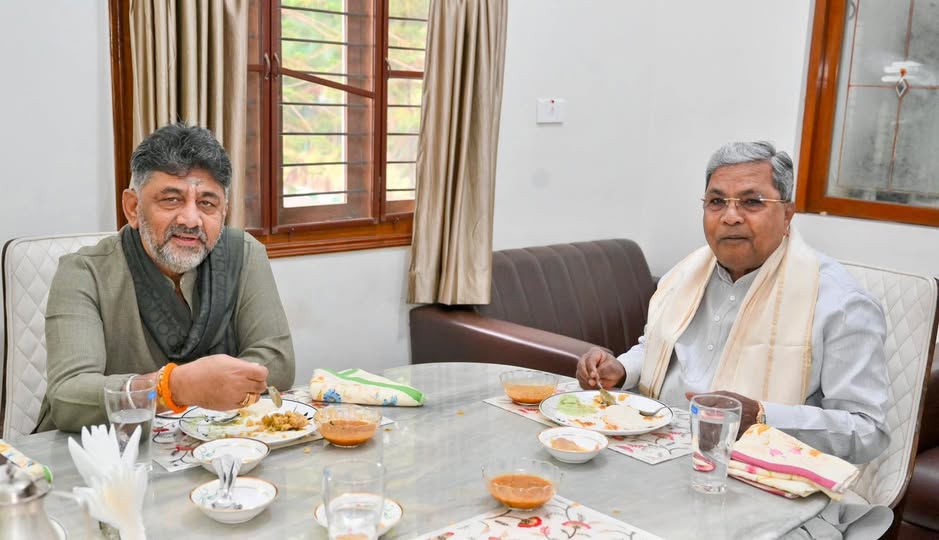
This is why the high command nudged both leaders to display unity, as seen in their recent, highly-publicised breakfast meetings. Though the setup looked staged, it forced both leaders to display bonhomie. The high command has effectively bought time, even though uncertainty remains about the future.
What can be inferred is that the Congress has essentially told DKS that his moment is delayed, not denied, shifting responsibility back to the state unit to present a united front and focus on governance.
The political tussle has undeniably reinforced Siddaramaiah’s stature as the pre-eminent Congress leader in Karnataka. His ability to weather the storm, backed by a significant number of MLAs and his mass appeal, which transcends his Kuruba base to encompass the broader AHINDA plank, forced the high command not to yield to DKS’s pressure politics.
For DKS, the deferral of his elevation is a significant test of patience and political maturity. His future is intertwined with two major factors: his loyalty to the high command, and the outcome of his legal battles, which remain a major stumbling block.
DKS has repeatedly demonstrated his utility as a troubleshooter, and as a crucial financial and organisational backbone of the party. His loyalty to the Gandhi family remains unquestioned—his most substantial political asset—particularly when compared to Siddaramaiah’s later entry into Congress.
However, his career continues to be shadowed by ongoing investigations from central agencies like the Enforcement Directorate and the Economic Offences Wing in cases related to money laundering and disproportionate assets. While DKS has consistently labelled these as a political witch-hunt, the unresolved legal clouds make him a riskier proposition for the AICC. Elevating him while these battles rage could hand potent ammunition to the BJP. His future is therefore tied to the timing of the high command’s eventual reward and the resolution of his legal liabilities.
The Congress’s way forward hinges on the 2024 Lok Sabha test of unity. With the BJP in Karnataka a divided house riddled with caste-based factions, the Congress can survive only on unity and the delivery of its guarantee schemes. The high command’s strategy aims to maximise 2024 wins, as a fractured government would be disastrous. A united Siddaramaiah–DKS front can prevent internal sabotage and present a stable alternative to the BJP.
The storm may have passed, but the low-pressure system remains, threatening to escalate again as the next election cycle approaches.
GFX
Three Pillars of Peace Formula
- Siddaramaiah stays CM till 2028
- DKS continues as KPCC president with ticket authority
- Congress may project DKS as CM face for 2028
(Vijay Grover is a Bangalore-based senior journalist and political analyst)
